Coming out of radio silence for an important news bulletin.
ArtBabble, which shut its doors for some tinkering before the proper launch, is open and has something special to show us.
I first mentioned ArtBabble back in February and was impressed by the design, the video delivery system and general elegance of the site as a whole. What it did do and didn’t do made, for me, a successful project. What it didn’t do was try to be a web 2.0 thing by trying to be a new facebook or twitter for museums. What it was doing providing content. Real original content properly madewith somedirection. You may miss how this is important in the world of linkblogs and retweets, but it didn’t pass me by that I was being told something and should listen.
The social aspect are in there, everyone gets a profile and discussion threads attached to every video. But whilst youtube is like trying to be social in a (very loud, very full, obnoxious) bar, ArtBabble is like attending a lecture with progressive seminars.
ArtBabble has now lost its betanity and we find out who its been mixing with. Namely Art21, LACMA, MoMA, SFMOMA, the Smithsonian American Art Museum and the New York Public Library. They all have a few videos up and I expect they’ll have more soon.
That’s six museums and one non-profit collaborating to give to annotated mini-documentaries.
The Tate Modern’s Expansion, dubbed the TM2 has been given council planning permission to go ahead. I doubt Southwark Council would ever block the design. The massive similiar-but-different 11-storey bent tower will add 65% more exhibition space.
This news almost didn’t make it to newcurator until I could confirm it all today. I just couldn’t take it seriously that the Tate Modern got approval over its enlargement and the British Museum wants more junk in the trunk.
Elizabeth Merritt, founding Director of The Centre for the Future of Museums, has two articles that I haven’t stopped thinking about since reading them as I feel they are both linked to the structure of museums in the future. A topic that doesn’t get anything like the attention it should when museum future talk is dominated by technology, collection management politics and money.
The first article dated the 25th of March is Questioning Assumptions. If there’s a better litmus test for what kind of museum professional you are, I can’t find it. The five assumptions lay down, diplomatically, a set of question about what has become defining ideologies of museums.
I don’t have much need to be so diplomatic.
I’ve seen the sheer mention of “deaccessioning”, “disposal” or even “selling” turn people into highly suspicious Gollums who look at you as if you plan to steal all the museum treasure to line to pockets of some third-party. My own viewpoint in this debate is pretty utilitarian. We live in an Age of Superabundance. We are inundated with images and information constantly and we bore easily. So when I see resources stretched so thinly to accommodate 90% of a collection that is (a) unseen and (b) unimportant to the population, I have to wonder where quality and quantity became confused and collection management became so unfocused. Let’s be honest, how important is a billion animal bones? Yes, yes, vast important wealth of information and all, but how important? If you billion bones are in constant use and researched every single day by hundreds of researcher, than you are justified in keeping them. If ninety-nine-hundred-thousand million have never seen the light of day, do you need them?
This is something I feel is a leftover from the museum tradition to be little else but the repositories of archaeologists. This is not a back hand to archaeology in general, but a lesson to be learnt. Soon, many museums can going to have to refuse any more objects unless they can make space in their finite resources. Consider those knock on effects.
Superabundance means there is a lot of “stuff”, and more “stuff” building up and recycling old “stuff” to be somewhat new “stuff”. I really don’t think museums can keep up. They might try. New buildings! New funding! New extension! The Museum Fat needs new pants! This is in part as museums as economic catalysts and in part that museums are in a constant need for more stuff and more space for their stuff.
I introduce the second article here, The Lost Generation, which I highly recommend if you were one of those interested in my “Getting the Start in Museums” post. People are getting older, living longer, retiring later and museums jobs are getting harder to come by and new blood isn’t getting through.
The Museum World. Fat with Clogged Arteries.
The last parts of both articles offer interesting points (when I take them and run off in a complete tangent). The assumption of museum tied to a place and an on-profits and focusing questions on new professionals. I can’t help but feel about a future where museums can drastically reduce their collections to manageable levels which then go into several thousand new museum start-ups being run by new people with new ideas.
A crazy experiment: take 1000 new professionals/graduates into groups of 5, give them £10k each and divide 10,000 objects “deaccessioned”/loaned from museums busting at the seems and tell them to “make money”. I bet that £2million (Cost of an expansion?) turns into £10million within two years and some of the most progressive museum thinking will arrive out of it, hopefully providing a basis for the future health of the museum world.
This proposal was disregarded. “Saving for the nation” has become code for a professional belief that anything hidden in a curator’s store was better off there than when shared with the public: the ultimate conspiracy against the laity.
Apparently, the scenario is that you are curator Susan Anderson and you’re in the museum during a large earthquake. Everything is thrown onto the floor and there are puzzles to solve in order to save objects and get around the museum’s security systems.
Now, the large graphic on the front of the box says “Hidden Object Game”. Is that like the hidden objects games I used to play in Flash? Where you had to find almost a single pixel amongst a huge complicated image like the world’s most frustrating Where’s Wally? Wouldn’t know having not played the actual game.
It’s nice to see museums as settings in computer games. I can’t think of many times that has happened. I can only think of a GTA IV mission and the level from Condemned 2. Warning: The video in these links are ultra violent, contain naughty language and people getting killed in a variety of graphic ways. Strange how museum’s are typecast. The Condemned 2 video is interesting through, because it’s basically a guy walking around a museum with an advanced mobile phone. The game obviously works upon a set of location triggers. How hard could it be to make Condemned 2 in real life using augmented reality hardware? (Without, you know, the brutal murder and stuff).
Can anyone else think of museums in computer games?
This is kind of interesting to me because I’ve had a great idea for a computer game involving museums. But, I have no idea how one goes about getting ideas on paper. I can’t code or draw or make models, but I already have a framework of what the game in my mind. Can anyone help point me to a format of how to write/author a game?
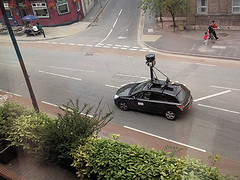
Google Street View Car in Bristol by byrion. Used under Creative Commons.
This is both cool and tragic. Google Street View in the UK was announced a few days ago. For those who don’t know, this means Google drove around in a car with a massive amount of cameras on the roof that takes pictures every few metres. The pictures are then stitched together to form a panorama you can somewhat move around.
I am a fan of museums and maps, and think there’s a lot more interesting stuff to be done with museum objects and GPS co-ordinates. Where an object is located, where it has been, where is it going (on tour?) where it was dug out of the ground or created would make great additions to museum documentations. Then, release it with an API and let people make there own maps from the collections. I’m sure someone is already doing this.
This part is the tragedy. As part of their privacy policy, any image can be requested to be removed or censored. (I’m not going to link to any article to prove this as they all seem to be reactionary nonsense). There are many other “sensitive” images removed and it’s already affected the Tate’s map.
The last time I did this there was a great reaction and I had enough to cover my trip to Poland.
Now, museum news is pretty slow. Every other story being about museums closing or laying off staff or slashing budgets. This isn’t really “museum” news as it’s happening to everyone. It seems my usual sources of inspiration as pretty quiet and I’m reluctant to turn this into just a rehashing of Museum 2.0.
So, I throw open the doors to all of you like a newcurator open mic night.
The theme of the guest post this time around is “What do museums need to change?” Maximum 400 words, a chance to air grievances, pet peeves, analyse situations whilst still keeping one eye on the future. It can be about anything in general about the museum industry.
Send your guest posts to pete(at)newcurator.com with something you want said about yourself, name, location, profession, website ideally.
I’ll post them when I get them and kick off discussions as well. I’ll do this all week.
1) People who work in or with museums or directly related to the museum industry
2) Artists, Arts Organisations and Galleries
The NewCurator twitter account hopes that the accounts it follows will act as a definite list for people interested in these fields, so will aim to follow as many os possible.
The NewCurator twitter account will allow anyone to become a follower, as long as:
1) They are a real person
2) They are genuinely interested
The NewCurator twitter account will block any other accounts who are:
1) Bots and “zombies”
2) Bad attempts at advertising
3) Follower-hoarders, meaning having far too many followers and not related to museums and art, making there no chance in making a connection and saying anything meaningful.
4) Offensive.
NewCurator will:
1) Try to respond to all @s and DMs. Don’t be shy, I like hearing from people and will try to answer all questions.
2) NOT respond to “welcome DMs” that say nonsense like “thanks for following” like I just signed up to your newsletter. NOR will I DM you saying anything similar.
3) Use twitter to announce blog updates
4) Ask strange museum-related questions and crowd-source answers.
I’ve decided to put these together instead of separate posts. Just to show the wealth of valuable information from the blogs I follow and because they all deal with the same kind of field. Here’s a whole bunch of thinking points that if it was written down on a piece of paper would probably cost you.
If he or she expects provocative political dramas on stage, then that’s your brand.
If he or she expects a fantastic time for the kids, then that’s your brand.
Music that’s familiar and well-loved? Your brand.
Long lines and crowded lobbies? Your brand.
It seems so simple, but as Mary Ann Devine points out, “branding” seems to have the connotations of a large fortunes being spent on a total design. Your “brand” is what people think about your establishment. Efforts should be made to make people think about you and in positive way. What does it look like if you don’t care what people think?
And yet many museums are fixated on creators. I show the tool and then they say, “yeah, but we really want people to share their own stories about fly-swatters,” or, “we think our visitors can make amazing videos about justice.” Museums see open-ended self-expression as the be-all of participatory experiences. Allowing visitors to select their favorite exhibits in a gallery or comment on the content of the labels isn’t seen as valuable a participatory learning experience as producing their own content.
Nina’s point is that the best participation experience are one’s with some set guideline and I agree. There’s nothing worse than staring at the blank sheet of paper and being told “Go”. Tell me to write a 100 word, ultra-short story about a dancing robot with a missing leg and I could write several pieces on the subject. As Nina’s graphic shows, there’s far more spectators and critics, and not everyone has the creativity to be motivated when given the “blank page”. From what I understand, critics and spectators would surely need the participation in the shape of a forum. What happens when you think your audience is something it’s not?
In a strange conclusion to this, and possible the most intelligent thing I’ve read on Suggested Donation, Lowconcept visits the Newark Museum in New Jersey. This museum is 30 minutes travel from Manhattan, so close enough to compete with the NY big dogs yet a bit too far to attract the same audience, so how does it survive?
The delightful answer: it attracts visitors through a combination of local, community-targeted programming and a focus on education through its galleries. Too much jargon? In short, the museum focuses on the visitor, not the art historian or snooty donor, through classes and instruction through its collections.
Lowconcepts also mention a large array of workshops, labels with guidance for interpretation and that Newark Museum being the second highest spender on education programmes. This is what happens when a museum has clearly though about its audience and its brand.
Suddenly, the Whitechapel had a lot of competition and looked very far from the centre of London – and it had a poor relationship with its local community. What I wanted to do was try to reinstate it as a place that could show international and British modern art, and reconnect it to its immediate locale. The first appointment I made was someone to work on community projects, and we started an artist in residence programme in local schools.
Hi-Def means having a resolution of at least 1280 x 1080. Most digital projectors have this. The Sony SRX-S110 projector has a resolution of 4096 x 2160. The Tokyo National Museum has a brand new one.
Having such a ridiculous resolution means that objects that are far too delicate to be seen by the public can now be viewed with incredible detail.
If I understand the above article correctly, the newly digitised collection can be placed in a 3D environment so staff can do a tour around the object in its original context (in this case, paintings hanging in a temple) and objects can easily selected be turned around by remote.
This is a great toy to have in a museum that can open up all kinds of opportunities. I especially like the idea of using it to improve lectures. Having such a resource would only be as good as the presentation so I hope they’ll be making many productions for it.
What the Jewish Museum in Maryland is doing though is exhibiting J. T. Waldman’s original graphic novel Megillat Esther, or the Book of Esther.
The excellent art is not the only reason for putting the work on display. Waldman’s scholarship proves that museums can make the use of a comic as a reasonable medium for information, especially historical. It’s possibly a far more engaging medium than most.
You can buy Megillat Esther using the Amazon link to the right. I highly recommend it.
Technology: Seb Chan makes five important points about using QR codes in museums. Although, I would have solved problem 5 by printing the codes on thinner paper and backlit it. A small lightbox is better than moving a whole lighting rig, surely?
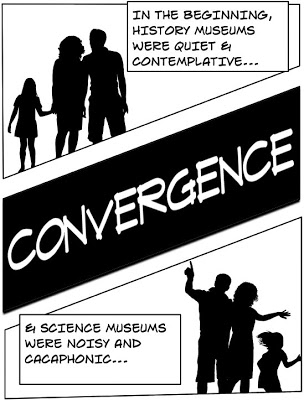
The third part of Museums Now’s three-part webcomic on the convergence of science and history museums is up. (Click here to see the first part). I really like the idea of explaining museum concepts this way.
Apparently, the whole news story about the Rose Art Museum was mainly outrage and miscommunication. Donn Zaretsky clears things up: It’s stopping being an actual “museum” and continuing as a student resource. Stuff my be sold (because it’s not a museum, no deaccessioning issues) in the future, but not in the current downturn.
I still haven’t been to see the Altermodernist exhibition yet and I won’t comment on it until I do.
The brilliance is in the simple fact that this opens access to these museums that these people wouldn’t normally have. The museums can count a whole bunch of extra numbers to their visitor count.
If transport is a barrier to museums, then provide transport.
Thanks to Tyler Green for giving me the invite to ArtBabble.org, Indianapolis Museum of Art’s project.
On first impression, it seems like a re-skinned art channel on YouTube or Vimeo. Then you see that all the videos come directly from institutions (at the moment, IMA). In this 2.0 world, its good to see the user relegated to the role of viewer, but one who can comment and still have the social experience with other users. The creation of content is left to the professionals so everything is good rather than having to wade through rubbish to get to it .
The other thing is that it works. Yes, it’s still in beta (what isn’t?) so I imagine the categorisation will continue to be built, but the FLV player is just a delight compared to others. Skipping around is easy, sharing and embedding is easy, watching the video is just easy and therefore enjoyable. Creative Commons licensing, mp4 (iPod) downloads and transcripts make this very special. The design of the site is just so damn pretty. You get the idea this is a social-video site with the intention of a professional resource as well as expanding museums.
As I spend the rest of my evening watching things, I leave you with something I found: Hirokazu Kosaka’s Calligraphy Demonstration. Perfect viewing for an already hard week.
Babble On.
QUICK ADDITION: You can’t see it on the embedded video, but when watching the video on the ArtBabble, the video playback bar along the bottom has blue lines over it. At first, I thought this was for subtitles. I’ve just noticed that when the video moves over these blue lines, there’s a menu to the right that you can open up and be given more information. Like the above video has lots of pages that link to other calligraphy-related content, like collections, other videos, pictures of objects etc.





Latest Comments