I’ll try my best to describe this new definition of hyper reality, but understand I’m still trying to get my head around it.
First, reality. Plain old reality. Go outside, go to the park. You understand this concept, yes?
Then there’s virtual reality. Computer-simulated environments. I remember when this meant putting on a heavy plastic welder’s helmet that burnt your retinas showing you out-of-focus polygons. Now, it can mean Second Life, a virtual world where you can put on cat ears and burn your retinas trying to work out why you suddenly crashed into a virtual billboard.
Augmented reality, in theory, is adding a layer of virtual over common reality. Normally in the form of a mobile phone (I still think AR should be in goggles) and using GPS, “viewing” reality then gets some extra information. It’s still in the very early stages of icons and hyperlinks. You could use an AR device to look at a building and see it has a giant floating marker above it or a yellow outline that then links to the building’s wiki page. We haven’t gone into William Gibson territory where your AR device shows that building being eaten by a 60-foot space squid. Yet.
So, what’s Cross Reality? ReadWriteWeb has these twoarticles, but I’ll summarise: Real world sensors affecting virtual reality world (and I guess vice-versa). In short, turn something on in the real world and the virtual thing comes on as well. If it isn’t happening yet, I imagine it will soon, but you can turn the virtual thing off and the real one will turn off as well.
As soon as AR get to the Gibsonesque animated giant squid stage, I guess it would also bridge the gap further. Imagine, I’m standing in an art gallery in Paris with my AR goggles, in front of a large kinetic sculpture with two buttons. I look to my left and I see a SecondLife avatar piloted by a man in front of his PC in Brazil. We can talk to each other. I press a button and the sculpture spins clockwise. Donaldo’s avatar presses the other button and the sculpture spins anti-clockwise. We are both seeing a spinning sculpture.
Then I walk away from Donaldo, clearly annoyed at his virtual button pressing. He sees me walk away and his cat ears display the “sad” expression.
This example, whilst elaborate, is pretty simple as I’m only talking about CAD models and synchronised switches. Cross Reality can involve a serious sensor net pouring data into a virtual world. Augmented Reality in the invasion of the real by the virtual. Cross Reality is some of the Real World dripping into the virtual. And who are the purveyors of the materialistic reality with a repository of cold, hard reality-based information? Some sensors, some program architecture and your museum’s datashadow runs in tune with your museum without much further work.
Quick Example: You have a gallery with a SecondLife shadow. You hang pictures on the wall that have small RFID tags on corners of the frame (for positioning). Your virtual shadow also shows these pictures. When you change the exhibition, the virtual gallery changes automatically.
What could be potentially exciting is a plug-and-play system. Like when you plug in your USB drive to your PC it automatically recognises it and (hopefully) can run it straight away. Well, imagine your gallery having similar USB ports and when you plug in your… laser light show or something, your virtual world picks up the 3D model out of the device and has it act the same in the virtual world.
Through The Extraordinaries, you might be able to use your smart phone — while waiting in the dentist’s office or standing in the Dept. of Motor Vehicles line — to:
• add identifying tags to photos and videos for a museum
I don’t know why Futurismic mentions Twitter as no-one else does. Although it would make sense for them to try to use it as iPhones are not the be-all-and-end all of smartphones.
Museum collection folksonomy isn’t a new concept. I’m always reminded of this whenever it’s brought up.
There are things already out there that do this, like Steve.museum. Wikipedia Loves Art and the Indicommons certainly touches on this area too. I like the idea of doing it with twitter. I remember Shelley at the Brooklyn Museum doing a “guess the animal” with a bunch of x-rays on twitter that I enjoyed playing. I wonder if you could automate the same sort of thing. People follow a twitter account that spits out links to an object every 15 minutes and you reply with a bunch of hashtags. There would probably need to be some kind of banned word list and method to moderate the more weird answers. Maybe the program could keep score/give prizes/promo codes. As far as I know, this isn’t already happening.
But I think the idea of microvolunteering in museums has a lot more to offer. I’m not sure when online-based volunteering became crowdsourcing tags only. I’m pretty sure that most volunteers sitting in museums aren’t trying to come up with one-word descriptions of objects.
Here’s a though about voluntwittering: I could spend all day volunteering trying to hand out leaflets about an exhibition or I could reach about 2000 people with a retweet in a few minutes. I don’t get rewarded for a RT (maybe a thank you) yet I could say on a CV that I volunteered with a museum if I stand in the road trying to catch random stranger’s attention (which is prettydamn important in getting a museum job nowadays).
I just want to pull these three links from my delicious account. There’s definitely something here that needs more thought. Chime in with any additional add-ons.
1. dropstuff.org – I think I understand this. There’s a giant mobile hut covered in LEDs on one side that acts as basecamp for all the editing/curating. There are also a bunch of what they call DS_HOTSPOTS, which I think are vending machine-sized physical links to the network. The Dropstuff network integrates five other 2.0 social networks as sources of creativity. You see, they have three layers to what they display: professional, “open stage” and workshops. It all meshes together wonderfully.
2. Armadillo: The FEMA Trailer Project – The MIT Visual Arts students turn one of the FEMA trailers used as temporary housing into a project incorporating design, politics, ecology, art, research and science. If you imagine this as a mobile museum exhibition, it goes far beyond that as simple temporary space. I’m not suggesting it would have to be exactly the same, but seeing this would feel like participating in an ongoing workshop. I don’t know if I’m being clear here, but you can see the difference between this and a cargo container with things hanging on the inside, right?
3. Pop-up Shop – KiosKiosK is a temporary/short-term shop front to sell creative products as part of a regeneration plan.
You see how I think there’s something that can meld these three things together. I was thinking along the lines of pop-up shops acting as stations and front-of-house to mobile museum exhibition workshop trailers that are all linked with a hydra-connected network of social networks and vending machines. Thrown in QR Codes and GPS for fun. If there was a way I could incorporate mini-satellites, I would.
There’s something missing to all this. I can’t quite put my finger on it, but I think its lacking one more stolen integrated idea. These three allow for extremely high-end mobility and flexibility as well as a solid foundation where needed. It may seem art-heavy but it really doesn’t need to.
Think about what defining skills make up the professional museum world. I don’t mean the people who are marketing, finance etc. No disrespect meant. I know that they provide excellent and necessary services that require a lot of knowledge about museums, but I believe that a good cultural marketing person would be a good marketing person anywhere. These people provide structure, not definition.
Which basically leaves the various guises and aspects of the “curatorial” staff. What were these people trained in? How do these people define themselves? I will make a generalised statement: most of them what fit into the following categories; archaeologists, historians (art or otherwise), conservators and what I tentatively call “educators”. There are some qualifications I’ve purposefully left out. Probably to the chagrin to many people I know, I purposefully left out things like “designers”. It’s a position I don’t believe many museums have, can afford or don’t delegate around the staff anyway. I imagine there are many other types I’ve forgotten.
But let’s look at the list. Conservators… well, it’s a pretty strictly defined role. Part scientist, part engineer and in some cases part artist. “Educators” I realise is a cop-out “Misc” category. But let’s get down to the crux of the issue: when it comes to the curatorial process of museums, how has it become dominated by archaeologists and (…I stick my neck out here) art historians?
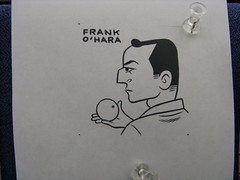
This is where I come to explain the title of this article, a play on the title of Frank O’Hara’s poem, “Why I Am Not a Painter“. I feel I have to explain these literary references. The last time I did it as a pun on a Roland Barthes essay, people thought I was calling for an end of curators.
frank o'hara by m kasahara, Used under Creative Commons.
O’Hara’s poem describes the interaction between him and artist Mike Goldberg and the differences between their respective art forms. Years after I first discovered O’Hara, I found out he worked on the front desk at MoMA and eventually an assistant curator (some sources say he was an “associate curator”. I don’t know the difference).
I said a few times on here that curators need to come out of the shadows and offices and get there names and faces attached to the work they do. Then I think of Frank, more famous for his poetry than his work at MoMA.
Was there a better person suited to a New York contemporary art museum than New York’s finest contemporary poet? He – more than anyone – understood the human condition of 1960s New York, hammering out poems on his typewriter, trying to capture the Present Moment knowing that the act of writing has put the moment already in the past. That’s why he used a typewriter; for speed.
So then I think, “Why aren’t there more Frank O’Hara’s” in the museum world?”
There are two things this is not a call for. This is not a call for a mass replacement of archaeologists and art historians in order to combat inertia. This is also not a call for more artist-curators, a term I don’t understand because of the very fuzzy definition. I can’t help but feel there are many artist-curators who are artists who project-manage their own exhibitions. Maybe involving some of their artist friends. What I’m talking about goes a bit further than that and not necessarily into art but definitely including it. A poet is an artist, true. But Frank was a very different artist to the artists he was curating. This was only to his benefit.
Who knows the power of meaning and interpretation of movement than a dancer? Who knows the effect of theatre and mise-en-scène better than an actor? Hell, who understands the forward-pushing narrative of one-thing-after-another than a comic book writer?
If you don’t have these people on your staff, then train them. This is professional development and possibly more fun than usual development courses. This is augmenting your staff’s creativity and innovation. Lord knows we need that now. This may be a very UK-centric statement now, but I just don’t believe we will get that by trying to force our museums workers into being part-time teachers.
Who understands the transfer of meaning within information than a journalist? Who understand argument better than a lawyer or a philosopher?
After you’ve been training your staff in the basics of various humanities they’ve never approach before, the other part to this idea is to use the museum as an outlet for their new skills. Talk about assigning emotional value to objects! Your staff write, direct and perform a play using the museum objects as stimulus (or… props?), you could reach new depths with all kinds of new audiences… if done right. As far as I can tell, the world of Frank O’Hara the poet and the world Frank O’Hara the museum worker barely overlapped despite him often writing poetry in his office. O’Hara went the usual route of publishing poetry. Today, we have far more scope in our museums to act as outlets for the staff’s abilities. The museum would almost become a production house of activity which could maybe bring out the poet in all of us.
15 things went on the delicious bookmarks, mainly a lot of stuff that I may make some proper comments on at some point. I’ve put a couple of sentences or quotes on each one.
John Robb scares me. Not through any kind of intimidation, but the fact that his blog Global Guerrillas is such a treasure trove of articles analysing the future. Robb’s focus is the future of military and warfare, but mainly how a massive bureaucratic money pit of a nation’s army can be brought to stalemate by a loose organisation of insurgents with a fraction of the budget. This is what terrifies me most: the movement into the next generation of doing things, in this case, war.
Robb has put up 11 (I’m sure they’ll increase) Standing Orders for the modern insurgency. Let’s ignore that the ultimate end of these insurgents are death and destruction and opposition of “freedom”. Those are the ideological extras. When you look at these Standing Orders, you notice that these are just models of management. This list could have come from a silicon valley analyst. Through simple translations into other languages of industry, you have a very powerful list of actions. This is the new way of Doing Things. You see how this interests me in relation to Metrocurators, but also the way museums will struggle using old methods of structure.
Here are John Robb’s Standing Orders, I suggest looking at the original link for background because I’ll be strictly talking about this is terms of museums. (I also don’t want to plague John Robb’s blog with museum related links)
1. Break Networks – Not communication networks. This means getting in between people and their closed systems. What does this have to do with museums? Well, how many people in the industry got jobs through people they know? How much is the industry lacking innovation because people haven’t been allowed in? Think about what has the most influence in museums and whether they are still fully deserving of such a position. Just how progressive are those giant membership organisations?
2. Grow Black Economies – Originally meant to fund insurgency through organised crime, the reasons for doing so are noteworthy: independence. Now, museums are going to be running protection rackets, but the idea of finding new income sources to obtain autonomy has to be a priority. This would allow much greater freedoms in innovation. Things like Giuliani punishing Brooklyn museum by cutting off funding. Or the Cambridge museum losing funding by refusing to splatter a logo over everything. Museums are currently slaves to too many outside influences. There needs to be a growth in Museum Economies in order for growth in Museum Thinking.
3. Virtualize Your Organization – Not so much about greater use of IT (although that may help)this is about having a greater flexibility and possibly a modular approach to organisation: “They do the job and go away”. Could an entire museum be run be freelancers? I’ve seen it done with some collections. I also wonder about the motivation is could cause. A person sitting on the same job for 20 years isn’t going to have the same hunger as a freelancer who has to hustle every day. Robb’s say that a specialisation of skill sets emerge in a short time because of this. Also, I must say, I’ve found more interesting things come out of the blogs of museum freelancers than anyone else. This is because freelancers have equal amounts of having to be employable and being innovative with an added extra of not having to “follow the rules” (a plus from being self-employed).
4. Repetition is more important than Scale – I wish this was true in museums, where the trend is for several-month long blockbuster exhibitions rather than weekly changes of new things. “Simple, low cost, easy, and repeatable… are both sustainable and generate the greatest potential returns.
5. Coopetition not Competition – Museums have systems already in place (mostly) to share information but are used in rather narrow parameters. This could be run parallel to great transparency in museums. This is about working towards common goals by using the same things. To me, this is the difference between ArtBabble and Creative Spaces. ArtBabble is a platform run by IMA, but they’re working hard to have the involvement of other museums to create content. Creative Spaces had too much singular interest that, I think, removed its greater purpose. To quote Robb, “rivals sharing common platforms… reduce costs… widen variety, increase flexibility, etc. For example, coopetition is the basis for Internet standards and the Web“. You want to be like the Internet, don’t you?
6. Don’t Fork (the Insurgency) – This one’s a bit harder to translate, but I take this to mean not being on the offensive against your fellow museums/staffers. Such as the amount of criticism against museums “breaking taboo” (see: Prissy Fatwas). I think this also means resisting internationalism/global issues for the sake of being a “local museum”.
7. Minimalist rule sets work best – Oh God Yes. There’s no point replacing the old systems with carbon-copies of them. For museums, this is about policy and ethics. I remember one museum’s collection policy that defined OS Gridlines, for God’s sake. What was more ridiculous was they ignored them anyway, often accepting objects from 40 miles away. Let’s remember that the reason Neil MacGregor became so important and rescued the British Museum was his adherence to a founding principle from 1753.
8. Self-replicate – Create other versions of yourself, in short. This is related to all the other Standing Orders, in that nothing will work unless it spreads to other organisations, possibly third-parties. Even if you don’t find the idea of becoming something like a metrocurator, you have to imagine this is the best way to advance whatever your goals are. Whatever the priorities are, they will be helped with similar satellite organisations. I think means more than just outreach and education programs. You want to be copied, not just learnt from.
9. Share or copy everything that works – Think about Creative Commons and Open Source. The sharing of ideas, forming them and them kicking them out into the wide world for anyone to pick up. This is related to 5. The idea of hording ideas helps no one. Think about how the entire industry as a whole benefits from an Open idea, which can therefore lead to greater benefits to individual museums. I know several museums are already doing this.
10. Release often and early - I can’t say anymore than how John Robb puts it: “Innovations, from tactics to weapons, should be released as soon and as often as practicable. Perfectionism, sclerotic planning processes, excessive secrecy, risk aversion, and other plagues found in hierarchical organizations are the enemy of success.” Right on.
11. Co-opt, don’t own, basic services - I get there this one is going, but not sure how to translate it into museum practices. I will leave this one up to the comment to help me unpick. What are the “basic services” and who has ownership of them? Part of me thinks about education and schools, but still not sure how it fits. Comments welcome. What do you think?
How would museum staffers do things differently if they were trying to increase the number of museum “fans” instead of “customers” or “guests” or “visitors”?
The examples were the fans of sports teams, Harry Potter and… a hotel. I’m going to dismiss the hotel because anyone could put a list of famous names for branding purposes. It’s no different to them wearing a watch or sipping a cognac. I’ll also dismiss the Harry Potter fan model because they are still customers. Their fandom is part merchandising demographic, part spectacle addict. The reason for queuing up from midnight is to be one of the “first” to experience. I think there are too many differences between the museum and book/film business plan that drawing comparisons are too tricky. For instance, the Harry Potter narrative has invaded four media: Books, films, DVD and television. Museums are pretty much a media in itself that tries to be “open-to-all” instead of “supply-and-demand”. I wouldn’t know how to shift between the two.
So that leaves sports teams. For my own benefit, I’m comparing museums to football (or “soccer” to those who don’t believe in definitions being limited by majority functions). At first I wondered if this was a merchandising thing as well. A football fan would buy the hat, scarf and kit emblazoned with the team logo and buy it every year. But I had misread the original question. How would museum staffers do things differently? The last time I did a “Make Museums Like…“, I had five things inspired by Monocle Magazine. This time in Make Museum Staffers like Football Players, I can only think of two.
1. I have this ongoing joke that David Beckham is the future of museums. Sure, both football clubs and museums are made up of team members that need to function together, but can you honestly say there are curators who people would say are their favourites?
Look at David Beckham, he has a set of skills that’s internationally recognised that got him a celebrity status off the pitch. The difference being is he performs in public. We can watch him do what he does best. Being a fan of David or the team he plays for means something because we hope/want the best performance. If I was a sports fan wanting the same thing from a museum, what have a got to support? The objects on display. They tend to be pretty static. I don’t have any actual people to support, they’re in offices and meetings. So all the museum performance/teamwork/skills on display are hidden and the fan only gets the end product. It’s like a football supporter only being able to support by getting the results. You may feel joyful or depressed by the results but it’s still just a list of numbers.
This is what I saw Nicolas Bourriaud try to do with Altermodernism. The whole exhibition was firmly placed under his name as he gave countless interviews explaining his made-up word. Within Tate Triennial FC, Bourriaud was the captain, the artists were his squad, the other staff were his coaches and Altermodern was his tactic (like Total Football or Long Ball). If only he chose art that more people would have liked rather than the typical alienating/challenging contemporary stuff he probably would have made a bigger impact. Fans want to see goals and wins, they don’t care that much about where they come from.
Who else is there? Neil MacGregor certainly gets a lot of press for what he does, but he doesn’t have David’s hair.
2. Competition. Simple one, that. A fan wants their support to mean something and to celebrate wins. There’s barely any competition in museums, so what is the point in being a fan of one over another? What does a museum staffer got to work towards that would attract a fan base? There’s no league table to decide who’s doing the best. The current crop of museum awards are popularity contests or stamps of quality, things that matter to a “visitor” or a “customer”, but not a fan. Shortlists, judging panels or voting won’t make fans. Football does this sort of thing at the end of the season when all the playing as been done and the silverware has been lifted.
How would you do a museum competition? Based upon what? Visitor numbers? Doesn’t sound in the spirit of things. Or should two museums square off in some kind of challenge in a knock-out competition to be crowned Museum Cup Champions? Some television rights, some decent coverage, some kit sponsors…
Hold on, I’m off to phone a television executive. I have an idea I want to pitch.
Conductive body paint allows for electrical current to pass through without frying bit of skin in the process. What you’re seeing in this video is the dancer creating connection between copper contacts.
This has great Teknomagi potential. A little ink and you can turn body movements into a switch. I’ll put it into context. Imagine you have a door. The absolute basic way to open it is a door handle and push. A slightly more advanced way (if you like) is a button you push and opens the door. Above that, doors that open automatically, either with movement sensors or RFIDs.
Now imagine a door where you had to place the correct hand sign on to it? Or a door that opens when you have to draw the correct symbol? Hell, you could make it even more interesting buy only opening if the correct pattern is on your hands. Any talk of participation in museums, you have an ink here that turns your visitors into wizards.
I have about 260 feeds going into my Google Reader. Many of them are Google Alerts or delicious subscription-type feeds. I sit in a torrent of information from a plethora of sources. All day, I’ve seen a billion people talking about Ben Stiller printing money. Not that long ago, I stopped trying to report on every story about how museum’s were cauterising massive financial bleeds. We live in a world where a fake museum is making more money than actual ones.
Yes, a fake museum. I don’t care if it said it was the Smithsonian. Any museum using straw as packing material is clearly one rooted in fantasy.
I wondered if I had lost the ability to write about the future. All my news feeds and I can’t find inspiration or motivation to write about the outbreaks in museums. It’s not helped by the New Yorker and David Hockney getting thrills out of making art that looks like bad mid-90s point-click-adventure games with 2009 technology.
The late J. G. Ballard once said:
I would sum up my fear about the future in one word: boring. And that’s my one fear: that everything has happened; nothing exciting or new or interesting is ever going to happen again… the future is just going to be a vast, conforming suburb of the soul.
The Ballardian nightmare is that we would run out of innovation. If news patterns are anything to go by, the recession has done something worse: It has put our future on pause.
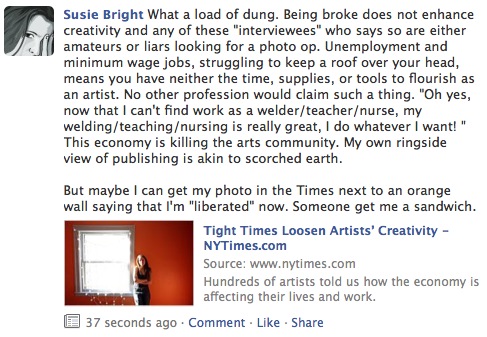
I’m viewing this through newcurator editorial lens. Everything I blogged was chosen (sort of) carefully. They were not all heralds of a sweeping changes in the museum mainstream, nor end points of discussion. They were little steps or small shifts along a path that I would sometimes get demonstrative over to make a point. I notice there has been a a distinct lack of these steps compared to a couple of months ago; an innovation downturn. Don’t believe what the New York Times says about “Tight Times Loosen Creativity”. What Mike Daisey (and Susie Bright) posted in response says it better than I could.
From mikedaisey.com
I’m talking about things making the news here. I say nothing against most of the bloggers I read who all make such fascinating reading. Sometimes I think I may as well hand Nina Simon the newcurator keys or risk becoming one of those annoying as hell pingback blogs that just copy my content. That’s why I’ve got delicious and tumblr.
This is also not a criticism of people working in museums (before someone undoubtedly accuses me of this). It’s more a comment on the current State of Things. You can see it in the wider microcosm of the art world. Repatriation and restitution is on the increase with museums all over the world handing back objects or going to court over it. Even JP Morgan recognise a good thing. Economic Plight = Culture / Ownership. There’s an Asset Grab going on and the only people actually buying are part of a French/Arab coalition.
What happened to the museum news? Or should I say, what happened to things in museums that were news-worthy? A dinosaur with bad posture and I think Manchester Museum plan to lock up a man in a tower. Looking at his quotes, it’s probably for the best. Same goes for so many art critics who appear to be having collective attacks of existentialism as they try to work out what they do and what they are now good for.
So I try to think about and research the Metrocurator and Death of the Curator ideas. First thing I find? There was a discussion about so many related issues that not only Godwin’d but stamped over well-worn ground in circles rather than any kind of exchange/development of ideas. It made the whole thing sound horribly and frustratingly boring.
Metrocurators is the term I used to describe a new generation of curator that’s lightweight, deals in very little bureaucracy, has a DIY attitude because of very limited funds and basically is running all over a city pushing small outbreaks of museums into public spaces. The motivation and the survival of a Metrocurator is based upon creativity. The former models of big established institutions look too slow and lumbering.
If you want comparisons, it’s like the graffiti writer versus the council clean up crews. It’s like innovative start-ups in Silicon Valley versus the big companies like Microsoft or IBM. If you care to ignore politics, its like Hamas compared to the American army.
I said in the original post, there’s “museum-y things” to be considered. I think I’ve found two missing pieces.
Public Collectors consists of informal agreements where collectors allow the contents of their collection to be published and permit those who are curious to directly experience the objects in person.
So ordinary people spend some time cataloging their personal collections and allow people to come have a look. So far, most of the collections are based in Chicago and made of books, films and vinyl (and the originator’s extensive collection of porn’n’ gore comics from Mexico).
This would be a valuable resource to the Metrocurator, who hasn’t got the ability to store, conserve or build collections of their own. Think about the numbers of personal collections in one city. It’s the Metrocurator’s job to recruit these people into lending a few objects as well as assisting in the correct cataloging and consulting on storage. That would take care of providing collections for the Metrocurator to use as opposed to having to rely on artist contacts to commission site-specific pieces.
The other missing jigsaw piece is funding. Sure, the Metrocurator could go through the usual channels of applying to grant giving organisations (or even find a venture culturalist). Or use “Crowd funding” like Kickstarter.com (found via Intelligent Naivety). Kickstarter (I’m so glad they kept the E) works like micro-philanthropy (as opposed to micro-credit) with people funding individual creative projects with pledges (I’d call them micro-grants). They also have a whole set of guidelines in place.
This may be a good way to fund the “building” each individual mini museum, especially when it comes to security. Or even finding the small amounts of funds for exhibitions.
With a bit of work, you can have exhibition space, collections and funding. I’m now trying to think of what else a Metrocurator needs in terms of infrastructure?
No, this isn’t another blog war. This is me remixing two blog posts a la Jason Nevins Vs. Run DMC.
I found these two blog posts at roughly the same time and was intrigued at the sense they made when put into other/wider contexts. This is partly an experiment, and party because whenever I see two lists (especially two lists of criticism!) I want to see if I can make a… critical matrix!
Paul Orselli’s ExhibiTricks said Five Things that make grocery store exhibits bad. I’m going to summarise and turn them into fundamental statements about the wider aspects of museum design, therefore museum intent. You have to read the original blog post for a greater explanation. But this is five bad design
1. “Anti-Green Design”
2. “Inefficient”
3. “Creatively lazy”
4. Unintended Messages
5. Fundraising ploys
Martin Weller of The Ed Techie made a list of Four Assumptions of the Publishing Apocalypse. These Four Things came from the criticisms of journal publishing’s outdated referencing guidelines concerning digital content. Again, go and read to see where I’m going with this. I feel there is a lot in common with journal publishing and museums, especially the academia, the resistance to digital and the fact that both are media and follow media methodologies.
A. The assumption of power
B. The assumption of quality
C. The assumption of immutability
D. The assumption of proprietary
Now, lets see if these 5 and 4 statements can make 20 pearls of wisdom. I apologise for the epic length of this article.
A1. The resistance over eco-digitisation - I’m going to take this as a statement about materials and museum’s failing ability to be eco-giants. Just think about the amount of paper a museum uses and wastes. Now, I want to believe that every single leaflet a museum produces is worth keeping, but its not the case. How much can be digital? Why isn’t every museum leading the eco-way? Solution: You only have to look at what the Mattress Factory is doing.
A2. Ignoring digital efficiency – I’m going to interpretPauls’ statement as "wasting staff time" and I think about all the other ways staff are locked into old fashioned practices. Solution: Too many to count but one example is a registrar using RFID tags to provide a better collection management. I think there needs to be new training to get over this issue.
A3.Stifling Creativity – I think this is a matter of trusting staff. Look at what Google do with encouraging side projects in order to tap into their staff’s abilities. The issue here could be the result of losing too many creative people to other industries. Solution: I would say the venture culturalist model in some form could help.
A5. Money Priorities – An ugly realisation that may be above my pay grade to solve. We’re all suffering in one way or another recently and museums have taken a kicking financially despite numbers increasing. Solution: If you come up with one, I’m sure we’d all like to know. The Museum Bailout idea on a grand scale (like national organisation level) could have done something, I’m sure. Everyone working together to improve membership numbers. Also, Maryann Devine spoke about a For-profit model for the arts which could be considered but would take a massive change in industry thinking.
B1. Green Quality-What is best for the museum should be what is best for the planet. I don’t mean this to be a puritan statement against extravagance, but as Paul said, is there a need for an overabundance of plastics? Yes, it is nice to have a giant molded cartoon character in an exhibition The other side of this is touring exhibitions. What is the carbon footprint of flying art from China? It would be a shame if it couldn’t happen. Solution: Greater ethical guidelines produced. Does there need to be a change in how we view materialism? Would people accept a rapid-prototype of the same object on the other side of the world?
B2.Inappropriate ideologies – Martin talks about quality as elitism and Paul talks about entropy. I’m going to take this as the stagnation of new people into the field. Solution: Go waaaaaay back to my article on museum HR to find all kinds of talking points.
B3.Lack of new ideas – There definitely needs to be a modernising process that say that something done 100 times doesn’t make it good. This is were the authority needs to be relaxed and inspiration needs to come from other sources, especially with online/technology. Solution: (and a great example of what I mean) The Brooklyn Museum released an API and someone made an iPhone app. Its time to tap that massive developer community out there and trust that they are not random amateurs.
B4.Narrow Meanings – Bit of a paradox to hold authority over quality yet make mixed connotations and contexts. But it happens. I think the problem here is overcoming bias. Solution: I fully believe that people can handle an incredible amount of information, why stop at labels and information boards? Send them down paths, let them explore the data themselves, give them everything you have on a subject in a manageable format. This must work otherwise wikipedia would never have become so big.
B5. Marketable Standards – Tricky, because if something work and makes money, why change it? But are you trying to “sell chunks of museum real estate”? This is where the US and UK differ. In the UK, it’s not so much a preoccupation with sponsorship but a concentration on under-16 education to receive funding. It either case, it can skew a museum plan into unsustainability in a long term ie. Young single males aren’t going to go to a place overrun by children. Solution: Don’t let it dominate your path. More variety of… products. (Ug.)
C1. Eco-Denial – THE PLANET IS DYING. Solution: SAVE THE PLANET.
C2. Comfortably Slum – There’s no excuse for inefficiency, especially with a financial crisis. Solution: Time for an audit. Hell, get some strategists in. I can recommend one.
C3.Repetition, Repetition, Repetition – You know what happens when you don’t change a stuck record? People get annoyed. To me, this is again an area of stagnation that would take a huge effort to overcome. Solution: More graduate programs, more internships, anything to hike new thinkers into the museum society. Government’s should really pay for this.
C4. Stay the course – I am of the opinion that individuals can consume information much faster than ever. Look at how viral marketing works and how it’s the only game in town. Cultural flashes before being replaced by the next meme. I think museums need to speed up their turnaround of content before people tire of them. Solution: I touched on this a bit in my Make Museums Like Magazines article.
C5. Knife-Edge Finance – What happens when there’s a financial crisis and there an over-reliance upon so few reliable income streams? Google “museum” and “crisis”. So much is broken, I don’t know where to start. Saving museum workers jobs would be good. Without them, there’s no museum. Just a room of stuff. Solution: Hate to say it, but can we rewrite deaccessioning ethics yet? You know, without dragging reputations through the mud. There must be some way to protect the public’s trust AND museums without flat refusals. I would prefer thinner museums than no museums.
D1. Ignore the problem – Yeah, without wholesale change the problem is going to get fixed. Solution: Need more Museum Eco-activists.
D2. No Other Models – I think you’ll find this changing quite fast. See any post of mine about museum expansionism. Solution: Adapt. Invent new systems. The Commons.
D3. Cultural Black Hole – Again, there’s a risk of losing good interested people to other industries. Again, I think of newspapers like I did in Death of the Curator. What happens when there are thousands of people who can work in a newspaper? They start blogs. Solution: Diversify, jump on bandwagons, find any new outlet and dominate it before it turns on you (eg. the music industry and mp3).
D4. Signal & Noise – Maybe more of the same, but museums shouldn’t talk about “authority” or “authenticity”; like they’re a given. They are things to be earned and they can vanish pretty quickly so its pretty dangerous ground to describe yourself in such ways. Today’s media is a lot of noise over signal and boasting isn’t going to help. Solution: Add to the production. Take Artbabble for instance. Those videos feel like documentaries made by experts… mostly. There’s something more that just showing or curating but producing something else. (This point isn’t 100% clear and may need further thinking).
D5. We own museums – Sponsorship can go somewhere else or dry up, people vote with their feet and imagine if all the big companies started their own museums rather than normal philanthropy. There is very little freedom for museums to combat this when you think about it. Solution: ?
There. 20 thoughts over 1500 words for you to ponder over the weekend. I apologise for any grammatical errors but it is quite late. If anyone has anything to add, like a different interpretation or a different solution, add them to the comments with the (letter)(number) reference at the beginning.
The concept is simple: after curators argue for their proposed acquisitions, collectors, who have ponied up money to participate in the event, vote on what to buy with the pooled funds.
Remember my Death of the Curator article? I was taken by the idea of ”crowdsourcing the curatorial decisions of an exhibition”. What I saw was the potential for pure populism of a large community to supersede an art historians curatorial expertise, amongst other things.
I saw the word “vote”. Maybe it’s not the Death of the Curator, but of the Museum Trustee.
Look at MyFootballClub. A load of people paid membership fees to go into a fund to buy a football (soccer in Yanqui) club. They ended buy acquiring Ebbsfleet United, a small Kent club in the fifth tier and turned it into the first web-community owned football club. As this Guardian article from 2007 states, the plan was to have the new community of owners pick the team and vote on all major decisions like a big crowdsourced game of Football Manager.
As I understand it, that hasn’t panned out exactly to plan. Liam Daish, the manager, still had final say on things like tactics and training. The “Board” was mainly dealing with, wait for it… voting onsigning new players.
I think you see where I’m going with this. A web-community run museum? The director performing whatever the Board decided through majority vote. The curator’s job is safe (ish).
I’m just kicking this idea out there for discussion. Being a trustee of a museum is maybe not as glamourous as running a football club. Trustees tend to be wealthy and well-connected fundraisers, so many museums wouldn’t be supported by a web community. I imagine there would have to be something to make it less… boring? I do quite like the idea of registering my vote to influence an acquisition. Hell, maybe even a deaccessioning. What shape would a collection take if several thousand people were deciding what direction to go into? So much is said about museums being in “the public’s trust”. Well, what would happen if the public were actually trusted?
I’ve wanted to show this video for a while, not just because it’s pretty amazing but also because it is a very creative way to make a point/display information. Everything about the BMW museum is to display the elements of design that goes into every car, established by the different car outlines appearing. You also get a strong sense of the BMW branding that extend to the rest of the museum. These shapes aren’t being scribbled out on paper or clunked together on a CAD program, they’re gently and aerodynamically built out of thin air. If there’s a better example of preparing the audience to the sense of awe running through this museum, I can’t find it.
Let’s be honest, a bunch of Bimmers in a building is called a car showroom.
The Cincinnati Museum Center generates an annual economic impact of $87 million and delivers $27 million in household earnings for more than 1,100 local workers, according to a new study by the University of Cincinnati.
The Art Institute of Chicago’s new Modern Wing is bound to make such a splash that the Museum of Contemporary Art and the city’s smaller museums and galleries are preparing for the ripple effect.
What’s unknown is whether they’ll catch the wave or be submerged by it.
So, a large enough museum has a serious enough economic and cultural impact. No real surprise in the role culture plays in regeneration projects.
I’m not entirely sure about the political systems culture has at a state/local level in the US. I hope someone can tell me. I do know that there isn’t a culture portfolio/department/secretary of state like there is in the UK. The UK Culture Minister does have quite a wide scope of responsibilities and powers.
At a regional municipal level in the UK, local councils have culture departments (often falling into disrepair because of budget cuts or becoming the responsibility of quangos). I’m going to assume its relatively the same everywhere, that there is a culture aspects to local government.
A large city museum could form formal partnerships with every other cultural institution in an area. Then form links to the smaller projects going on. A large museum could just become the de-facto culture department right under a local government’s nose. A museum could offer some serious organisation, support, resources and reputation to every other cultural activity in a city area. Acting as the hub, or even a place to host a weekly forum and if the museum can do a better job promoting culture in a town…
It comes down to the organisation. If a museum, with a council of city culture around it, can make a serious improvement to the culture as well as the economic standards, then it could surely it could start deciding cultural policy. What could the local government do? Oh, so you plan to cut our funding, eh? In that case we will shut down all of yourcity’s culture. Let’s see the economic impact that would make.
I’m expecting to be called a dirty communist here because I’m essentially talking about unionising the cultural institutions of a city. I may just be thinking out loud here, but with the economic crisis and museums shutting down/cutting budgets I fully believe that many of them will survive through major collaboration projects. If it works, and a city’s culture partners all help each other out do some kind of year long city festival that saves their budgets then what reason is there to remove the partnership? What reason is there to stop after the economic crisis has past?
For this to happen, you would need a pretty big museum (small or medium ones wouldn’t be able to pull people towards it) and a local government not taking culture seriously enough. Very quickly, you could have a group having a severe influence over something many countries have a top-level politicians overseeing.
Sam does seem nervous with a camera in his face, and does focus on the “space for art” explanation that seems to get lukewarm responses from the passersby, but I think this is a champion project.
Now, in it current state (and reasoning), the project fits into the genre of “street art”/”public art”. There are just two small details that would turn this into Grade A Museum Expansionism
1) Obviously, the theme. Change the focus from a mini site-specific installation art gallery to a museum micro-exhibition. It seems that the current plan is for artists to create new works of art to fit in the hole. The only difference is that any object (that fits) could be placed in there. I suppose a creative/artist curator would have the licence to find all kinds of interesting ways to display objects. Also, QR Codes, Bluetooth, short-range radio transmitters? Would all go a treat in something like this.
2) It’s when Sam says he’s looking at other spaces all over the city that is so interesting. Let’s imagine the project is successful and all kinds of small otherwise useless places like this are found and turned into displays (artist’s work or otherwise). This is when it stop being street/public art, yes? I realise the next point is debatable, but I’m going to run with it anyway. Street/Public art is the prerogative of the artist. Artist sees space, artist fills space. What Sam and Paula become at this point are curators. They find the display space on the streets across the city and control the ouput. Yes, yes, they’re not doing proper museumy things like collection management or environmental conservation, but those aspect can be added later. Sam and Paula become Metrocurators.
(I almost made this concept a homage to Warren Ellis by calling it Transmetrocurators)
Now, here’s the exciting bit. Just as Sam says, he’s just a recent graduate, looking for spaces. He isn’t made of money, he’s not doing this attached to a institution like a gallery or a museum. This is the guerrilla tactics of the Metrocurator. Small, streamlined, low-cost and high impact. This guy got on the BBC News (and here!) and he didn’t need a big organisation behind him to do it.
This kind of on-the-city-street mini exhibition space need a term of its own. It has to describe being a museum, being small, being inside nooks and crannies and being on a city street… Alcoveum? What do you suggest?
Somewhere on this blog, I put out the idea of “venture capitalist” projects in museums. I said something like gathering together a whole bunch of museum collections that are just gathering dust and putting them on medium-term loans to a bunch of “start-up” groups. The thinking being that these small groups of up-and-coming museum workers or fresh out of graduate programs could get a load of experience running short-term mini-museums, and people would throw money at them to make it happen. Admittedly, the details were a little hazy.
Claire Sexton, Communications Coordinator at Art in General (twitter), got in touch and we had a discussion about what they do. I’m glad to say that the system they have in place for artists project could be adapted.
Art in General (so called because it occupies the General Hardware/General Tools building in New York) do all kinds of things too numerous to list them all, but do check out the Fine Art Adoption Network. The project I’m interested in the New Commissions Program. I drop quotes from the site here to explain.
New Commissions Program centers on developing and exhibiting new and challenging projects by artists who are interested in creating new work.
Since the program’s launch, Art in General has invited and commissioned new works from six to eight artists every year. Three to four of these artists each year are chosen through an annual open call competition reviewed by Art in General and an Advisory Panel; the other three to four artists are selected by Art in General’s curator after extensive research, studio visits, and meetings with local artists.
The open call has no thematic or spatial parameters, and artists can choose to present a project proposal based on long-standing or emerging interests.
Now look at the process for the Open Call and the three phases that begin with a 600 word proposal, and you can submit any idea. If there are any artists in NY reading this, you should give it a go.
This is the model on how to do this, just tweak it for museums. A group leader, instead of a single artist, submits a proposal. They get space (probably both office and exhibition), access to the whole group of experts on staff and a sizable production budget. What Claire tells me is that Art in General will also work with you to say where you went wrong with your proposal, which is so important in evaluations. I applaud them for that.
What the museum project would do is either (a) take the group around the storerooms to find objects that are not part of any other plan and able to leave the store of (b) give the group a bunch of museum objects based upon the original proposal, just to make things more interesting.
Now, what makes Art in General work are the supporters and the serious amount of funding. Art in General handles all that so that the project leaders don’t have too and I think that’s important.
Checklist
Submissions from project leaders.
A team of staff to work with each group.
A panel of experts.
A load of money from sponsors
(The only real difference from Art in General) A whole load of museum objects from a collection.
The Art in General organisation has all the methodologies in place and they’re being pretty successful. Their aim is the production of new work for artists. I say this could easily be done the same for museum workers.
I’m thinking this would make an excellent TV programme.
I’ve been keeping an eye out for one of these for a while now. Part of the Museum Expansionism categories is the trend of museum’s moving into non-places as opposed to being in a place (museum buildings) or in space (Public art?).
A non-place is summed up as a place with the transient nature of space. These are “places” that we pass through, often artificially, or have to pause in. Temporary places we stop before moving on. Airports are non-places, as are train stations. To some extent, shopping centres/malls are non-places. Technically, standing in front of a cash machine is standing in a non-place. There’s a lot of waiting and killing time in non-places.
Hotels are also non-places. Temporary residences on our travels.
So now I’ve found a museum in a hotel or vice-versa. Admittedly, I wasn’t looking very hard. 21C Museum Hotel in Louiseville, Kentucky. They are apparently dedicated to solely collection and exhibiting 21st century art. It seems to be legit and not just a gimmick hotel with exhibition space as they talk about the museum aspect having definite non-profit status as well as permanent installations.
I’m just waiting for a museum to build a hotel extension now. HoMA, anyone?
I’ve been pouring over all the stuff that came out of the MW2009 conference. There’s far too much for me to talk about individually, yet I don’t really want to just post a load of links. So I’m going to talk about the one that caught my attention the most.
Shelley Mannion’s blog post about the session spoke about question of what you could transform a museum into something else. I think a liberal use of metaphor was involved, but hey, I’m game.
Shelley group chose Nature, as in.
Engages all the senses
Diversity of environment, terrain, landscape
Place of surprise and discovery
Dynamic and changing
Vast and awe-inspiring
One group chose Fantasy Baseball (which is like Fantasy Football over here, right? Pick a team, players get point over the season, most points win?). The idea seemed to generate a couple of laughs, but when I say it and call it the Death of the Curator, it causes all kinds of reaction. I mean, thousands of people picking their favourites and pretending they are the manager?
Anyway, I’m going to play now, and I don’t have a group.
Make museums like: Magazines
Or, more accurately for my tastes, make museums like Monocle Magazine.
A magazine structure with similar responsibilities. An Editor-in-Chief like Tyler Brûlé, section editors, correspondents, freelancers etc. Every gets their name on what they create.
Lots of different content, structured. Okay, Monocle has five general topics, but there are about fifty different things in each topic of various sizes, from features to small columns. I pick up the copy I have here and under BUSINESS is a report of Arbil in Iraq, a two-page spread on the brands involved in airport security, ten short articles on ten businesses not suffering from economic collapse and three slightly longer columns on three business as examples of the future of retail in Japan. Its amazing.
Top level design and “format”. Monocle magazine looks good. It always does. Their design team has a lot to do and they do it well. I imagine they’re paid handsomely. Every edition looks good and within the desired format. This has got me thinking in a different tangent about the production of an exhibition being the same as publishing. May explore further in another post, but you get the idea of inserting content into a structure like a magazine, right? The better magazines have very strict style-sheets to give a coherence to everything inside, especially with lots of different subjects. Bad magazines don’t have two pages that look the same nor have two editions have anything in common with umpteen different fonts, hundreds of different column layouts, random splashes of colour with as many badly taken photoshopped images crammed into every space. There’s also the side of formatting which is the physical: the size, the shape, the quality of the paper, the number of pages. all of which slight changes can make a huge difference. Like when The Guardian changed from a broadsheet format to a thinner Berliner format. They’re sales shot up because of the easier to handle paper for reading on planes/trains as well as aligning themselves to be more like European papers as per they general pro-European/international stance. “Format” is one of the most important priorities. Lets the writers/journalists/(curators) get on with being creative and filling that format.
Twelve Monthly Issues. This is where I give people an aneurysm. Monocle does an edition once a month. How often does a museum do a complete turnaround? A temporary exhibition once every couple of months? I’m saying museums need to do massive changes, whole New Editions, once a month to keep a readership interested. I’ll let you work out how to pay for it.
Something Worth Collecting. Now, I admit most magazine are cheap trash to be read once and recycled. Monocle differs because it looks great, has high production values, it’s as thick as a book and it shows me the world. First edition copies of issues one of Wallpaper* Magazine (Tyler Brûlé’s previous job before Monocle) are extremely collectible because they are worth something. In museum terms, the product on offer is an experience. Make people want to collect the experience. Make them something tangible to say This is Mine. Not merchandising, but an intended object. I go out and buy Monocle Magazine because it’s worth something. In 40 years time, I’ll be able to say that whilst there monetary value may have increased and they’re becoming increasingly rare, it was the excellent level of magazine journalism and quality of design during an era of insipid media cultures. Museum experiences shouldn’t be memorable, they should be collectible.
That’s five things, “which require little or no modification of visitors’ existing behaviors”. I’m damned sure that most visitors buy magazines. I’m sure I could think of many other points, like magazine racks in shops covering a wide variety of topics and demographics other than “family” or the priority of reporting first and offending second, but this would turn into a thesis.
This is a call out to anyone who reads this site who’s a dab hand at creating a little webapp.
Basically, I’ve had an idea but lack any coding ability to pull it off. I could try to use some of the tools out there already, but it would look messy. Would prefer someone to do it for me and do it properly.
You know that part were I said I have no coding ability? Well, I’m also not sure what abilities someone would need. I imagine php, mysql, css and maybe something else weird and alien to me.
I don’t see this as a large project. I’ve seen more complicated facebook apps than my idea. What I can’t do is pay you. What I can do, and what expect, is something on it saying “developed by…”. I wouldn’t mind somehow releasing it under Creative Commons to solve any ownership issues.
Yes, it have something to do with museums. If it works, it’ll be a nice piece of activism.
Interested? Drop me an email at pete(at)newcurator.com and I’ll send you the details of my idea. If lots of people reply, then I’ll choose the one I like the most.



Latest Comments