Last Saturday, I went to go to the Museum Boijmans in Rotterdam. I had to take the chance to go see other parts of the Netherlands and the proper public transport system here makes that easy.
They had an opening of the new biennial rotation of their permanent collection. I do enjoy it when museums do this. Such massive collections in storage, I wish more would make the effort to take it all down and start again. I need to point out, Museum Boijmans is not small. 350 paintings were on display.
For the first time, the collection contains loans from other Dutch museums. The Museum Boijman seems to not only increase access to its works, but the works of others. The loans came out of the other museum’s collections that were not on display. These sort of domestic partnerships always instill in me a sense of optimism. It’s such a simple concept with a tricky administrative process. When it happens, the winners are always the museum visitor.
I went backwards around the collection, starting from the contemporary and ending with medieval. The layout of the galleries into two long loops made it interesting to move backwards through art history. To view a painting and then what came before really helped my understanding. I felt I was building layers upon my knowledge instead of starting from a reference point in history that is unknown to me.
Something I noticed about the curatorial decisions; most of the labels where in terms of the museum itself. For example, next to several Picasso print was the explanation that the museum bought a subscription from an aging Picasso, not realising that he would go on to make thousands of them.
The building the Boijmans inhabits was designed by Dutch architect Ad van der Steur. Influenced by the fact that many of the paintings came from private collection, the galleries range from small, intimate, irregular octagons to larger, airy spaces. The octagons make a very flexible space. The two long walls perfectly fit two good-sized paintings. The outside wall often has a high window to gently illuminate the room. The two corners opposite the window have smooth angles. This can “frame” a single hanging painting or frame the paintings hanging on the longer walls. Either side of the window, the corners become entrances. It’s a modular design. Each room a section on a subject and shaped into a plugin. Walking around these smaller rooms means you can envelop a surprisingly large amount of information without the usual fatigue.
Needless to say, the whole experience impressed me.
I did not get to see the whole museum. Who ever does? But I did get to see two other exhibitions.
In the very large hall was Nathalie Djurberg’s and Hans Berg’s (music) installation SNAKES KNOWS IT’S YOGA. Lots of small glass display cases filled with grotesque, ugly, wide-eyed and hairy little figures all in various states of hedonism with large projected screens of short claymation films. They do not seem to twisted or hideous but rather blissful in their base pleasures. One could feel uncomfortable at the at anatomical detail of one long-haired and bearded man, but you have to notice just how damn happy he is swinging from a branch of a beautifully crafted blossom tree.
I was introduced to the other installation with a sign by the main visitor information desk: Pas op: Pindakass!
Watch out: Peanut-Butter!
The Peanut-Butter Platform by Wim T. Schippers is… well… a large room with a large two-inch thick rectangle of peanut butter. The smell in incredible. You understand why the entrance to the room had double doors installed. The floor had written warnings about keeping a safe distance. The museum has the platform guarded to prevent someone from getting any stupid ideas. I admit, when I first it, my first reaction was the desire to make a big peanut butter angel.
In front of the entrance was a display that I took a lot of interest in. High quality stone covers the entire Boijmans floor. Leaving peanut butter on it would surely stain. This display showed the experiments taken of peanut butter on various surfaces to if it could be cleaned and keep its shape. It’s these little details I love. I imagine it would be a question on most visitor’s minds about how they installed the platform but also highlighting the conservation efforts, not just of the art but of the museum itself.
I wish I took more time there. There were a few other exhibitions I didn’t get to see. As I left, I was given an extra treat. A sculpture by one of my favourite artists: Claes Oldenburg’s SCREWARCH.
One of the most intelligent things ever written on io9.com was by Matt Jones, Design Director of Berg. “The City Is A Battlesuit For Surviving The Future“. Radical architecture designing an urbanism that is “increasingly linked and learning”. I strongly suggest you read this article. This quote from Dan Hill stands out.
We can’t see how the street is immersed in a twitching, pulsing cloud of data. This is over and above the well-established electromagnetic radiation, crackles of static, radio waves conveying radio and television broadcasts in digital and analogue forms, police voice traffic. This is a new kind of data, collective and individual, aggregated and discrete, open and closed, constantly logging impossibly detailed patterns of behaviour. The behaviour of the street.
Everything we need to survive the possible outcomes of the future is dependent upon the city becoming an organism. The Internet of Things video from IBM says the “planet has grown a central nervous system”.
I don’t doubt that claim, except I say that the cities of this planet are going to be the first that actually construct a that workable system of system. We can really ramp-up the hardware inside our City Battlesuit.
The role of the city in the future will affect the role of the museum. All this data, all this information, networked and communicating along the city’s nerves, adding to the superabundance. Cross-referencing stuff will just produce more stuff. There will be organisations who will turn this into some useful apps, like the intelligent alarm clock that will check your calendar and your route.
The museum’s part in this must be to get directly immersed in this city’s central nervous system. It’s role will be like the lymph node, distributed throughout the city’s body (networked/linked) and providing the immunity against the city’s ills. Culture will be the city’s white blood cells.
I don’t see this as another form of social engineering. You can distract museum’s with all kinds of outside missions. I remember one museum who had to try to deal with the city’s knife crime problem. I don’t see this response involving a political step.
By being involved in the system, the museum can make its own responses. That data will be analysed (maybe into the visualisations that are so popular) to give the populous something to make their lives a little better. This isn’t just market research. This is about audience development. This is to make sure the living-city-organism doesn’t die or brutalise itself. This is to make sure the City has a Soul.
Location data leads to a list of nearby places arranged in a nice UI. It’s a good directory with links to Google Streetview. Lots of potential to add things to each venues profile.
Now, let’s look at something similar. French organisation CultureClic’s app, also for the iPhone and they also show a Blackberry, Nokia and a Samsung. I figure it works on others. Watch.
I hate kiosks. I’ve said it before. A sad leftover of late-20th Century museum design. Get some technology and put it in a box. Keep it sealed like one of the exhibits.
Technology now is flexible, mobile and information hasn’t been a strictly linear experience in years. There is nothing a kiosk (ie. a central information terminal) can do that’s better than my phone or my laptop. I sit and casually watch television, hitting into Google people, places or history and can do quick data mine for surrounding information.
It is painfully tricky to do this in museums. Mainly because of the general lack of space to sit or available WiFi. Museums that have this can be a godsend, especially if you feel you don’t have to buy a coffee first.
So I love museum mobile apps. I like to have a little control over getting more information. That’s why I like Augmented Reality so much. But AR is still a few steps too far from that plateau of productivity.
So then there’s TAP. Good old wireless networks, no fiddly barcodes and I can get a bunch of curated content that I can pick through. Properly curated too.
TAP is a content management system. And it’s Open Source.
You can have this in your own museum. Here’s five reasons why. They should have added a sixth: Made by a Museum. The Indianapolis Museum of Art is becoming the game-changer to the future of museums. It may be one of the first to become a resistant museum tribe (1. Localise production. 2. Virtualise everything else).
This hasn’t got anything like enough exposure over here in the UK, where Culture doesn’t have a… culture of early adoption of innovative technology. TAP can go, and you have mobile tours in your museum.
Shame its iPhone/iPod only. But the exciting part is that the IMA is looking to keep on developing this. There’s no end to the potential of a good UI and an easy-to-learn system behind it.
An interesting addition to an exhibition design? This video shows what you can do with two big flatscreens, some easily available technology and a IR-emitting necklace. $3000 for the lot. You could look out onto a Roman city, Mars or the view Turner had from his Margate home.
Andrew Taylor of the Artful Manager writes about an interesting toolkit for measuring success in theatres aside from the usual headcount and box office. Some interesting quotes from the handbook.
Every time [The Arts Council of England] give money to us, at the back of their minds they are rehearsing arguments about why it hasn’t gone to a hospital.
The problem with only assessing numbers is that you get funding bodies wanting to put on more theatre, rather than necessarily better theatre.
It is easy to relate these to the museum world. There are more cuts coming despite being “out” of the recession and the lure of the blockbuster exhibition remains. The handbook lays out some really good template surveys and methodologies that creates scores for:
Concentration and Engagement
Learning and Challenge
Energy and Tension
Personal Resonance and Emotional Connection
Shared Experience and Atmosphere
There are a few things in the handbook which would need some translation to museums and some that just aren’t relevant. How much Tension is there likely to be in a museum experience? Well, that is if you didn’t work there. There’s a lot said about time passing, which makes sense for a theatrical performance and makes up the Concentration metric. How could this be framed for museums? “I saw a lot in my time there” doesn’t really offer much to measure. You’d think everyone would see a lot in a museum.
Instantly, I think there would need to be a Participation metric. Which brings up another issue to me. All this is done in the form of surveys. Participation, like engagement, could be argued that by filling out the form in the first place is a measurement.
Just how successful can carrying out surveys be? A museum audience would react differently to a theatre one, especially “after the event”. The museum goer is, in part, measuring themselves. The trick is to incorporate the metric-gathering into the experience.
What metrics would you want to see in a museum version of this toolkit? Sensory experience? Identity Building? Thematic Awareness?
The Centre for the Future of Musuems made five predictions about the museum of the future. They said Green, Personalised, Comfortable, Interactive and Flexible. Read the article to get the explanation of each one (especially “Interactive”. They means something a bit more advanced. I think a better word would have been something from the Nina Simon lexicon “Participatory”)
I pretty much agree with these predictions, so I would like to offer five of my own.
I predict the museum of the future will be:
1) Closed. As in the doors are shut and the staff laid off. Whilst the financial and business world are slowly recalibrating themselves to try to deal with the new systems in places, I imagine there are a great number of museums that just will not have the ability to adapt for whatever reason, or the reasons will be out of their hands.
2) Enslaved. I think this to be the best antonym for autonomous. What I mean is that there will be ever increasing influences or a museum program from outside the museum. Corporate sponsorship of exhibitions, oppressive criteria for funding, government social engineering agendas and media lynch-mobs of ignorance. The actual museum will be very few decision left to make.
3) 3D digital. A more positive one. It only makes sense that the current digitisation projects will move into the next phase and an extra dimension. Considering there are people doing basic 3D scanning using only a webcam and other people doing amazing handheld highly-detailed scanning, museums are going to have to start soon.
4) Sillier. I agree with the CFM’s statement that future museums will be Flexible, but I feel that’s a statement about requirement rather than actuality. Distributed sites and chameleon spaces are sensible suggestions but urban regeneration through the construction of massive monuments isn’t going to go out of fashion. Well, it’s not as long as our concept of a city doesn’t change too much. As nobody has a set idea about what a museum or art gallery has to look like, they can build ever more bizarre buildings in attempts to be iconic.
5) Curatorless. Celebrity curators (like Shaq rather than Koons) or tyranny-by-majority decision making processes to pick out favourites. I wouldn’t be surprised if the task of curators is outsourced either to voting schemes or freelancers. Those banks sitting on large art collections will probably have more need for curators anyway.
Those are my five. Anyone else want to come up with five of their own?
I often come back to the idea of “slack space”. A term coined by artists in Margate who turned empty commercial properties into art exhibition space. Many other terms have cropped up to describe this process. Many similar projects have appeared. I’m not sure there is a single former-Woolworth’s in the country that hasn’t had this idea associated with it at some point.
Sharing information like this is a good example of Museopunk. Even if it seems to be more art-focused, the information is easily adaptable should anyone want to try.
There’s three neologisms I’ve been kicking around on this blog. This is them together into one place and maybe separated out a bit.
Metrocurator
This came from a story about a couple of artists who turned an architectural blip (in this this case, an empty gas meter box thing on the side of a building) and turned it into an art gallery. It dawned on me that a decent number of these type of displays could make a “street museum”, in the same vein as “street art”. Not as an outreach project or fluffy “museum-without-walls” intent, but as a museum spread across an entire city.
What is the biggest resource and the biggest outgoing a museum has behind objects and staff costs? A large building that needs maintenance, heating, lighting and a number of things that are only for the building, not the museum. A Metrocurator, I suppose, is a design response to the scenario of having a completely decentralised base but still keeping high levels of access to objects and information (as opposed to displaying objects in other kinds of building i.e. banks, hotels etc.) The idea is to be as highly modular as possible.
Being a Metrocurator also means having a decent understanding of architecture of the city as a whole. There’s no convient blank walled space to act as a neutral framing device. Location and juxtaposition will be additional contexts. Just like architecture, be aware of resorting to Libeskind-style spectacle. It may not get away with it. This includes dropping a cargo container into the middle of a street and trying to claim it as a Metrocurator project. This is just substituting a building for a different kind of building, be it a temporary one. Also, a cargo container/cavavan/kiosk would be unusual and out-of-place, thus acting separately from the city it intends to meld into.
Two things. This could greatly increase access. Take as many objects as possible and put them out there into the populous. Let someone else be innovative with security and conservation. The other thing is how easy this would be and how little money would be needed. This could be run like a start-up. Without constructing/renting a building, the core of a museum mission could still be obtained at a fraction of the cost. It just means some other changes to the system.
I remember describing Metrocurators as: “lightweight, deals in very little bureaucracy, has a DIY attitude because of very limited funds and basically is running all over a city pushing small outbreaks of museums into public spaces.”
You can see where I need to seperate the definitions a bit. A Metrocurator can or not be a Museopunk, but a Museopunk doesn’t have to be a Metrocurator.
Museopunk
A DIY attitude is very Museopunk, and kind of makes sense for a start-up Metrocurator. But if MOMA released a bunch of Metrocurators into New York with a ton of cash behind them, they could probably get the job done. Same thing with bureaucracy; a Metrocurator wants to deal with as little as possible. A Museopunk wants to change bureaucracy to allow for greater freedom of innovation, especially in reaction to failing “cookie-cutter” models or corporate interests.
Museopunk borrows from, and probably partially overlaps, Edupunk. This word encompasses all museum parts with a punk notion. Prezpunk, a punk outlook on conservation. Who ws it it that said “Curatopunk”? Sorry to who said it but I’ve lost where that came from. I came up with Registrapunk to cover the punk approach to collections management.
Personally, I’m seeing the best of Museopunk innovative thinking coming from the wannabes, the bottom rungs or the outsider freelancers. I suppose these are the people who want it the most and want to succeed and see an entrepreneurial approach as the way to do it. That is to say that there isn’t a lot of things going on in museum institutions that could be considered Museopunk. Involvement in the Creative Commons for one. Putting CC licenses on photos or entire documentation records. Building your own software. Not getting overly involved in these ready made blockbuster exhibitions that are put together and sold as a packages (I want to call them “Microwave Exhibitions”).
In my opinion, Museopunk is a reaction and a desire for museums to regain some of that soul. Which goes onto my next concept…
The Mutant Curator
Yeah, allow me my over-dramatics.
I can barely go five minutes without reading something that says Duff Media X needs to be like Just-as-Duff Media Y to create a Supermedia because Z is like a Curator. Newspapers needs to be like magazines because of Tyler Brûlé. I liked Joanne McNeil’s idea that publishing needs to be like record labels because of Tony Wilson. Music needs to be like theatre because of Amanda Palmer. This needs to be like that.
This may just be endemic of the transition stage of all media. Digitising audio and visual information is collapsing the old boundaries of solid state media, making them splice together towards the inevitable interconnected Superabundance of information. The Media Soup.
It’s down to personal opinion if this is a good thing or not, but the thinking is that we will then turn to Mutant Curators to sort through it. People with influence or celebrity or hero-status will tell us what music to buy, what news or commentary to read, what beer to drink and more importantly, who else to listen to.
I mean, thanks for being a filter against the InfoShock and all, but this is how cults start. Twitter will become a compound to preach. Remember, we are their “Followers”.
—
Museopunks and Metrocurators are going to be up against the oncoming beast that is the Mutant Curator of convergence media. One of the main reasons I use the word “mutant”, apart from it being the bastard offspring of the All-Media, is that it will mutate the word “curator” into something that is a shadow of the original meaning. The New York Times got it wrong. Curator doesn’t mean selecting and culling nor does it mean “I have a good eye”. It is a job. With Skills. I would have thought the journalist writing that article would have been more sensitive to the misappropriation of a title to the lowest common denominator.
Museopunks and Metrocurators are, I believe, a way for those skills to survive.
Earlier this week I had a conversation with an American colleague about (amongst other things) the British way of holding your cutlery and the comedy value of the thing in my garden that I call a water butt. After we had stopped laughing we got into a discussion about the extent that your own cultural background and the way in which things are presented to you affects personal interpretation. I kept this in mind while I was listening to and watching the gears.
The designer Stefan Sagmeister gave an insightful TED talk about the power of taking time off. He closes his design studio for a whole year every seven years, explaining that he is ‘…shifting five of his retirement years to his working life for greater creativity’. I really like that concept, and maybe one day I’ll be able to afford to do it too. Sagmeister spent his first sabbatical in New York, trying to look at his adopted hometown differently; his second in Bali where he made t-shirts and furniture inspired by the ubiquitous stray dogs. In an entertaining presentation he tells of how subsequently he ‘felt closer to design’ but also went on to make art inspired by his time out. Particularly striking are the products of the logo generator and his numismatic art which was ultimately taken into custody by the police.
Fostering creativity was also the topic of KCRW’s DnA podcast. Their case study was Central LA High School Number Nine (better known as the School of Performing Arts). This controversial building was discussed by its students, teachers and the architect Wolf Prix. He had wanted to create a ‘reference point in the city,’ that would inspire creativity not only in its pupils, but in the general public too. Can a building inspire creativity? Or is it about the people who are involved with its running and use? The building could be seen as a container for the creativity which goes on within and around it. Does it actually contribute though?
If you take as a basis the way a frame acts around a painting then yes, the building can and probably does contribute something. NG director Nicholas Penny talked about the way frames interact with images in the National Gallery podcast. ‘Frames isolate the picture [and] therefore they affect the way we view art.’ Using a case study, he discusses how frame colour and decoration affect our perception of paintings.
In addition to talking about the practical aspects of using frames, Penny advocates telling the gallery public whether they are looking at an original frame or not. But how important is this really? It is not something that I have ever really considered. However, our perception of a Mondrian or a Gainsborough will be altered by the way in which we view it as a whole. By this I mean that the frame is as much a part of this experience as the information on the label, the colour of the gallery wall or even just having somewhere to sit and look at it. If there was simply the canvas itself, our personal interpretation may be different (like viewing a painting online in white space, you might say). So in thinking about the artist’s original intention: this might be entirely altered by our viewing it in a non-original frame. We could be taking a wholly different experience away with us. Does that matter? Or do we do that anyway, simply by all coming from different backgrounds?
Crowdsourcing or curating, or a bit of each? It’s the talk of New Curator and the talk of the airwaves. Since Pete’s posts Death of the Curator I and II, I have noticed aspects of this debate turning up more and more in podcasts. None in the realm of museums themselves admittedly, but in areas like business and architecture: you’ve got to think laterally here. During the past week, I’ve picked up on these three.
Harvard Business Ideacast discussed the pros and cons of giving the consumer what they have asked for. Does it really work? In talking about business strategies in the recession they championed ‘Innovation that transforms the meaning of things.’ (Isn’t that kind of what curators do in interpretation?) Business professor Roberto Verganti argued that the Wii would never have been invented if Nintendo had listened to the gamers. Players wanted more powerful passive consoles with more functions. Seems they didn’t know they wanted something to get them up and actively moving and interacting until it was presented to them. His argument was basically, if you ask people you get more of the same and nothing new. While I realise that not all curators will go for radical reinterpretations of their collections either, this does appear a good case in point against relying too heavily on market research or crowdsourcing. It will just be the same old, same old.
On the other hand…
Carol Coletta’s Smart City radio show took the theme of city planning in response to emotions this week. Talking to Vancouver planner Larry Beasley, Coletta asked why experiential planning was better than the more traditional efficiency-of-services based way. Beasley argued that designing at the level of the human being, appealing to our emotions, would make us want to live in cities again and ‘feel true affection for them’. It is not made explicit but it seems that they have done extensive market research to come up with these conclusions, which are then actioned by ‘the city’. Obviously there is an element of selection going on, or Vancouver could have have ended up with giant candy floss trees and bright yellow municipal buildings. Essentially though, the idea is that the city can then choreograph an innovative vision for their community in accordance with all the things that its people need for feelings of wellbeing.
In the middle of talking about magazines branching out onto the web, NPR Pop Culture put forward that the magazine is the only medium with a distinct point of view, that of the editor, and this distinguishes it from all others. This comment made me stop and think. Of course, I have to disagree. Museums do this too. Exhibitions, galleries and whole museums are put together from the point of view of their editor: the curator(s). So, if we took crowdsourcing to its logical conclusion, museums would not have the distinct point of view of their editor anymore, the curator. Does that matter?
Last weekend I had my first real-life demonstration of Layar. It was pretty impressive and it occured to me that you just can’t appreciate how it works as you move the phone, when viewing a demo of it on a computer monitor. Listening to KCRW’s Design and Archtecture podcast, I hit on the begininnings of an idea. They reviewed the film (500) Days of Summer which has an architecture driven plot. The film’s co-writer, Scott Neustadter talked about filming in Los Angeles, using only pre-1940 buildings as a backdrop. The premise for this was that the main character ‘…sees beauty and meaning only in the past.’
41c Angelus Temple by Kansas_Sebastian. Used under Creative Commons.
So, say he has a phone with Layar on it. It might work best for him by showing him information not about what is there currently, but was was there in the past. A museum of information through time and space. If you think about it, this is what Google Street View will become. Their 2008/2009 images of the world are a snapshot; an archive of a moment.How often will they update them? What will they do with the old ones? I hope they keep the images available and build onto them.
Could museums and archives use old photographs, plans and title deeds of places to construct this kind of historical augmented reality treasure trove? It would be a massive undertaking admittedly, but I would love to see it.
Incidentally, on the same podcast there is an interesting interview with architect Richard Best. In a gamble to be proactive in the recession he went on a reality TV show with a real estate theme. And won. It paid off for him, but the thought of reality tv makes me shudder.
Sony’s Reader Daily Edition was critiqued by APM’s Future Tense. They postulated that it might overtake the market leader, Amazon’s Kindle. It will be able to facilitate wireless downloading of books, has a touch screen and will be able to read pdf files and google books. The most interesting thing for me is that Sony are linking with a scheme for borrowing library books in e-form. The loan will then expire in three weeks, like a normal library return. This seems like a great idea. Especially as buying e-books has not always meant that you got to keep them. This type of loaning service seems indicative of a point made in JISC’s recent documentary Libraries of the Future. That ‘…technology is adapting to meet the needs of users’.
Lastly, a great video from New Scientist showing how new laboratory techniques can be used to make you feel as if you are your virtual avatar by inducing an ‘out of body experience’. I don’t know how this might be used in museums and galleries, but I do like it. Enter, stranger.
What were you doing when the Berlin Wall fell? Is it something you remember or just something that you’ve read about in history books? German cultural magazine, Arts.21, is running a series reflecting on the country twenty years after reunification. In their latest videocast they investigated how visitors and residents of Berlin remember the Wall. Surprisingly, on asking the public, people of all ages could not really remember where it had once stood. Although much of has been removed, this really surprised me. It really isn’t that long ago. Do our individual memories really overwrite such a monumental physical change in the cityscape so quickly? I tried to think of some more instances to mention and even investigate, but could not come up with anything on the same scale. Forgetting where the old town hall once stood is one thing; the Berlin Wall seems quite another. The question is, does it matter? The Wall lives on in museums, infilms, as the parts still standing and in souvenir form on mantelpieces the world over. Its significance will not be forgotten, but it seems that its location might.
NPR’s Pop Culture podcast discussed the seminal British TV programmePlaying Shakespeare. In 1984, Ben Kingsley was the only universally known actor featured in the programme but now it appears filled with the greats. However that’s not why I’m recommending that you listen to it. Pop Culture highlights a line from the then little known Sir Ian McKellan about how definitions of acting ‘naturally’ change over time. King Lear was played very differently in the British Empire of the 19th century to how he is interpreted today. The grand certainty of the delivery reflected how the nation was situated in the world. It is an argument that lends itself to museum collections. The interpretation of museum objects depends on the social norms of the time, often causing controversy if it does not. For instance, in the West we generally no longer display galleries of taxidermied stags’ heads as blood sports are less popular. There is discussion and debate about the inclusion of golliwogs in children’s museums. Cases that have not been updated for some time can reflect past racist, sexist, and colonialist attitudes on the part of the museum.
I must ask, is it right to just hide this history of interpretation? Museums reflect the cultural mindset of the times in the same way that theatre does, but we have the chance to tell a further story. Dilemma labels which highlight that which is ‘out of touch’ (often in ethnographic displays) are nothing new, but I suggest using them more often in all kinds of exhibits to provoke debate from visitors and from staff.
Child psychotherapist Camila Batmanghelidjh suggested an amusing 60 Second Idea to change the world. She believes that skating on rollerblades would make political meetings less boring and generate more creative thinking with faster outcomes to tough problems. She has tried and tested her theory with various physical activities in meetings, including yoyo-ing and reports that it works. Could this be an experiment for museum staff? Would the economy of thought help in curatorial decision making? Let me know if you try it out… if you can get it past a health and safety risk assessment, that is!
I just want to pull these three links from my delicious account. There’s definitely something here that needs more thought. Chime in with any additional add-ons.
1. dropstuff.org – I think I understand this. There’s a giant mobile hut covered in LEDs on one side that acts as basecamp for all the editing/curating. There are also a bunch of what they call DS_HOTSPOTS, which I think are vending machine-sized physical links to the network. The Dropstuff network integrates five other 2.0 social networks as sources of creativity. You see, they have three layers to what they display: professional, “open stage” and workshops. It all meshes together wonderfully.
2. Armadillo: The FEMA Trailer Project – The MIT Visual Arts students turn one of the FEMA trailers used as temporary housing into a project incorporating design, politics, ecology, art, research and science. If you imagine this as a mobile museum exhibition, it goes far beyond that as simple temporary space. I’m not suggesting it would have to be exactly the same, but seeing this would feel like participating in an ongoing workshop. I don’t know if I’m being clear here, but you can see the difference between this and a cargo container with things hanging on the inside, right?
3. Pop-up Shop – KiosKiosK is a temporary/short-term shop front to sell creative products as part of a regeneration plan.
You see how I think there’s something that can meld these three things together. I was thinking along the lines of pop-up shops acting as stations and front-of-house to mobile museum exhibition workshop trailers that are all linked with a hydra-connected network of social networks and vending machines. Thrown in QR Codes and GPS for fun. If there was a way I could incorporate mini-satellites, I would.
There’s something missing to all this. I can’t quite put my finger on it, but I think its lacking one more stolen integrated idea. These three allow for extremely high-end mobility and flexibility as well as a solid foundation where needed. It may seem art-heavy but it really doesn’t need to.
Weirdly, the site is currently a car park. The argument used in the courts was that nobody objected to parking your cars on the dead. Still, I don’t think it’s a great example of tolerance to point out other people’s failings. Then again, they never claimed to be a Museum of Tact.
To me, I think there is a greater shame in this. Tolerance Museums do great work and are important in the theatre of global politics. We need museums to bring us together and act as seeds of definition in the scary swirling mass that is the globalised civilisation. If this museum goes ahead or not, it will forever be tainted with the actions that lead up to its founding as being entirely in opposition to its fundamental mission. This can only damage the concept of a museum.
Also, I hate the architecture. Nothing says Tolerance than a big ol’ wall in a city that’s a bit sensitive to the meaning of big ol’ walls.
Sam does seem nervous with a camera in his face, and does focus on the “space for art” explanation that seems to get lukewarm responses from the passersby, but I think this is a champion project.
Now, in it current state (and reasoning), the project fits into the genre of “street art”/”public art”. There are just two small details that would turn this into Grade A Museum Expansionism
1) Obviously, the theme. Change the focus from a mini site-specific installation art gallery to a museum micro-exhibition. It seems that the current plan is for artists to create new works of art to fit in the hole. The only difference is that any object (that fits) could be placed in there. I suppose a creative/artist curator would have the licence to find all kinds of interesting ways to display objects. Also, QR Codes, Bluetooth, short-range radio transmitters? Would all go a treat in something like this.
2) It’s when Sam says he’s looking at other spaces all over the city that is so interesting. Let’s imagine the project is successful and all kinds of small otherwise useless places like this are found and turned into displays (artist’s work or otherwise). This is when it stop being street/public art, yes? I realise the next point is debatable, but I’m going to run with it anyway. Street/Public art is the prerogative of the artist. Artist sees space, artist fills space. What Sam and Paula become at this point are curators. They find the display space on the streets across the city and control the ouput. Yes, yes, they’re not doing proper museumy things like collection management or environmental conservation, but those aspect can be added later. Sam and Paula become Metrocurators.
(I almost made this concept a homage to Warren Ellis by calling it Transmetrocurators)
Now, here’s the exciting bit. Just as Sam says, he’s just a recent graduate, looking for spaces. He isn’t made of money, he’s not doing this attached to a institution like a gallery or a museum. This is the guerrilla tactics of the Metrocurator. Small, streamlined, low-cost and high impact. This guy got on the BBC News (and here!) and he didn’t need a big organisation behind him to do it.
This kind of on-the-city-street mini exhibition space need a term of its own. It has to describe being a museum, being small, being inside nooks and crannies and being on a city street… Alcoveum? What do you suggest?
I’ve been keeping an eye out for one of these for a while now. Part of the Museum Expansionism categories is the trend of museum’s moving into non-places as opposed to being in a place (museum buildings) or in space (Public art?).
A non-place is summed up as a place with the transient nature of space. These are “places” that we pass through, often artificially, or have to pause in. Temporary places we stop before moving on. Airports are non-places, as are train stations. To some extent, shopping centres/malls are non-places. Technically, standing in front of a cash machine is standing in a non-place. There’s a lot of waiting and killing time in non-places.
Hotels are also non-places. Temporary residences on our travels.
So now I’ve found a museum in a hotel or vice-versa. Admittedly, I wasn’t looking very hard. 21C Museum Hotel in Louiseville, Kentucky. They are apparently dedicated to solely collection and exhibiting 21st century art. It seems to be legit and not just a gimmick hotel with exhibition space as they talk about the museum aspect having definite non-profit status as well as permanent installations.
I’m just waiting for a museum to build a hotel extension now. HoMA, anyone?
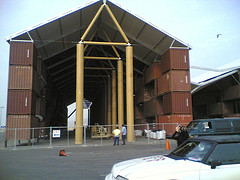
The first one is the Shigeru Ban’s Nomadic Museum (good pictures here), which is made out of shipping containers and cardboard and is… shipped all over the world to host an exhibition.
The other one is the ContainerArt project, where containers become temporary exhibition space. It appears that the containers were used more like mobile installation pieces. Still, it’s very clever.
I think about something between the two. A museum of stackable exhibition spaces. Not just side-by-side art pieces or just a large building to put stuff in, but a set of containers… containing a museum as a whole, travelling around the world. Set the displays right and you’ll only need to close the doors and be on your way. Design the exhibition right and the containers could stack in multiple different ways to fit a variety of spaces.
I’m starting to believe you don’t need museum buildings anymore. Just a whole bunch of mobile or temporary exhibitions in mobile or temporary buildings with maybe a single centre for conservation and storage.

 HP has been developing



Latest Comments