
Museums as the City’s Lymph Node
Posted in Design, Museum Expansionism, Technology on 16. Jun, 2010
One of the most intelligent things ever written on io9.com was by Matt Jones, Design Director of Berg. “The City Is A Battlesuit For Surviving The Future“. Radical architecture designing an urbanism that is “increasingly linked and learning”. I strongly suggest you read this article. This quote from Dan Hill stands out.
We can’t see how the street is immersed in a twitching, pulsing cloud of data. This is over and above the well-established electromagnetic radiation, crackles of static, radio waves conveying radio and television broadcasts in digital and analogue forms, police voice traffic. This is a new kind of data, collective and individual, aggregated and discrete, open and closed, constantly logging impossibly detailed patterns of behaviour. The behaviour of the street.
Everything we need to survive the possible outcomes of the future is dependent upon the city becoming an organism. The Internet of Things video from IBM says the “planet has grown a central nervous system”.
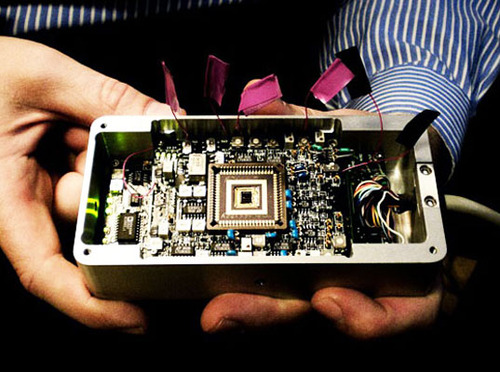 HP has been developing CeNSE, thousands of tough, cheap sensors to start gathering data.
I don’t doubt that claim, except I say that the cities of this planet are going to be the first that actually construct a that workable system of system. We can really ramp-up the hardware inside our City Battlesuit.
The role of the city in the future will affect the role of the museum. All this data, all this information, networked and communicating along the city’s nerves, adding to the superabundance. Cross-referencing stuff will just produce more stuff. There will be organisations who will turn this into some useful apps, like the intelligent alarm clock that will check your calendar and your route.
The museum’s part in this must be to get directly immersed in this city’s central nervous system. It’s role will be like the lymph node, distributed throughout the city’s body (networked/linked) and providing the immunity against the city’s ills. Culture will be the city’s white blood cells.
I don’t see this as another form of social engineering. You can distract museum’s with all kinds of outside missions. I remember one museum who had to try to deal with the city’s knife crime problem. I don’t see this response involving a political step.
By being involved in the system, the museum can make its own responses. That data will be analysed (maybe into the visualisations that are so popular) to give the populous something to make their lives a little better. This isn’t just market research. This is about audience development. This is to make sure the living-city-organism doesn’t die or brutalise itself. This is to make sure the City has a Soul.
Expect more things along this lines.


I love this. Think the museums, community centers, libraries, and the people who make them hum help give it the soul, so it seems like good logic that they would be active in making the connections and giving, err, sense to to the sensors.
Sense to the Sensors. That’s wonderful.