There’s three neologisms I’ve been kicking around on this blog. This is them together into one place and maybe separated out a bit.
Metrocurator
This came from a story about a couple of artists who turned an architectural blip (in this this case, an empty gas meter box thing on the side of a building) and turned it into an art gallery. It dawned on me that a decent number of these type of displays could make a “street museum”, in the same vein as “street art”. Not as an outreach project or fluffy “museum-without-walls” intent, but as a museum spread across an entire city.
What is the biggest resource and the biggest outgoing a museum has behind objects and staff costs? A large building that needs maintenance, heating, lighting and a number of things that are only for the building, not the museum. A Metrocurator, I suppose, is a design response to the scenario of having a completely decentralised base but still keeping high levels of access to objects and information (as opposed to displaying objects in other kinds of building i.e. banks, hotels etc.) The idea is to be as highly modular as possible.
Being a Metrocurator also means having a decent understanding of architecture of the city as a whole. There’s no convient blank walled space to act as a neutral framing device. Location and juxtaposition will be additional contexts. Just like architecture, be aware of resorting to Libeskind-style spectacle. It may not get away with it. This includes dropping a cargo container into the middle of a street and trying to claim it as a Metrocurator project. This is just substituting a building for a different kind of building, be it a temporary one. Also, a cargo container/cavavan/kiosk would be unusual and out-of-place, thus acting separately from the city it intends to meld into.
Two things. This could greatly increase access. Take as many objects as possible and put them out there into the populous. Let someone else be innovative with security and conservation. The other thing is how easy this would be and how little money would be needed. This could be run like a start-up. Without constructing/renting a building, the core of a museum mission could still be obtained at a fraction of the cost. It just means some other changes to the system.
I remember describing Metrocurators as: “lightweight, deals in very little bureaucracy, has a DIY attitude because of very limited funds and basically is running all over a city pushing small outbreaks of museums into public spaces.”
You can see where I need to seperate the definitions a bit. A Metrocurator can or not be a Museopunk, but a Museopunk doesn’t have to be a Metrocurator.
Museopunk
A DIY attitude is very Museopunk, and kind of makes sense for a start-up Metrocurator. But if MOMA released a bunch of Metrocurators into New York with a ton of cash behind them, they could probably get the job done. Same thing with bureaucracy; a Metrocurator wants to deal with as little as possible. A Museopunk wants to change bureaucracy to allow for greater freedom of innovation, especially in reaction to failing “cookie-cutter” models or corporate interests.
Museopunk borrows from, and probably partially overlaps, Edupunk. This word encompasses all museum parts with a punk notion. Prezpunk, a punk outlook on conservation. Who ws it it that said “Curatopunk”? Sorry to who said it but I’ve lost where that came from. I came up with Registrapunk to cover the punk approach to collections management.
Personally, I’m seeing the best of Museopunk innovative thinking coming from the wannabes, the bottom rungs or the outsider freelancers. I suppose these are the people who want it the most and want to succeed and see an entrepreneurial approach as the way to do it. That is to say that there isn’t a lot of things going on in museum institutions that could be considered Museopunk. Involvement in the Creative Commons for one. Putting CC licenses on photos or entire documentation records. Building your own software. Not getting overly involved in these ready made blockbuster exhibitions that are put together and sold as a packages (I want to call them “Microwave Exhibitions”).
In my opinion, Museopunk is a reaction and a desire for museums to regain some of that soul. Which goes onto my next concept…
The Mutant Curator
Yeah, allow me my over-dramatics.
I can barely go five minutes without reading something that says Duff Media X needs to be like Just-as-Duff Media Y to create a Supermedia because Z is like a Curator. Newspapers needs to be like magazines because of Tyler Brûlé. I liked Joanne McNeil’s idea that publishing needs to be like record labels because of Tony Wilson. Music needs to be like theatre because of Amanda Palmer. This needs to be like that.
This may just be endemic of the transition stage of all media. Digitising audio and visual information is collapsing the old boundaries of solid state media, making them splice together towards the inevitable interconnected Superabundance of information. The Media Soup.
It’s down to personal opinion if this is a good thing or not, but the thinking is that we will then turn to Mutant Curators to sort through it. People with influence or celebrity or hero-status will tell us what music to buy, what news or commentary to read, what beer to drink and more importantly, who else to listen to.
I mean, thanks for being a filter against the InfoShock and all, but this is how cults start. Twitter will become a compound to preach. Remember, we are their “Followers”.
—
Museopunks and Metrocurators are going to be up against the oncoming beast that is the Mutant Curator of convergence media. One of the main reasons I use the word “mutant”, apart from it being the bastard offspring of the All-Media, is that it will mutate the word “curator” into something that is a shadow of the original meaning. The New York Times got it wrong. Curator doesn’t mean selecting and culling nor does it mean “I have a good eye”. It is a job. With Skills. I would have thought the journalist writing that article would have been more sensitive to the misappropriation of a title to the lowest common denominator.
Museopunks and Metrocurators are, I believe, a way for those skills to survive.
Just throwing this idea out there. Hopefully someone with greater economic knowledge will come up with some points.
I’ve been thinking a lot about the Brixton Pound, and other similar attempts of community currency. As described on the organisation’s website behind it, the B£ is intended to help promote local businesses during recession. Money that sticks to Brixton is the tagline. From a BBC report:
Proponents of local currencies say they boost the community’s economy by keeping money in the area, but critics dismiss them as fashionable gimmicks, tantamount to protectionism.
“A local economy is like a leaky bucket. Wealth is generated then spent in chain stores and businesses. It disappears leaving an impoverished local economy,” explains Ben Brangwyn, part of the team behind the Totnes Pound, launched in south Devon in 2007
The report goes on to talk about the problems (and there are some great ones in the comments), the fundamental one being that they are seen as nothing more than gift vouchers.
It is just gimmicky? I think there a certain flaw in restricting use to an area, but think about Book Tokens. They helped promote the giving of books as presents (especially when it was difficult to be certain what type of book to get). So why not promote visiting museums? Use them either to pay entrance fees (Yes, many UK museums aren’t free), for tickets to special exhibitions (like in the Nationals) or use them in the shop.
I’ve not been able to find such a scheme. I’ve found vouchers for individual museums but I think it needs to be on a wider scale. It may work locally: museums/cultural institutions of an area/state/region could form a partnership to accept these. I think it would work best on a national level. All museums in a country accepting and issuing Museum Currency. An international Museum Currency would be even better.
I’m sure there could be a better name. Museum Denarius? Go for the historical reference?
This is for the UK, I’m afraid. I don’t know if there’s an equivalent in other countries. I wonder if it could be possible if the Museum Currency was an automatic declaration for Gift Aid, which is tax relief to increase the value of a donation. I do know some museums do this on an entrance fee. Yes, yes, I realise that it’s not that simple.
Comments welcome on this. I think there is a lot of scope for interesting things. A new “currency” could be dismissed as a marketing ploy or just for tourists. Well, it would benefit museums by being just that.
Every Thursday will have a bit of a summary of what’s going on over at Museopunk.ning.com. All my notes, links and discussions on the Museopunk subject are going to be on there rather than on newcurator.com.
Really happy with how its going so far and very pleased with who has signed up. Feel free to sign up and join in the conversations.
* Your Definition – People are airing their thoughts on what Museopunk means to them without forming manifestos. It’s a bit rambling and side-notes at the moment, but I like it like that.
* Paul Orselli: Museopunk – If there’s anyone who has influenced Museopunk before I made the word up, it’s Paul Orselli.
* Video – Dan Cull has uploaded a ton of Edupunk stuff. Good reference points.
I’ve been involved in discussions about what punk is before and they’ve never ended nicely. You’ll always get arguments about authenticity, terms like “true punk” or “real punk” get thrown about and soon afterwards someone makes the statement that everyone else is wrong.
I will hammer anyone who tries to push this discussion into those terms. Go take it to some record shop or music forum. I realise the term is weird and wide-reaching, but I refuse to get bogged down in semantics.
To avoid this happening, I threw the question out on Twitter and Facebook. What I’m more interested in is “punk” as a suffix. Cyberpunk, Steampunk, that kind of thing. I wanted to make sure I was going to speak about something that there was a general consensus on. Thanks to everyone who responded. The same kind of words were appearing, if not slightly different takes on them. Things like “Rebellion” or “Alternative” came up, but a general sense of an underground or fringe/”not mainstream” approach. Sarah Anton (Phillyspice on twitter) said that “It could be a desire to explore the new, desire to push boundaries just to do it, etc.”
I dunno about any solid definition, but this will do as a basis for what I’m talking about. There’s a reason people write books about this sort of thing. There’s also a reason why people hate the use of “punk” as a suffix as it is, that every use bleeds anyway any real meaning.
What a time to then introduce the concept of Edupunk.
I also plan to annoy these people even further by stealing including what Dan Cull called PrezPunk (I suggested AcetonePunk).
In the true spirit of using a punk-suffix that has no link to the original meaning except an overused statement of rebellion and promotion of the alternative, I offer Museopunk.
What does that mean? This is the exciting part: I’m not sure yet. I’m not going to put forward anything like a manifesto. Lord knows we have enough of those flying around and they barely make any difference. We live in a time that’s beyond manifestos. I guess this is why I like the -punk suffix. It’s not laying down the rules in stone.
I’ll tell you something, I think we’re creating a generation of Museopunks. There’s too much talk of museums and money. Endless securing of funding and applying for grants. Corporate sponsorship or government criteria. And when it all goes wrong and money is diverted away or philanthropy ain’t what it used to be, don’t you wonder when museum’s lost their soul? Dan Cull said (on Facebook) that “punk” is about the community over profit margins. Well, for a non-profit sector, we sure are concomitant to profit-making world.
I imagine the satirical situation, where a museum staff spend all their time applying for funding so they can get paid to apply for more funding.
I don’t want to get to that.
Yet, it seems to me that some of the most interesting people I have spoken to because of Newcurator are freelancers, graduands/post-grads, those barely starting out or clinging onto the bottom rung. This is where the Museopunks are. They have some of the best ideas and the most energy yet they aren’t very high in the hierarchy.
Notice how I don’t say, “they don’t make much money”? We do it for love, not the money. As Paul Orselli points out, the upper echelons are all about fundraising anyway.
Something I’m not going to go into (because it needs more research/questions) is the innovative uses of technology and a strong belief in keeping things Free. This, as you can imagine, is almost another article, especially with the Tories in the UK making noises about how they plan to stuff culture but also the soon-to-be-widely-available museum APIs. This makes me instantly think about John Robb’s Standing Order 11: Co-opt, don’t own, basic service, which at the time I couldn’t make much sense of in the museum world. This requires further thinking.
Edupunk is about the anti-commercialisation and DIY attitude for teaching and learning. Dan Cull’s Prezpunk focused on conservation, citing many community projects, which I liked the idea of deinstitutionalised . I’d say Museopunk overlaps Edupunk a bit and encapsulates Prezpunk, so there’s a lot more -Punk to fill, and I’ll admit that Nina Simon probably has a few things covered.
But when you think about all the functions of a museum or a curator, nobody in those two Wordles said anything about making money.
‘What’s the real story, then?’ asked a man of his eight or nine year old grandson, who had said that the museum’s text about the portrait of a 16th century gentleman farmer ‘wasn’t right.’ The boy told him an epic tale of bullfighting instead. It was fascinating to listen to and underlined for me the power of images on the imagination.
Photographer Taryn Simon’s recent TED presentation was about her work taking images of ‘secret sites and worlds we wouldn’t normally get to see’. She discussed two projects: photographs of other-wordly, behind-the-scenes locations, and wrongfully convicted people at crime scenes. Simon is interested in the multiple truths attached to images and opined here that the viewer’s perception hinges on the intent of the creator. She brings forth some compelling ideas about the use of photographs in criminal convictions for instance. In explaining the intent behind her own photographs, she outlines her own intent in presenting them, but what if she didn’t? What would we think? As she suggested, I would bet that it might not be exactly what she had just explained to us. There are always other stories surrounding the work: the idea of the other, the alternative.
The reading of art changes over time and with new evidence or thinking comes reinterpretation. Traditionally we learn from art historians about the meanings behind works. ArtBabble’s newest partners, SmartHistory made use of new technology to present a different kind of discussion about classical art. Describing themselves as a ‘dynamic substitute’ for traditional art history learning, they used Second Life ‘correspondents’ (real-life art historians) to interpret using a recreation of Michelangelo’s ceiling to the Sistine Chapel. In conversation they explained its significance, making, which techniques were used and focus on particular scenes, all of which you might expect from a traditional lecture. What made the difference is that it being Second Life, it can be viewed in the round and they can also fly about to see things close up. I would love to see this used to greater effect giving alternative explanations and with opposing historians and interpreters having debates in-situ in Second Life.
Or what about some children giving their opinions? In the Our City podcasts, schoolchildren made recordings about their hometowns in a worldwide learning experiment. I do wonder how much input the children have into what they think is important in their city and how much the adults guide them. The episodes I have listened to describe their cities in rather pedestrian terms. Whilst I realise that there has to be guidance, they could use the children’s own language and creativity to a greater extent.
This leads me to an idea. Make a podcast wherein children could to tell others about both the real and imagined stories of the paintings. What would it be like to step inside a Gainsborough or a Mondrian. Would it be hot or cold, would there be other people or creatures in there? What might have happened just before that captured moment? This could lead to a large-scale outreach project set up between museums and galleries worldwide to supplement traditional art history and promote wider engagement between children and paintings.
There was a storyteller in residence recently at my local gallery, as part of an archaeological exhibition about the Stone Age. Performing at the height of the school holidays, he held swathes of children rapt with tales of hunting, fishing and trading. More than the life-sized wall painting of a mammoth or the guess-the-smell-of-the-stone-age boxes, he really brought the period to life for the visitors. They could ask him questions and recieve an accurate answer (I believe that he was an archaeologist who was also an amateur actor); they could see how a Stone Age person would dress and how he would use weapons. But none of this would have really come together had it not been for his verbal delivery. That made it come alive.
I have already addressed what makes a ‘good’ podcast (for me). I came up with a number of suggestions for ease of use and interest. One thing that I didn’t mention was the perhaps the most important: the style of presentation. When listening to podcasts and watching videos, I’m sure you notice as I do that no matter how interested you are in the subject, sometimes the presenter just bores the pants off you. That’s when I find my mind wandering from the latest developments in exhibition design to what I’m going to have for dinner, or what might be on at the cinema. This is clearly not what the makers of these media intended.
One of the most charismatic podcasts for storytelling that I have found (well, apart from The Moth, of course) is The Memory Palace. The latest episode reported on German prisoners of war escaping an Arizona prison camp in the 1940s. While this might not sound all that enthralling to you on the face of it, the presenter Nate DiMeo has that same great delivery as the Stone Age man. This coupled with an evocative backing track that lent itself to the spirit of the story really kept my attention.
I think it is well worth museums utilising people who can deliver the stories into museums and galleries to bring their exhibitions alive: even if only for special events. Get your podcast-makers to lay more emphasis on the delivery of the content too. The podcast and its presentation is one more layer of the interpretation, and one which needs equal standing with the gallery exhibits. In fact, it could even be just one part of the whole of the exhibit or collection, where you have to listen to the podcast to gain specific information in a museum version of transmedia storytelling.
I like to think of it like this. The most important person in the museum for the visitor is the assistant at the front desk who can tell them about that day’s tours and events, why the museum has loads of Simian ware but little flint and where is good nearby for lunch. The most important person to the podcast listener or video viewer is the presenter. They are the public face; the first impression for the whole outfit. It’s all in the delivery, people.
You can contact me at August(at)newcurator(dot)com.
* Catherine Manning – To act as ’story keepers’ and to encourage people to interpret the world we live in from different perspectives.
* J@simpleposie – To risk being with the art, immediately and contemporaneously and to offer it in that spirit; to love showing art to people.
* Max Rhino – To ensure the proper balance between preservation and accessibility for a given collection; to act as a subject matter expert available for consultation by anyone requiring information.
* Perian Sully – To mediate between raw experience and information. To give material culture life and uncover new paths for uninformed and informed minds alike to travel.
* Karawaane – To help the development staff fund raise via smart & engaging shows/programs/etc.
* Steve Smith – Provide Context. (To, for,and with an Audience. Driven by Mission. Within the limits of space, budget, time, and technologies.)
* Kirsty Hall – Placing artists and works in a new context that encourages a deeper understanding of the art.
* JenniferNg – To challenge audience to new knowledge, or to think about existing knowledge in new light using the most effective means possible.
* Mia Ridge – To collect stories, whether sublime or ridiculous, to let us know which is which; be able to tell us significance of objects
* Museum of Folly – Contextualization is the most important curatorial function.
* Paolo Viscardi – Enabling intellectual and physical access to and effective future development of museum collections.
* Joanie San Chirico – To create a work of art in itself by hanging a cohesive, well thought-out exhibit.
Thanks to everyone who took the time to respond. I appreciate it.
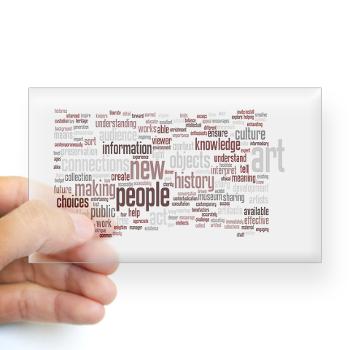
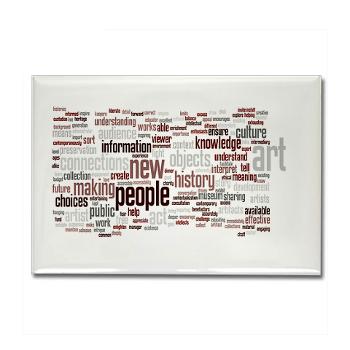
Big and right in the middle; people. I’m not sure if there is a more poignant symbol for the function of a curator. Yet, there are still many curators who hide in offices all day. Right next to “people” is the word “connections”, which many of the responses had as a theme. It appears that the expectations of curators is to provide the legwork to provide meaningful “connections” in a society overrun with “links”.
Also of note, “new”. Strange, when you think that curators and museums are mostly dealing with historical information, yet there must be a “newness” to the outcome. A “new” viewpoint, a “new” fact, a “new” object or a “new” experience (if nothing else, then “new” to me). What fascinates me as a reader of Lipovetsky (who says that the Supermodern era is not an era of new culture and fashions, but a recycling of previous trends) is how this appears to mean that the curator, who has collections/objects of a “historical” era, is having to do just that.
As per usual, I’ve put this on a mug, but also a magnet and a sticker this time. All can be bought from the newcurator shop.
Last time was an interesting exercise. Want to ask another question and compare the results.
Usual process. Respond to @newcurator on twitter, use the #MIFC hashtag (so I can keep track) or answer in the comments with a single sentence. Don’t worry if it doesn’t appear immediately. It has to go through a validation process.
I would really appreciate as many answers, retweets and passings-on as possible. With these things, it always works better this more people’s involvement.
I’ll probably do the Wordle and possibly a mug again, but this question really interests me because of my last post. Curators are changing into new roles yet others are considering the curator as an ideal. So its high time we need to ask:
I don’t strictly know what to make of this. I’ve long been saying that museums are a media and can learn a lot from the problems of other media industries. Especially when it comes to adapting to the future methods of consuming media. One warning is when the media is entirely consumed by the methods. The music industry will long be used as the example of non-adaption. Newspapers and journalism seem to be the next ones seriously thinking about this. My Death of the Curator articles were about a similar trend where the role of the curator would change beyond what it is recognisable now by crowdsourcing or social media being used to make curatorial decisions.
Four articles that came to me over the past couple of days has caused a major rethink. I took the “Death of the Curator” scenario to be part of the similar early movements like copyright-infringing MP3 downloads and Myspace Music or “citizen journalism” and free online news content. But there appears to be a line of thinking towards a bizarre convergence. The Curator may die but in it’s place will be New Mutant Curator.
I was originally going to talk about two more instances of Death of the Curator that offer glimpses of the new role I was originally talking about.
Via Nerdgam’s excellent tumblr (because, curiously, none of the links work) is London’s Next Top Curator by Salon Contemporary (No, me neither). Six contestants each run a pop-up gallery to compete for a final put to public vote on the website. This must be the first time I’ve seen curators put to vote in this way. Heh, maybe I should enter.
Another project is ArtPrize, but again seems to be mainly an artist competition with an interesting use of several social media outlets. I like how Art:21 called it “decentralised curation“. From what I can tell, it’s the role of curators and galleries in this competition that needs to be noted. Whilst their final decision-making privileges are put on hold, they get the chance to influence:
…playing a large role the formation of the event, each presenting a collection of entries that reflect their own sensibilities and expertise.
Fascinating. We’ll come back to this.
Continuing on the theme of learning from other media industries, Jeff Jarvis of Buzzmachine continues to try and save newspapers. His latest delightful neologism is “Hyperdistribution”. But hold on, let’s pick through this strategy a bit.
* Reverse-syndication – Okay, maybe this one is newspaper-orientated, but it generally means acting as a base for a network of people to distribute. “In the link economy, value is created by he who creates content and she who delivers audience.” Hell, I get a lot of messages from museums telling me about their stuff. Social networks do this sort of thing, especially on twitter. But maybe there’s an organisational model here to make affiliate bloggers.
* The embeddable paper – Getting content out there? Getting other people highly involved in your content and to pass it around? Can you say “The Commons“? How about Powerhouse putting their collection documentation under a Creative Commons license? I would list Brooklyn Museum’s stuff but there’s too many of them, but they have certainly branded each and every one very well.
* Specialization – I could argue that museums are too generalised, I could argue that they’re not. There aren’t too many general museums that aren’t ancient and successful anyway. But I have noticed more newer museums pointing towards a particular theme.
* Social engagement – Museums are all over this.
Well, so much for learning from other media. It seems museums are ahead on the innovation scale. Newspapers need to become more like museums. Hold on, aren’t museums already going through a period of intense cutbacks? Saving newspapers by using social networks, technology and media to deliver hyperdistributed content… just like Brooklyn Museum, who still took a financial kicking recently.
And now it’s being said that “Curation is the new role of media professionals“. Relying upon a person’s expertise and style to act as a information filter for you tastes. They use Arianna Huffington as an example, but I could throw in the Boing Boing crew, Warren Ellis and Tyler Brûlé and any number of people, experts in their interests, organising research, delivering in a unique and interesting way. Hell, I could argue that Bill O’Reilly and Keith Olbermann fit this model. Personalities bigger than the news they’re supposed to represent, acting as filter and commentator to a specialised audience.
All my talk of museums learning from other media innovations and mistakes and now they’re all talking about becoming museums! Just try to draw a diagram of this! And museums curators are slowly being replaced by audience-participation-heavy social media experiments, instead taking on the role of… an expert… a filter… a commentator… relying upon the force of their personality and position to influence and direct a particular audience.
The Curator is Dead. God only knows what this new Über-Media Mutant Curator of the Information Superabundance Age coming to replace it will be like. But there will be many of them. In a less dramatic way, the convergence of many media roles into a “Curator-class” seems inevitable.
Last weekend I had my first real-life demonstration of Layar. It was pretty impressive and it occured to me that you just can’t appreciate how it works as you move the phone, when viewing a demo of it on a computer monitor. Listening to KCRW’s Design and Archtecture podcast, I hit on the begininnings of an idea. They reviewed the film (500) Days of Summer which has an architecture driven plot. The film’s co-writer, Scott Neustadter talked about filming in Los Angeles, using only pre-1940 buildings as a backdrop. The premise for this was that the main character ‘…sees beauty and meaning only in the past.’
41c Angelus Temple by Kansas_Sebastian. Used under Creative Commons.
So, say he has a phone with Layar on it. It might work best for him by showing him information not about what is there currently, but was was there in the past. A museum of information through time and space. If you think about it, this is what Google Street View will become. Their 2008/2009 images of the world are a snapshot; an archive of a moment.How often will they update them? What will they do with the old ones? I hope they keep the images available and build onto them.
Could museums and archives use old photographs, plans and title deeds of places to construct this kind of historical augmented reality treasure trove? It would be a massive undertaking admittedly, but I would love to see it.
Incidentally, on the same podcast there is an interesting interview with architect Richard Best. In a gamble to be proactive in the recession he went on a reality TV show with a real estate theme. And won. It paid off for him, but the thought of reality tv makes me shudder.
Sony’s Reader Daily Edition was critiqued by APM’s Future Tense. They postulated that it might overtake the market leader, Amazon’s Kindle. It will be able to facilitate wireless downloading of books, has a touch screen and will be able to read pdf files and google books. The most interesting thing for me is that Sony are linking with a scheme for borrowing library books in e-form. The loan will then expire in three weeks, like a normal library return. This seems like a great idea. Especially as buying e-books has not always meant that you got to keep them. This type of loaning service seems indicative of a point made in JISC’s recent documentary Libraries of the Future. That ‘…technology is adapting to meet the needs of users’.
Lastly, a great video from New Scientist showing how new laboratory techniques can be used to make you feel as if you are your virtual avatar by inducing an ‘out of body experience’. I don’t know how this might be used in museums and galleries, but I do like it. Enter, stranger.
Following on from my love letter to Augmented Reality, there’s something I touched on at the end that looks like something worth following up. Almost at the same time I was thinking about it, I watched another keynote speech by Bruce Sterling to the guys at the Layar Augmented reality browser launch event. (For those who don’t know, Layar is a great little app for Android smartphones). About halfway through the speech, Sterling gave a very interesting suggestion for the AR industry to combat the inevitable lowbrow/downmarket uses by being involved in museum culture.
How exactly is that going to work?
I’ve alluded to this many times; AR would allow for more information to be “connected” to an object, and I left it at that. You could take a painting or an archaeological treasure and surround it with extra bits of media, floating text boxes, video or maybe a ghostly hyperlink to a collection database entry (if you’re unimaginative).
Stuff that you could do on paper and screens, ultimately. Oh, you could design a better UI to hold the information. Historically, museums aren’t interested in that. Something like AR that smells a bit like an “optical Internet” (a phrase Bruce Sterling rightfully sneers at), it’s most likely going to be a bought product or outsourced to a freelancer. Few museums will want to get involved with designing that architecture. They’ll want to buy something they can fill. So what can AR do for collections management?
I pull this image from Marieke Guy’s Rambling of a Remote Worker. It’s the Gartner Hype Cycle, a graphic to show where a lot of new technologies are and where they’re going and predictions about how long it will take. What’s right next to Augmented Reality in the Technology Trigger phase, heading towards the Peak of Inflated Expectations?
So, we have two emerging technologies, one that can make all kinds of information or 3D images dance before our eyes, and another that can print out 3D objects. Remind me again why museums are still Draconian over photographs? Whether it’s holding onto increasingly meaningless intangible assets or holding onto an ultra-materialistic purpose of controlling access, we are rapidly heading towards a cultural state where it won’t matter. Your photographs and image protection will almost seem quaint. Best thing to do would be to open it up and get it all out there like some museums are doing, getting some interest in them and some use out of them because otherwise it will look like you’re desperately protecting your own handful of sand.
3D printers and 3D overlays. You’d think that some serious 3D scanning equipment is going to be needed soon, right? I can’t imagine we will entirely rely upon 3D modellers and 3D animators to deliver this. I doubt people are going to pay someone to sit down and create thousands of models with Sketchup.
This will be the next step in digitising collections.
It’s going to be a pain. I doubt everyone has got around to photographing their entire collections yet, and now we have to give each one something akin to an MRI? Where are we going to get a scanner big enough to go around our twelve foot high statue? And do we really have to scan in every single archaeological fragment and splinter?
But think how cool it would be. Download a 3D model to your phone and spin it around, look underneath it, look really closely if the resolution is good enough. Look at it as an X-Ray, infrared or something similar (then spin it around again). Hell, if 3D printers get into homes, why can’t I print out one inch-high paper models of my favourite museum objects? Or download 3D models onto your own AR museum layout, moving around bits of QR coded paper as your webcam tells you how you’re repositioning Roman pottery. Maybe even a little AR curator could follow you around and belittle your efforts of exhibition design or grasp of Art History.
AR people need a good cultural foundation. Museums have a big resource to make it happen.
I was asked a while back why I’m so interested in Augmented Reality. To me, it’s the polar opposite of a computer “kiosk”, something I’ve hated on several times regardless of touch/multi-touch capabilities. Is comes down to a question of design intent or, more specifically, platform. Brooklyn Museum’s Shelley Berstein has written a blog post about kiosks, so I want to share some thoughts.
First, a story.
I’ll keep the name of this particular museum hidden. I use them as an example for my criticism, not to negatively criticise that particular institution. At the time, they had just gone through a massive renovation. Everything was now behind steel-framed reinforced glass and proper lighting. So the space looked good.
There was quite a large amount of objects on display. More than I would have thought necessary. Rows upon shelves of them with only very small one sentence descriptions on labels. I was no expert on the subjects and felt a little overwhelmed by what I was supposed to be looking at.
I asked a question of the people on the desk. Admittedly, I don’t think they were curators but I only asked if they had a particular object. They took me to a computer. It was broken. They took me to a another computer. That was broken as well. They told me to go home and look at the database online. I did, and found the object I was looking for as well as plenty of other information.
This is what Shelley calls a “Lose” situation; the website in a kiosk. I go a bit further and say its the “Not Better Than the Internet” situation. I went home and got something better than what the museum was offering. Even if the kiosks were working, what was I gaining from turning my head and looking at the objects?
What museums do well is material Reality. They have that sussed. Objects as authenticity is almost intrinsic to the definition of what a museum is. Even when “Intangible Heritage” was the vogue, it was still in terms of the actions surrounding objects. (This seemed to mean the conservation of dance, theatre and skills in Third World or Far East countries to stave off the impending “Western” Monoculture, if UNESCO is anything to go by).
The treatment of technology in museums is still in this materialistic Real way: The Kiosk, just another object on display. A monitor with touchscreen or a keyboard, bolted to a wall or given its own plinth, technology on display just like any other object.
Before I get hundreds of suggestion of good kiosks, I will admit that Shelley’s comment book computer is a sensible idea, so there would be good and bad kiosks just as there is good and bad AR. The point I’m trying to make is about design and, as always, the future. A kiosk approach to technology in the museum concentrates that platform into a limited space, which was fine many years ago when that was cutting edge. Without meaning to sound like a post-cyberpunk novel, but technology is now a homogenised aspect of our everyday lives.
To put it simply, my phone is better than your kiosk is ever going to be.
A kiosk also breeds a bad habit I’ve noticed in museum. They get installed somewhere then forgotten about. They are never updated and ignored until they break. This may be why I think they always look so dated. They’re as static as the objects next to them. I imagine there are kiosk-types that do update with use, like the comment book computer, if the comments are viewable by all. I admit that’s acceptable. At least it’s doing something. I think about the use of kiosks at the Mattress Factory, but I like to think they have the right idea of it being a node of technology within their overall technology overlay.
Overlay. I can stand anywhere in a museum and use my phone and get information. I could get artist’s biographies, historical articles, even news about what’s in front of me. But that’s still contained within a device. Okay, a far more mobile one that I have total control over and with less limitations. It’s still a concentrated device connected to the Other Place known as the Intarwubs. What excites me about Augmented Reality is how it can fill the gap between the superabundance of information out there and our actual lives. Updating Apps could associate huge amounts of updating information right in front of the objects the museum wants us to give a damn about. And we would be able to control it… or at least keep asking for more and ask for it in a language that won’t completely offend your intelligence.
Look at this and look at the possible future an Augmented Reality platform in museums has. What’s the latest advancement in kiosk? Now, you can use more than one finger.
Maybe Augmented Reality won’t stay on phones and we’ll have goggles or visors or contact lenses and control our infomation hallucinations with Pranav Mistry’s Sixth Sense technology (four fingers!). Maybe, crazy idea, the Augmented Reality platform could perform actions to the objects…
I spoke about Cross Reality before. The use of sensors to bridge Augmented Reality and Virtual Reality. Again, more possibilities being tested because technology is permeating every fabric of our lives and culture and dragging that funny universe on our computers into this Reality. I wonder if, through this and the increasing complexity of fabricators, the next phase of museum digitisation will be scanning of objects into 3D models.
God knows what that will do to our authentic Museum Reality.
Awesome. Kickstarter rules means the money has to be raised within the timeframe or it doesn’t get any of it, so please reach deep and throw a few dollars into pot. There are also rewards for certain donations, so go have a look.
I’ve seen a lot of blog posts recently about the Future of Museum Studies courses. I am infuriated by how the discussion seems to be along a ciriculum basis and that those providing the courses need to make these minute changes in education practices and pray for a long term gain.
You want to have an excellent Museum Studies program? Guarantee jobs.
When someone passes your course, they should be immediately headhunted into a museum. I don’t mean year long internships, I mean proper actual employment with a goddamn living wage.
Call it the same performance indicators as your pass rate. “100% of our students passed”. Every school, college and university aspires to 100% pass rates. If they’re not, then they have a target to aim for. Here’s a new goal: “100% of our student got a job in the museum sector”.
Okay, you can wuss out and say “100% of our students, who passed and *wanted* a job in museum sector, got one”.
This should be actively and aggressively pursued. Not this tinkering with the conceptual. Have some faith that the person you hand a piece of paper with their name and award on it is an intelligent person ready for what museuming can throw at them.
Of course, it’s criminal to take their money, hand them a piece of paper and wish them luck with a handshake. Too many graduates from the full full taxonomy of museum studies courses are having to compete in the job market lottery. And it is a lottery. The most basic entry-level positions into the museum world are now getting TONS of applicants. This is a sad state of affairs.
Maybe this is another performance indicator. Maybe schools shouldn’t be taking the money of these students if the future employment doesn’t exist. Isn’t that the greater problem? Museum’s hardly have a high turnover of staff with people sitting in the same position for umpteen years. We are Wasting the Opportunities of the Talented.
Without going into too much detail about the “how” (someone will undoubtedly bring up costs), I think there are two ways. Turn Museum Studies courses into headhunter networks. Take your students work and CV and cram it up the noses of your contacts. Try not to insult your student body with volunteer work. I’ve seen the answer countless times: “To get into museums, do lots of volunteering and internships”.
In short, something just above slavery. Work hard for an indeterminate amount of time and maybe the industry will maybe reward you. The current model for improving museums through new blood is the same as parents controlling children with Santa.
The other option would be an establishing of a museum milkround. I am told this is a particularly British concept, and I have no idea if this sort of thing happens in the US. A milkround used to be when companies would actively recruit in universities. They would trip over themselves to get graduates. Alas, this was in a time where there were a slight fewer graduates who didn’t have to take on several thousand pounds worth of debt. The system must still be able to work, right? How many museum studies-esque courses are there? How many museums are there? Surely this relationship can be facilitated.
But no. All this got delegated to online job boards and magazine advertising. It created a lottery.
The bitter taste in the museum student’s mouth was that what they thought was professional development is now considered almost useless to their future compared to the gamble of the job market or the gamble of obtaining a useful contact.
The courses should be doing this for them. Not enough of them are.
I’ve read a few things about the skepticism around academia as work training. My Christ, who let in all these Art History and Archaeology PHDs? They’re practically *running* the place and now there’s the hint that a Museum Studies qualification is unnecessary? The one thing these people are being trained in are now possibly not trained? Or not trained enough, as I notice in another comment that museums are made of of too many specialisms. Nonsense. The whole world’s industry is made up of specialisms. This is the sort of thing you’ll learn on the job. You want a task done, get someone with the intelligence to do so. Not mess around trying to find someone with one hundreds years of proven experience
That way leads to stagnation. That way leads to the brightest graduate stars never been given a chance. Train them, teach them, give them your Mark of Cain and get them the chance to perform. They need you.
You heard it here first. These new partners see the arrivals of two new states being represented in the Norman Rockwell Museum and Art Institute of Chicago as well as ArtBabble’s first partner from outside the US, the Van Gogh Museum. I imagine this won’t be the last international partner.
I’ve become fascinated by the potential of the KQED partnership and will hope to find out more soon. Also personally stoked at what the Guggenheim has to offer. Hopefully they’ll involve the other global members of the Foundation.
All of the content will be available on ArtBabble.org some time Tuesday 28th as they’re still adding at of this moment. Babble On.
Nina preaches a particular brand of participatory design that I only partially understand myself, but I guess this is why Nina gets paid to give talks on the subject. I understand it as a movement in museum ideology from passive to active to social. This last part is exceedingly difficult to manufacture. What Nina is aiming for is getting a dialogue going that comes so easily in that mass-social-experiment known as Web 2.0, where complete strangers form communities over common themes. The trick is getting that 2.0 goodness off the Internet and into the physical museum. There’s no point in having a dualism of high web-based participation and a passive museum space. Nina fears this becoming a widening gulf. So do I: my beloved AR can’t happen otherwise.
In most museums, technologists are still seen as service providers, not experience developers. They live in well-defined (and self-protected) silos. There are stereotypes flying in many directions—that curators won’t give up authority, that technologists don’t respect traditional museum practice, that educators are too preachy, that marketers just want to get more live bodies in the door.
This is why Nina dreams of a museum that’s also a bar. It an attempt to move museuming into a established model community structure. (Nina – if that ever gets off the ground, I’ll drop everything and come be a barman/curator)
There’s nothing I think isn’t fair in what Nina said. Rob called it “misinformed” and I disagree. It’s justifiable to base a critique upon a single visit. It may be the toughest challenge, but if you can’t grab someone on their first visit, how likely are you to get a second. It’s brutal, I know, but people have 300 other things vying for their attention. So if someone goes to your gallery and doesn’t feel the same involvement as the Internet, that could be considered a curatorial weakness.
First off, I’d like to argue against lumping all sorts of museums together in this discussion. I think the relationship between virtual and in-person offerings is necessarily different when the museum is an art museum.
Standing Order 6: Don’t Fork (the Insurgency). I believe a museum is a museum. If we start finding reason to exclude art museums, then why not maritime museums or archaeological museums? Every taxonomy of museum has different issues. Hell, every institution has different issues. We’re not dealing with magic bullets or surgical scalpels here. We’re talking about the movement of museums towards the future. That movement is going to stagger and lurch. It would be a shame if the lurch made the technology side of museums merely an accessory, in an art museum or otherwise.
This is why I harp on about Augmented Reality. This is why Nina was talking about loyalty cards. (Not “interactives”, whatever that means. That words sounds so 90s, like “multimedia”). These things can be homogenised right through a museum.
When I talked with Rob Stein, the IMA’s CIO, about my frustration, he suggested that “institutional change has to start somewhere.”
Rob was clearly a bit sore about Nina visiting the IMA as a regular visitor and coming up with this very hard criticism. And it was very hard. Not harsh or snarky. Hard. That was Nina in full cultural critic mode, analytical and evaluative. There are lessons to learn, as proven by the large amount of discussion it generated.
Do I think the IMA deserved it? No. There are far worse museums committing far worse sins. I do believe it has to start somewhere and the IMA is doing great work. Looking at the list Rob made, things like Project IMA or the “Multi-User Collection Browsing with Physical User Interface” have some really exciting elements in this field. I can’t think of many museums seriously trying to make this much effort to establish web-and-reality communities. As Rob states about innovation in museums:
At times it seems to be ephemeral… a gossamer to be grasped at. Other times, you find yourself standing right in the middle of it without knowing how you arrived.
So, Nina went into a gallery and found it sparse compared to the online experience. Rob states the what they have done (albeit, in short term projects rather than total museum integration. Fair comment?) and then talks about the very interesting things they’re working on to get that experience. I like to think that they’ll “get around to that sparse gallery space”. It has to start somewhere.
Nina gives us a warning about a potential ghettoising of museum tech. I think it’s unfortunate that it was the IMA that inspired such a warning. Rob tells us where they are with the current museum tech movement. Where we are and what we should be concerned about. Two points along a line we can make judgements from. There’s a lot to learn here for us well-informed museum people, especially when we need to start thinking like the uninformed public that can’t drag out important members of the museum staff. Was is it that we’ve learnt?
We’re in a credit crunch. We all know that. I won’t bore you with the details you already know about budget cuts or the lack of jobs. What I have noticed recently coming through in the media lately is reflection on how people are working around it.
I started the week watching Alan Yentob’s Imagine: Art in Troubled Times.* He talked of art and austerity, Roosevelt’s New Deal in the 1930s and speculated how recession affects the arts for the better. In the Great Depression the US government paid artists a salary to produce things to perk up everyone else. However municipal backing brings no guarantee of quality. I wonder if that were to happen in today’s recession who would get the say on what was a good piece of art and what wasn’t. Would artists conform to what Ben Bradshaw or Peter Garrett thought they should be making? Doubt it somehow.
This programme made for an interesting debate, asking who the arts are for and what they seek to inspire. Art (in its most encompassing sense) allows us to be transported from our everyday lives for a while. So what can we do to foster this idea and make it work for people? Can we do anything? And quite frankly in this recession can we even afford to? One way which has already been happening is to use the empty shopfronts which are increasingly a part of High Streets and Downtown areas the world over. Who wants to look at this?
Free Parking - For Lease by ryan-chow. Used under Creative Commons.
Curator of the latest of these ventures, Manon Slome thinks that art can thrive in this kind of environment and something positive can be created. She discussed the Manhattan No Longer Empty project on Bad at Sports. With galleries going under and artist representation lacking, it made sense for all to use what was available for the minimum price. In an attempt to revitalise these empty spaces, artists were invited to make installations in response to the economic crisis. Often they would make site specific pieces in response to, for example a fishing tackle shop ‘capturing the zeitgeist of the store.’ Slome reports a great response from the public, from artists, and increasingly from backers who appear to see the positive aspects of this kind of ‘community art’.
So there do appear to be some upbeat elements in these uncertain times. Art might help us all through. Even just going to the cinema or to a museum for an afternoon might be enough to transcend the credit crunch for a little while. Shouldn’t museums and galleries be making the most of this in their advertising?
This all seems redolent of the art of the Depression era doesn’t it? Cheering up the masses? Take heed of a final warning from Arts and Ideas. Their panel talked of the myth of positive austerity. That the willing embrace of WW2 rationing and ‘getting on with it’ really is a myth. Nobody saw it in those terms then; it was damned hard. We all know how tough it is at the moment. I wonder what folk memory will say about this recession. What nostalgia will have been created of this time when historians look back?
* Admittedly not a podcast but a BBC TV programme and hence not available worldwide.
There has been an interesting juxtaposition in the podcasts that have caught my notice this week. They have been either about the very latest developments in technology for the future or the preservation of things that are being lost.
APM’s Future Tense talked to NASA about their communications projects. They have already tweeted from space, but aim much higher (and further) than that. By building an interplanetary internet they want to be able to make the most of spontaneous interactions with space vehicles and telescopes. I’d love to think it could be this:
‘Take more macro photographs of that crater, send them to the Hubble telescope and copy the email to the Smithsonian so they can archive them at the same time.’
Normally in space exploration, you would have to plan to take those photographs on your next mission, so this would get things working much faster. How could this technology have an application for museums? Could we send data out there instead of just retrieving it? A virtual space museum? I would love to hear what you think.
The BBC World Service special report Save Our Soundsdiscussed the changing soundscape. In a thought provoking podcast, they covered urban sound design, lost soundscapes and are preserving sounds by charting aural turnover on an interactive map.
Sound is often used in museums: as part of audiovisual display, as oral history or in interactives. What I find more interesting though is the sound of the museum itself.
If you closed your eyes for a couple of minutes what would you hear? It really depends on where you are. There could be the hubbub of school groups or the quiet contemplation of people considering art on the walls. The hushed but frenzied excitement of somebody discovering an object they love and telling their friend. A film quietly playing to itself on a slow day. The scratch of a pen on paper as someone takes notes. Footfall, chatter, excitement, boredom. And behind the scenes? Typing and papershuffling in the offices. A telephone conversation. The whirr of machinery in conservation services. The clatter of someone making a cup of tea in the staff room.
I bet that your museum sounds different in all kinds of ways to the one where I work.
I think that it would be an interesting experiment to have a museum sound art exhibition. Chart a day in the life of a museum, edit the snippets and pipe it into a gallery. I would love to people-watch while the visitors figured it out. Very subtly done, it might seem like a haunting.
Too self indulgent? Or just seeing things from a different perspective? I think it is worth a shot.
I started off talking about new technology. All technology gets old eventually and will probably end up in a museum. Here is a great videocast by The Stuff of Genius about that once brand new technology, long range radio.






Latest Comments