2) Have you met “hanneorla” and seen all the amazing artwork she looks at on her travels? I’m not only impressed by her beautiful images, and the fact that she seems to totally geek out on individual sculptures, but she also adds lots of meta data to each image she uploads. Take note. She’s doing it up right. And what she’s doing is basically documenting the condition of mostly outdoor sculpture. Imagine if someone would plug her into Wikipedia Loves Art. She’d win every competition at every museum! Check out her sets.
3) I don’t suppose I even have to list this one, but I will: The Commons
More than 500 Prints and Photographs Online Catalog (PPOC) records have been enhanced with new information provided by the Flickr Community.
b) The Brooklyn Museum uses high res images of 19th century Egypt, and shows earlydocumentationphotography. I can still here one of my favorite art history professors reminding me the importance of photo documenting historic sites, because “you never know when it’s not going to be there anymore.”
4) I can compare the Hepworth at the IMA to one in Yorkshire, England. Now, where are the other 6 sculptures in this edition? Wouldn’t I like to know…
“Rather than letting lots of pound shops appear, we are encouraging people to start up businesses. We know recessions are awful but can be a good time for artists as creative ideas start appearing while otherwise redundant people are sitting at home fiddling and doing creative stuff.”
Another empty shop in Sidcup High Street by davepatten. Used under Creative Commons
What better way to encourage economic stimulus than making sure commercial properties don’t fall into ruin and improving the image of the surrounding area?
I wonder what a slack space could be for the wider museum industry? One thought is part of a project’s community outreach, especially if a museum is outside the city centre. Or it could be temporary exhibition space for more of the collection to be on display, hopefully allowing some of the more crackpot objects museums tend to have in their storerooms. Hell, maybe even temporary storerooms where groups of volunteers can gather in a space to get stuck into a collection management project.
The way to really make this work would be a scheme set up by the local government to force work with property developers to make this happen. Very short-term minimal-or-no cost leases for creative and cultural purposes.
MOMA in Brooklyn by aolin. Used under Creative Commons.
The lines between museology and marketing will certainly blur in Museum Expansionism. If you took a museum exhibition out onto the street, you’d certainly want it branded to make people aware of who is behind it as well as promoting your museum. As museums explore further beyond their walls, what battlelines will be drawn?
This question comes from MoMA’s advertising campaign/exhibition in a Brooklyn subway station that’s pretty close to the Brooklyn Museum. They bought every single possible advert space and put either “MoMA” on it or a painting from the MoMA collection. The website is promoted at every opportunity, where you can download audio guides or watch the video tour, there’s also lots of attempts to get you to buy a membership package. The Metropolitan Transportation Authority call it a “station domination”.
Pacific Atlantic MOMA by David Overholt. Used Under Creative Commons
Both sides are being pretty diplomatic about it. Chief Communications Officer of MoMA, Kim Mitchell (notice, not a curator) calls it an experiment coming from a marketing advisory committee. Brooklyn Museum spokeswoman Sally Williams says “There’s room for us both.”
Nice words between people who probably all know each other. This is the cutthroat world of advertising, so will it last forever? Marketing departments may appear as slightly separate entities to the more central curatorial and conservation staff within museums. Yet they are increasingly able to draw upon museum collections in grander ways as Museum Expansionism becomes an increasing part of a museum’s mission.
It getsloadsofgreatpress. I’m not sure a subway station ever looked so good. I guess the public gets what the public wants.
“Augmented Reality”, in the simplest terms possible, means having computer graphics and information overlay real time footage. So point the camera at something and the view screen will display all kinds of extras.
There’s a lot of possibilities here. One could be the chance for almost encyclopedic amount of information available right next to an object, being the next evolution in audio guides. The other being a simple collecting of information, stored onto your handheld for use later like collecting stamps. The interesting option is the mixing of this with Jane McGonigal’s idea of bringing “Alternate Reality Games” into a museum. (Alternate Augmented Reality Game… AARG?)
I imagine going into a museum with my handheld and start playing “Rameses Return”, a role playing game about the Egyptian king’s attempts to possess a new body. Or “MuseoDuel”, a Pokémon clone were you capture and collect museum objects to form your own fantasy museum/exhibition. Or “The Quartz Labyrinth”, every area has a set of puzzles that upon completion gives you time inside the main auditorium to compete for some kind of museum merchandise. I imagine all these game on disks that I can carry with me.
Think about the opportunities and options these creates and the whole new wing of curatorial theory this opens up. This technology is almost unlimited in scope in what museums can do with it.
The Watermarks Project is an example of art in public spaces and museums nicely intersecting. Predicted water levels are projected onto buildings with information about the conditions that apply, like the icecaps melting or a strong wind. It’s at that point that you see the very real possibility that the water could be above your head and where you are standing will not save you.
Terrifying stuff that makes it primarily an art project. But it’s the cold hard science and information that makes it a museum discussion point. How many times has the environment been featured in a museum? Countless. What kind of impact does the representation of the end of civilisation have when you can see it above your head?
There was also involved a workshop to fully integrate museums, but this is what a museum exhibition looks like when it’s spread across an entire city.
I feel that it is time for museums to become more than buildings, more than collections of objects, more than organizations of great people. The museum of the future must become an altogether different entity, one in which its public is the entire world and its focus is no longer exclusively on physical objects, but rather the dissemination of cultural heritage information. While the days of museums being the sole “authoritative sources” of information are probably over, that does not mean that museums cannot make themselves vital in entirely new ways. I would definitely point to my old alma mater, The Indianapolis Museum of Art, as an institution that understands this. Whether it’s innovative Web applications like ArtBabble and Dashboard that help the community as a whole be better at presenting information, or enlightening blog posts and Twitter feeds from staff members like Rob Stein, Daniel Incandela, and Richard McCoy, the IMA clearly understands that its location in the Midwest need not mean that its reach be limited exclusively to Hoosiers. The IMA is becoming not just a museum, but an indispensable resource to the community as a whole. They are clearly a model for the museum of the future.
Koven Smith is Manager of Interpretive Technology at Metropolitan Museum of Art. Check out his blog http://kovenjsmith.com.
Museums earn our engagement through their own individual quality and authority—but they also work in concert with other sources of information in our culture building a “network of meaning” that each of us accesses in our own ways. The network of meaning is the network of information sources that for better or worse create public culture. The network of meaning can be dismal, banal or in the case of Nazi Germany, outright corrupt and corrosive to moral values. Or the network of meaning can work intentionally (and unintentionally) to create great societies. Today our network of meaning is exploding exponentially as a vast array of online resources bring everything to our desktop from trends, news and politics to pornography.
Museums will either vastly evolve their missions to include this new online portion of our network of meaning—or they won’t. Those that do will meet a terrific challenge of virtual outreach and communications with and among patrons and passers-by. Those that don’t will become more and more irrelevant.
The only choice for the museum in this moment of change is to participate or not. I believe it is imperative that a museums must lead and use their authority to establish reliable, moral centers of information and communications about each museum’s mission within the new network of meaning.
Encyclopedic museums like the Louvre will have the opportunity to offer their collections and resources like rich databases of culture, used by the Louvre staff and others to create synthetic communications and new understanding. Museums with smaller, more focused collections or missions will be able to build strong online identities—as consumer brands do—by earning a specific place in the network of meaning through understanding how audiences need and want to interact and engage—like the Walker Art Center. Museums with specific missions, such as the Holocaust Museum in Washington DC, will need to pursue two strong strategies, one built around creating an authentic presence and dialogue with audiences online, and the other to “patrol” the entire network of meaning to fight malicious opinion and correct wrong information.
Regardless of the scope or mission of a museum, the frenetic evolution of this rich and collaborative online “network of meaning” brings the challenge of exploding the current physical, time—bound concept of the museum into a new concept that uses collections, staff, patrons, and resources to engage audiences everywhere, any time, to advance the mission of the institution. Museums will transform in the coming years from local institutions focused on preserving and expanding their collections and buildings to trans-national institutions focused on fulfilling a cultural need in our new network of meaning.
Rohn Miller is Strategic Director at IconNicholson in NYC, one of the leading strategic design firms working with cultural institutions. Their work includes Website and Internet design with the Metropolitan Museum of Art, the Chicago Humanities Festival, the Doris Duke Foundation, and several other major cultural institutions we are currently partnered with. Rohn is specifically working on how social media transforms the way museums work with the public. You can follow him on twitter.
To me, the “future” of museums is actually found in their origins. Stripped to the fundamentals, the two compelling, intertwined things that museums provide best are objects and context (“stuff and stories”, if you like.)
It is amazing how many museums lose sight of this in their headlong rush for the next cool technology, blockbuster exhibition, or Museum 2.0 scheme (or are we up to 3.0 now?)
The awe of engaging, in-person, with real objects, combined with the impact of a carefully-crafted narrative is what got me working in museums in the first place.
Can museums do a better job of engaging their communities and expanding the dialogue? Certainly. But to do so by sacrificing the fundamental “stuff and stories” in search of the next “big thing” seems like a losing proposition, especially in these fraught economic times.
So here’s to a future filled with museums drawing upon the strengths of an engaged community, interesting objects, and creative staff!
Paul Orselli is the President and Chief Instigator of the Paul Orselli Workshop (POW!). Check out the FREE museum exhibit design resources at orselli.net and exhibit tips, tricks and news at his excellent blog Exhibitricks.
This is a nicely put together addition to the exhibition. Even though the whole comic is in Flash (which may cause some people/other webcomic artists to cringe a little) it certainly make use of it, with small movements to animate the panel and links to definitions when specialist language is used. I would have liked better speech bubbles and a much better font, but they are small criticisms considering the art and the story are genuinely engaging.
There should be more museum-based webcomics. Maybe even resident comic-creators.
“The traffic, noise and music would disrupt the neighborhood,” said Simon, 83. “It’s like dancing on the dead people’s memory.”
“The [center] is making a desperate grab to railroad this project through the planning process,” said Susan Gans, an entertainment lawyer who has led the opposition.
Entertainment lawyer? That can’t be right. Surely the kind of lawyer that needs to be involved would be an expert on city planning and civil law. Who knows.
It seems the major arguments are the usual suspects: parking, roads, noise and architecture. It seems that whilst nobody is complaining about how it looks more than “it won’t fit in”, it seems the size of it is a bigger issue. The expansion will total about 28,000 extra square feet.
What I’m more interested in is the removal of the memorial garden and the fact that the expansion doesn’t seem to be for museum-related activities (bar being a source of funding).
Back on the 4th January, I introduced the idea of “museum expansionism”. It was to be a general term for occurrence of museological concepts and theories going into entirely new realms.
It basically started with my obsession that museums were taking exhibitions into airports.
The sentence that seemed to catch a lot of attention was “What if you had the resources to spread a museum across an entire city?” The idea of taking the museum TO people was an attractive concept to explore for some.
The Mini Museums are tall, triangular cabinets. Looking at the photo, they seem secure but also appear to be modular in their construction. It looks like bits can be easily taken apart and replaced, meaning putting up new displays could be quick. It acts as advertising too, making the museums known in the town (I would have chosen a different font, but hey).
Ciara Canning, Curator of Community History:
“The idea is that by taking objects out of their traditional museum setting we can bring our collections to the widest possible audience. Our ‘mini museums’ offer a taster of the wonderful objects which people can see in our museums and will hopefully encourage more people to visit in the future and see what else Colchester and Ipswich Museum Service has to offer”
Firstly, I find this topic exciting. There’s a lot to be thought about as this isn’t a fully fleshed out idea.
Have to applaud the way the future is being approached by the AAM. The focus isn’t on predictions but more building towards a future we want, not reacting to a future we don’t know.
There was a lot of comments about this idea of “Happiness” and that games are successful by making people happy. It seems that people took this as a replacement for current museum objectives, not an extra layer to be explored.
I have to say, I’m rather shocked at how resistive a lot of people sounded to these ideas.
“Happiness Engineers” is an odd concept and one that I wouldn’t be willing to give to all game designers. Anyone who has played a poorly designed game experiences frustration and a sense of being ripped off. This is something to watch out for: Not everyone gets happy with games, but the best games do encourage happiness. What is the ratio between good and bad games? Would a museum allow an unsuccessful experiment?
I think World of Warcraft isn’t the best example to use as many started talking about addiction rather than happiness. Not that the addiction to museums would be a bad thing.
I suggest a better model would be Half-Life 2. Some of the best plotlines and story telling in single player but also a very large multiplayer community, as well as hundreds of modifications using the same engine.
Not enough is being said about story and plot yet. Early days. I think this has more to do with Dr McGonigal style of games she’s involved with (ARGs) that seem to have motivation based around puzzles.
Someone asked about curatorial involvment in a game, be it heavily involved or not at all. Depending on the kind of game, I suppose. It could be an open-ended sandbox game or a linear narrative. Both work in the video game world despite vogues for one or the other.
Games are not all about killing people and with no morality so are just escapism. The Nintendo DS and Wii have sold millions of unit and they have about five games involving guns.
Seriously, guys, drop the “scavenger hunt” idea. It seems to dominate these kind of discussions and it is not the be-all-and-end-all of what could be achieved.
Not sure about the idea of “goals” and “achievements” and “leveling up” yet. It seems linked to the idea of gaining badges to show accomplishment and I feel that’s a bit too much like Boy Scouts. Certainly should be involved, but not the sole reason for this.
Calling it “gaming” sounds like it gave the wrong idea to people. Maybe a different title is needed. I put forward Role-Museum-Games, RMGs, that some seemed to like. It gives it genre and definition different that current video games and maybe put forward the idea that the whole thing needs to be created before being dismissed.
“People running around the museum disturbing others” is a worry, it seems. Well… Don’t design your game like that.
Design it to be played in a group or on your own. Design it to involve stealth. Design it for an age range. Design it with a difficulty curve. Design it to be linear or not. The point is that the design will serve the function.
Some more structed posts will follow on this topic in the future.
This is a really neat idea. From the looks of it, about 560 followed the twitter and there were about 580 updates. From the latest posts, it’s hard to tell how many were paid for exactly and how much was usual twitter noise.
It seems @ayrshirebard, or I should say @craigmcgill, went for following those who make up the twitterati. I follow ever single twitter with “museum” in their name. Probably wouldn’t have hurt to generate interest amongst them. If @GettyMuseum, @MuseumModernArt or @ninaksimon got hold of it, I think they could have got a lot more followers/donations.
TITANIC MURAL by Andy Welsh. used under Creative Commons
Despite describing it as the world’s most recognisable brand, one would think that naming something after the Titantic wouldn’t inspire much confidence.
Culture is often used as a regeneration catalyst. This is nothing new. More often than not, they are bolted on the side of large housing estates like a hospital or school. The difference with the Titanic Quarter is that the flats, hotels and banking centres are being placed around what will become the Titanic Museum, the cultural centre for all this branding. This feels less like a housing estate with an artificial addition and more like people will be living on a heritage site. The blurring between hotel and museum continues.
To put this in context: what would the feelings be if hotels and luxury apartments turned up in Northern France, renovated the local museum and heritage sites and called it “The Somme Battlefield Quarter”?
What kind of museum residencies are there? What do they do?
There does not appear to be strict rules or guidelines to what one may expect a residency to achieve or how a residency is structured. They appear to take the form of consultants, short term or long term, temporary or permanent contracts, leader on a project or a position within the hierarchy. The common factor is the resident takes the role of the creative outsider, the person who can respond to stimulus with talent and can take a zen-like approach of not being molded into a museum shape.
The idea has a history going back to the days of the Royal Court, where people were expected to perform for the monarch’s amusement. James I had Shakespeare as his personal favourite playwright and Ben Jonson as Poet Laureate, effectively Artists in Residence for the King. There is also a diplomatic aspect in a residency. They act as the visitor from another world who is representing more than just themselves. As was the case, the position of Resident was once a title just below Ambassador in an embassy.
What other residencies could there be? A Dancer-in-Residence? I’m surprised not to find more museums with poets and playwrights involved. Resident musicians/sound engineers seem to be the biggest growth industry. Resident DJ? Resident filmmaker? How about a resident martial artist for those with appropriate collections? A resident magician?
The Museum Resident forms an important function regardless of their discipline: To make the museum a hub or lynch pin of cultural activity, to have more of the actual living-breathing culture alive within the museum walls. Not enough is being said about the museum resident and future of museums, as residencies can open up numerous options for the museum to explore.
Yesterday, I said the third thing for museums to do during a recession is to DO SOMETHING. I wish I could have expanded on this and given some more insight/suggestions. Words failed me in trying to describe that economic changes meant “everything else” changes and that the creative and innovative will shine, or something like like.
“But everything now points to a profound shift in the economic, demographic, political, social and technological environment in which we operate. I think we need to encourage museums to be more opportunistic—try lots of new things with relatively small investment of resources, knowing that most of them will fail and learning from those that succeed. Maybe we need to encourage experimental start-up museums to try entirely new ways of operating, accepting that many of them might close if their approaches don’t work out.”
I strongly suggest reading the whole post. It may be one of the most important blog posts of the year so far.
There are not enough people talking about the positives of a global recession. There is almost a daily report of a museum facing closure or how nobody is buying art anymore. Things are being shaken up and this may be a time where the situations have changed so people need to be a bit more creative and a bit more innovative.
Can I think of three reasons why the recession is good for museums?
People will always want entertaining. Not to cheapen the eucational value of museums, but going to a museum is a great day out. A great day out to somewhere that’s free to enter is more attractive nowadays.
Culture is a great economic catalyst. At some point, we’ll have to dig ourselves out of this hole. Culture, museums and art galleries have often been used to stimulate economic growth in the past, no reason why it wouldn’t work now. (Hearing about museums financially suffering makes no sense to me. They’re too important right now to go under)
This is a chance for museums to DO SOMETHING. It may be a time to try experimental approaches to things, and some people can really shine when they are told they have very little budget. Instead of massive single projects and events, now may be the time to try out several smaller projects to see what happens.
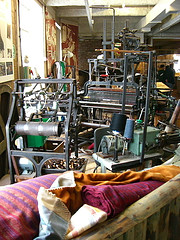
Cloth making machinery from the turn of the century by :: Wendy ::. Used Under Creative Commons
Trowbridge is a town in Wiltshire, which boasts a heritage in the wool and furniture industries. Yet they have only had a museum since the seventies that started out as room in a civic building for illustrations. In 1990, The Shires shopping centre opened and they gave a large room to the museum, rent free for 25 years, where large industrial machinery and historical artefacts can properly represent Trowbridge’s past. The building now occupied by The Shires was once a working mill. The developers saw benefits in keeping some elements of cultural heritage alive.
The museum is located “above” the commercial shop units. Walking past booksellers, opticians and the inevitable franchise coffee shop, the entrance to the museum is set in between them. A concrete stairwell and an industrial lift within a small alcove reminding everyone they are a museum and they are indeed open. A different architect or a different plan could have turned the museum into three or four storage units for businesses to have their stock rooms.
Shopping centres are part of this strange phenomenon that is forming a significant part of our lives as people become more transient. They are neither places to stay in nor spaces to travel through but “places to travel through”. Trowbridge Museum is located within one of these places, when normally museums are places in themselves. This is a perfect example of Museum Expansionism. A museum in an unusual position. “I went to the shopping centre and tripped over a museum”. When put in such context, such a location could be a risk. People go to shopping centres to shop, or to browse commercial items they mentally add to lists of Wants. How often do people go to a place for one thing and end up doing something completely different? This is a tricky statistic to fully comprehend. Trowbridge Museum puts itself in the way of that marketing term “Passing Trade”.






Latest Comments