Community Museum
In “Take Your Time, Olafur Eliasson”, Madeline Grynsztejn said: “The context between the cultural and commercial spheres over thinking and doing is one of the defining tensions in contemporary Western society. And the museum is the knife-edge location where this context is being played out, for there the conditions that determine or influence our sense of self are scrutinized in a conscious and concentrated way.”
Major art museums have been grappling with this question of providing a place for the public to look at themselves and their world through a non-commercial lens. As Ms. Grynsztejn puts it: “…we have arrived at a point when art, the museum, and cutting-edge commerce increasingly share visual modes of organizing meaning and express related ambitions to provide the individual with what have been described as “models of experience, opportunities for self-recognition, and the ingredients of identity”.”
One approach to maintain this identity space for the public (in large institutions) is to offer big, bold, and sometimes luscious immersive experiences- such as Eliasson’s. I’d like to talk about another. It’s a local, low fi, and nimble approach we’ll call the “Community Museum” model. Yes, along with farmer’s markets and food carts, museums have a place in the back-to-local world.
These are small institutions or ad-hoc spaces where the primary ingredients for visitor experience are: location, participation, elevation, and sharing. What they have in common is that they are more about providing a place for their public to shine and share, and less about suggesting what they ought to know.
In the Denver Community Museum, Jaime Kopke created a place for her neighborhood to respond to her “challenges” and participate in culture and identity- all in a neighborhood setting. At the San Francisco Mobile Museum, we are experimenting with taking the “making” and the museum to the neighborhood (and our first exhibit is a collaboration with the DCM).
When I began the Mobile Museum I wondered if it would result in a nuance on the “wisdom of the crowds”. Yet through the process of making and sharing our participants are having deeper experiences and deeper thinking about their world than they would have without it. They are also inspiring their peers (our visitors) to participate. These informal environments also fit their level of making experience. All together, it seems to fill a need for creating moments of intellectual pause and reflection for the public, as well as a platform for cultural expression by the curators.
In this small scale context, I see a world where the curator is also part journalist, part community ringleader. The visitor is at times audience, artist, and critic. The coming together of these two groups makes the museum.
Maria Mortati is curator of the San Francisco Mobile Museum (twitter: @sfmobilemuseum) and a Senior Exhibit Developer at Gyroscope Inc.
The Arts Council has a new website. Good thing really as I remember the last one being very difficult to get around. Now, they’ve gone for something feeling more like an arts magazine approach. It was clearly time for an image change. The Arts Council has been taking a bit of a kicking recently in a few mainstream newspaper articles.
To go with the launch of the new site, they commissioned artists Thomson & Craighead to make a short piece of video art, Several Interruption. Nice simple idea. I wonder who it was who would have said, “You’re the Arts Council, how about some art on the website for the Launch?”
Here is the Thomson & Craighead video. (Requires flash, Javascript to be unblocked and sound)
DISCLOSURE: Yeah, I get paid for you watching this video. I get a few pennies per play (all the way through, I think). This is the deal. You watch this interesting piece of video art and I get to pay my hosting fees. I promise to only do these things if they are relevant to newcurator’s editorial, so I won’t be running adverts for films or something. And I’ll say every time if I get paid. Deal?
Recently, I read an article about arts engagement, and a quote the author plucked from a poem by Aleda Shirley struck me as appropriate in describing the precarious position the museum assumes when exhibiting work that could or does stir up controversy. Shirley, in The Rivers Where They Touch, writes “Falling backwards from his boat, the diver would see, beneath the surface busy with leaves and eels, how the rivers don’t seem separate after all and perhaps tell us what night so often tells the pilot, the cartographer, the pair of lovers sighing from a bridge: that an edge is never a simple or a sudden thing”(1).
Without too prosaically dissecting the museum with this quote, it is useful to ponder the edges that arise neither suddenly or simply in museums, most tangibly in the intersection of values, rhetoric, and experience that is the art exhibition. At a macro-level, with the whole picture spread before us, when a museum exhibits art that could be deemed controversial or incite conservative ire, it is seemingly justified by how it communicates the goals of the institution as a space for talking about the “tough stuff.” However, from a staff’s perspective, often what we see is the here and now, a scary drop into the dark abyss ahead as we attempt to appease the public, to push the boundaries of art and conversation, as well as sate the aesthetic tastes of our funders. Navigating sharp edges that appear to push and pull in a myriad different directions. How do we delve below the surface, as the diver in Shirley’ poem, and see where these many currents fuse as one?
In response, I want to explore Marking Portland: The Art of Tattoo, a popular culture exhibit at the Portland Art Museum.

As part of the Marking Portland exhibit, visitors could stand behind this monitor and get pictures taken with superimposed tattoos on their bodies. This is another example of the museum bringing in the public as part to the exhibit and not simply as spectators.
I had the fortune of interning there this past summer and witnessed first-hand the public outpouring of support for Marking Portland, which was actually kept up for longer than planned because it was so popular. The show took place in what I call the thoroughfare gallery; the museum is two buildings and this gallery space connects the two in a long, wide corridor. Here, a projector screen was placed on one wall and images of tattoos were projected in a rotating fashion for the public to view. The photos were all publicly-sourced; the museum set up a Flickr account strictly for the purpose of collecting images of body art from Portland residents or whoever had a mind to post their photos. Every day, a crowd gathered in front of the screen and on the benches in the gallery for long periods of time, as if watching a movie. The statistic that states that visitors only stand in front of an art work for an average of 3 seconds, or an equally dismal figure, did not apply here. The shared authority evidenced in this exhibit allowed the public a conduit for contribution, and ensured that meaningful dialogue around Marking Portland was not simply the responsibility of the museum, but was shared by the public. Of course, not everyone who saw the show thought it was something the museum should be exhibiting. But on a larger scale, the museum must be commended for smartly attempting to connect the popular culture aspects of the tattooing with examples of tattoos in its ancient Asian art collection. For some, this helped elevate the topic from mere spectacle as it linked it to the wider art historical narrative.
Fiona Cameron writes, “In attempts to marginalise conflict, many institutions deny the inherent politicalness of topics and audiences and instead promote the public reinforcement of a particular set of values” (2). Here, Cameron like Aleda Shirley, is addressing edges, not simply from a safe aerial view, but below the surface where institutional narrative and community values are not so divergent. They can successfully be united around a controversial exhibit as the Portland Art Museum demonstrated through the shared authority that made Marking Portland a success and not simply another attempt by a museum to institutionalize popular culture or become a gimmick for attracting a younger, hipper audience.
(1) Katz, Jonathan. Understanding the past; Envisioning the future. WESTAF Symposium Proceedings: Re-envisioning state arts agencies, 71-78.
(2) Cameron, F. (2006). Beyond surface representations: Museums, edgy topics, civic responsibilities and modes of engagement. Open Museum Journal, August 2006. Retrieved November 1, 2009, from http://archive.amol.org.au/omj/volume8_index.asp
Megan Blankenship is a graduate student in the arts and administration program at the University of Oregon, blogs at MJ Writes, and is currently immersed in researching the role of the art museum in facilitating dialogue concerning controversial exhibitions. Questions, comments, and wine recommendations can be directed to mjwritesblog(at)gmail.com.
Konnichiwa. I have return from the Island Fortress Hideaway. It was very pleasant week all round.
For most of that week, I found myself writing a good few thousand words of a novel for NaNoWriMo. You can see my profile here. Add me as a writing buddy if you’re doing it too. I know, I am massively behind the word limit. But I think two good days and I’ll be back on top of it.
I may, at some point, start talking about it on here every once in a while. It is about museums and the future, after all.
I’ve neglected the various parts of the newcurator datashadow, so I’m probably going to be focussing on them for a while whilst I play catch-up. You can find me at:
Delicious – Where I throw the various articles that have caught my interest.
Tumblr – Mainly, something of a scrapbook for images. I don’t tend to reblog or use text that often, and I’ll follow back anyone who isn’t looking like a spambot. I think I’ve only blocked one person for being downright disgusting.
Twitter – My Almighty Pulpit to the Outside World. I’m over 2300 followers, almost at 2000 followings and rapidly approaching 2000 tweets. As for the dramatic difference in who I’ll follow back, it’s mainly down to the fact that I don’t have a clue who they are and what they do. I will always follow back any artist or museum worker. I’ve extended that pretty far to mean almost anyone associated to that realm. There’s a few culture magazines, many kinds of designer, plenty of freelancers and a variety of students in various states of graduation or employment. It would help if you told me if I should be following you. @ or DM me.
I still continue to block snake oil salesmen. I do love the “Report for Spam” button. I’ve also created a couple of lists, “Museums” will just be a short list of museums I’m trying to pay a large amount of attention to, and “Museum Shinobi”, which I hope will turn into a comprehensive list of people working within museums. I may make an “Artist” and a “Museopunk” list soon, but without a decent RSS feed on each list I’m in no rush to do it yet.
Facebook – This still doesn’t have a plan. It’s a great way of discovering artists though. I get a new one every day and I do like looking through their work. Otherwise, feel free to follow me. It seems to be used as an informal way to contact me. Not as official as a blog comment, not as direct as an email, not lost in the masses of a twitter response. I’m kinda happy with that.
Flickr – People make me a contact, I return the favour, the whole friends RSS feed going into my feed reader. So I see all. Otherwise, I don’t use it for much. When I use photos in blog posts (something I do rarely anymore) I look on Flickr and add them to my favourites. Otherwise, I don’t use it for much.
Last.fm – Haven’t listened to anything in ages. Will correct that today. Try to friend me on there if you like, but I will judge if I want your music in my Friends Playlist. Radio Newcurator is still plodding along. Someone keeps listening to a lot of 80s synth. The people in that group tend to know me in some form or we have something more than just a one-off contact. Don’t let that (or the 80s synth) put you off. Probably best to say if I know you on another network.
And of course, the Museopunk network. It’s been a bit quiet recently but I hope to kick it around a bit. Go join.
MacGuffins
Museums have been around in the real world for a while and a rich set of understandings and expectations have grown up around them. But the web is still something like a western boom town. We’ve tossed up some buildings overnight but we have yet to live in them for very long. Some are just facades.

Facade by Jeff Doyle. Used under Creative Commons License
So far museums have done a better job of putting their content online than they have of reproducing the social architecture and topology of “the old country.” With only a few notable exceptions, most museums web sites are not “places” in a way that even remotely compares to their brick and mortar counterparts.
My sense is that most museum web sites do a pretty good job on the content side compared to how well they do on the social side. Museums don’t necessarily understand the social function of objects and spaces in their own museums and thus aren’t able to reproduce those functions online.

Museum by Jeff Doyle. Used under Creative Commons Licence.
What is the role of this painting (Picasso’s Artist and his Model) and this museum (Pinakothek der Moderne) in these young people’s lives? I couldn’t even find this painting on the Pinakothek website, but supposing I could: do you suppose they would provide anything remotely resembling the same “value proposition” to website visitors the the physical museum is providing here? Has anyone gotten married to somebody they met at your museum website?
Museums are places to make passes at people who wear glasses. They are places to show off your new wardrobe, practice your French pronunciation, people-watch, eavesdrop, and show off the fun facts you learned about Matisse or the boiling point of helium, or just stroll with a friend…
It’s hard to do any of those things at most museum websites, though if you think about it, you can do some of them on Flickr. Flickr has done a pretty good job at turning digital images into social objects.
Sociologists speak of “boundary objects” serving as interfaces between different communities of practice. There is a sense in which all museum objects serve as boundary objects. But the interactions occasioned by those objects are phatic as well as interpretive. Objects serve as pretexts for both small and big talk. They are the MacGuffins of our personal and public dramas; they create social possibilities that would not exist otherwise.

MacGuffin by Jeff Doyle. Used under Creative Commons Licence.
In object-centered social interactions, objects play the role of the ball in soccer, the cards in whist, the book of “Launcelot” in the story of Paolo and Francesca, by Ingres (above left).
Obviously, people won’t do exactly the same things in online museums that they do in real museums. But they will certainly want an equally rich experience. And for that experience to have anything to do with a museum’s mission, it is going to have to include social objects. Otherwise we might as well go to bar or chat with our friends on Facebook.
Objects are props. They share a social space with humans. The social space they share is the museum.
Jeff Doyle is the Technical Director at Zirgoflex, who are developing the software that powers Open Museum Online. You can also read his blog and follow him on Twitter.
Describing herself as both artist and procrasinator, Haley Nagy made an immediate impact on me with The Nagy Family Cookbook, a beautifully evocative artist’s book.
Working in mixed media, with a real feel for using encaustic, Haley creates captivating work often addressing contemporary issues such as homelessness and cultural rituals like birthdays. The crux of her work is to explore the ‘hidden’.
In the photoessay series Saving Yourself: Steps to Preserving the Chastity of Adolescent Girl, Haley causes her work to interact with its audience by leaving dirty smudge marks on their fingers, in an exploration of the connotations of the word ‘unclean’.
It was difficult to choose only three pieces of Haley’s work, but I have selected the following pieces to show her range. The first is a detail from the artist’s book which first captivated me. The second is from her Seen but not Heard series about the homeless. The third (look closely) shows the subtlety of her latest work.
You can find Haley at her website, Flickr and follow her on Twitter.
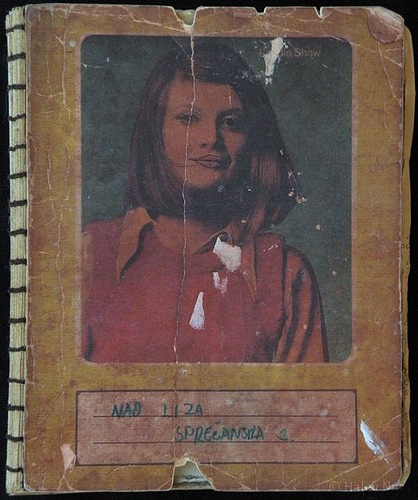
Cookbook Front Cover © Haley Nagy
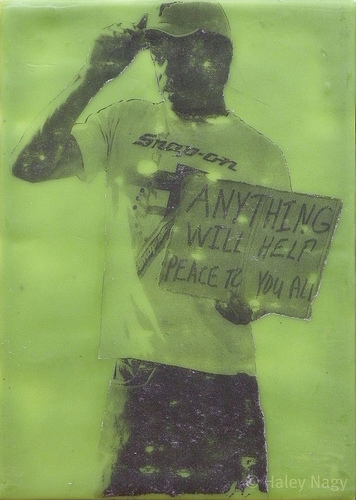
Anything will Help © Haley Nagy

Conceal © Haley Nagy
Participating Contributors
“The creative act is not performed by the artist alone; the spectator brings the work in contact with the external world by deciphering and interpreting its inner qualifications and thus adds his contribution to the creative act.” Marcel Duchamp
Say what you will about his art, Duchamp was right in his idea of turning spectators into contributors. While this is an important concept in art appreciation, it’s perhaps even more important as a survival philosophy for museums and historical societies.
From the beginning, museum spectators (visitors) have taken a passive stance in their relationship to their museum. This, it goes without saying, needs to change. The continued growth of social media tools can not only be beneficial in enabling museums to start intentional conversations with their visitors but also can be used to turn those visitors into participating contributors. It’s allowing visitors to do everything from helping to shape the direction an exhibit will take to supplying some of the content to be displayed.
The advantages to developing this relationship with the visitor are numerous. At the top of the list though may be the way that this entrenches a visitor within your (or perhaps more accurately their) museum. Additionally, a visitor with items on display is perhaps the strongest advocate a museum could have. With a personal connection to something to talk/Tweet/Blog about the contributing visitor is now not only part of the curatorial team but also part of the marketing unit as well.
Let’s look at a few examples of this concept. As you consider these remember that there are opportunities to integrate visitors through technology no matter the size of your organization.
One of the best examples can be found at the Ontario Science Centre. In a space that focuses on Toronto, they have an exhibit that explores the city by using a web-enabled kiosk loaded with a map from Yahoo! Maps. The exhibit encourages people to take pictures of themselves around the city, tag the photos, and then upload them to the museum’s Flckr account. These photos are then pulled directly into the exhibit map so that when the visitor tries to learn more about say the local coffee shop, the image that comes up is the one of that visitor at the coffee shop which they took and uploaded before leaving for the museum
In a completely different environment, The US Army created a mobile exhibit trailer for its recruiting efforts. When you enter the trailer, there is a touch screen panel whose initial graphic is a map of the United States. You can use that map to find your region and there watch videos which were created and uploaded to the site by other potential recruits.
At a different level, The Summit County (Ohio) Historical Society (in conjunction with other local organizations) has established the Summit Memory Project. It’s a place that allows people to share everything from postcards to first person accounts of the area’s history. People submit their photos and stories and then members of the Historical Society scan and format the material to maintain a consistency.
These are just three examples of many. While museums continue to work on social media as a method of communicating, there should also be equal time spent on exploring how those tools can be combined with existing exhibits or used separately as a standalone exhibition tool. If the goal is to move visitors from Duchamp’s passive “spectators” to participating contributors, what better way is there to do that then by re-purposing the tools they are already using?
Noell Wolfgram Evans is the Senior Writer/Producer at Mills James. You can follow him on Twitter at Noell_MJ. He can also be reached at nwolfgramevans[at]mjp.com
For one week only, Museopunk Thursday will move to a Monday. There’s still lots going on over on Museopunk.ning.com and we are now up to 63 members which is brilliant. This week:
Introductions continue: please do chime in if you haven’t yet.
Jeffrey_r wants to know Who’s on the Twitters? as do the rest of us.
There is a review of the Steampunk exhibition in Oxford. Have you been to it yet? Tell the rest of us what you thought.
There is an interesting discussion started by Erika Dicker about being the official blogger for your museum. It would be great to hear from more of you on that.
All this and also digitisation, unconferences and even some music videos just for fun.
Head on over and join up if you haven’t already.
“I want to be in New York City,” said my friend Paul Slocum, who ran a predominant new media gallery in Texas called And/Or. I’m definitely thinking about what he just said. No one is born in a small market that doesn’t dream about being able to move to New York or Los Angeles and thrive. It’s romantic; the whole art world is full of that romance stuff, and so few of us do anything but dream about what could be.
I look out the window and see the storefronts around the gallery space, thriving a few years ago, now mostly empty, with little hope now that the art events will feed them with people. I don’t think Paul knows what he gave to everyone around him, but with the economy, and the limited amount of people in his field working around him, he felt it was time to move on.
If it wasn’t for And/Or gallery, I’d never have seen a physical Corey Archangel piece, I wouldn’t know who Micheal Bell Smith is, I would have never encountered JODI in a gallery setting, and I wouldn’t have thought YTMND’s could actually be transformed into a quirky show. If it wasn’t for his small gallery endeavor, I don’t think the digital art scene in Texas would even be what little it is. Paul worked like a shaman, spinning the air of technology around himself and drawing us all into his web of laptop death matches and 8-bit chicanery. He is always calm, calculating, and smart, and the few months his gallery has been closed have felt like a black hole ripped open in the fabric of our little regional continuum. I feel like those of us who are staying behind are holding our breath and wondering if the promise of budding art communities in smaller cities – once a hot spot of attention – will continue to have any relevance now that the patrons of the big art markets are feeling the money pinch.
The rest of the country is feeling it too; weekly you hear about another gallery shutting its doors locally or in one of the larger markets. The people who tell you “hey did you hear XYZ is closing” look at you with watery, fear-soaked eyes, like they want a solution and just don’t know what to do. The answer isn’t that simple. As long as the United States art community refuses to do anything but hold onto the traditional gallery setup, which lofts anything displayed in a few overpriced and barely livable cities, things are going to take a very long time to recover. The investors who fuel the art market just aren’t going to invest when times get tough. Galleries and artists seem to respond to this by just bearing down and hoping that if they can forge the long winter, things will be fruitful again when the ice thaws.
I can’t help but look at And/Or’s doors closing, its contribution to the small scene it was in, and wonder if more people would be willing to just put together shows right now, in any space – virtual or physical – if this would help push more artists through this difficult time. Paul’s space was never doggedly traditional, and he paid for it with a day job and by living in a closed-in area in the back, but what he did that was amazing was expose otherwise isolated people to new things. He brought in artists from around the country and world, and I don’t think this is something local collectives, online collectives, or progressive people should be unable to do. After all how many artists have Flickr accounts, YouTube channels, twitter, etc? How many artists are just an e-mail away? If the art world wants to thrive instead of just falter, it needs to start thinking about working together in less ordinary, and more extraordinary ways.
Vanessa VanAlstyne is a digital artist in her third year of an MFA. You can see more of her work on her website, her blog and follow her on twitter.
In the last Listen to the Gears, I talked a lot about research, dissemination and perceived value for money. Really, it seems it is all about Impact. Unusually for this column, I am going to discuss only one podcast. There was a very interesting panel discussion, recorded at the recent Cambridge Festival of Ideas and put out on the Guardian Culture podcast. In ‘Austerity for the Arts?’ four British arts professionals considered the state of arts and culture in the UK in the light of the recession.
Sue Hoyle discussed the economics of mixed funding and the decline of arts funding at a local level. Calling for strong leadership in the arts, she championed those who would innovate and not just keep chugging along the same way people had done it for years because ‘that’s the way we have always done it.’ Huge changes in funding need to happen, but someone has to be strong enough to take those risks.
Peter Florence from the Hay Festival made a very good point: the arts did not end in the 30s/40s/50s. Austerity in itself is not bad for the arts. He’s right. Creative people are not going to stop making/writing/creating just because there is little funding for it. Florence again stressed the importance of finding new and creative ways of funding and claims that people in Britain are good at this due to a very rich cultural education. In fact referring to the SAS in the first instance and bemoaning the Olympic bid he uses the marvellous line:
‘We are not world class in anything other than killing people and culture’
So, that’s our impact then? That is what we are known for? Help me out here, rest of the world! Really?
Sheryl West from the Arts and Humanities Research Council (one of the main funding bodies in the UK) addressed the impact of the cultural sector in her talk. What can the public be seen being done? What is the impact of their research? She argues that academics and arts professionals need to demonstrate the value of funding to the taxpayer more. So, how can we all do that? Make it more accessible? Would websites work? TV programmes? Exhibitions? Blogging?
Oh. Hang on a minute. Remember how they don’t like that? What to do? It seems there are polarised debates on Impact – some say it is good: tell everybody about what you did and how it can help them! Some say it is bad: keep your head down and only publish it in esoteric journals. West argues that there are real problems with academics being too embarrassed or modest about their research, so nobody gets to hear about it. She also hits upon the same problem with dissemination that I discussed last time: namely that academics are not rewarded for impact but for things like journal based research which mainly stay within the academy. Her ending statement is this: ‘In a period of austerity we need to OWN the idea of impact and get behind it.’ So, in museums, galleries and other cultural institutions, how does that affect us?
What do you feel about impact? How do you measure it? Is it to do with money? Value-for-money? Visitor numbers? Is it how much outreach you can do in the local community? Or for your institution is it about how many journals your staff can get published in and how much funding you can get from that? Or do you even think that you can measure impact?
As you know, Pete is away this coming week. If there is anybody who would like to write a guest post, you can reach me at August(at)newcurator.com. Tell me your ideas for the future of museums. I’d like to hear them.
I’ve got a few things I need to do this week, including a much needed tidy-up of the top right of this site. Then I’m basically be off-grid for a week as I’m leaving the country for a week.
I will be handing the keys over to August for that time with the only instruction of “Go nuts”. Should be interesting.
It would also be really good if there were some guest posts just to keep things ticking over. I don’t like getting overly editorial, nor do they have to be very long.
As a set of guidelines, I like articles about the future of museums or strange underground movements in the museum world. I do like opinion pieces if they’re about a really interesting topic. I don’t exactly have a list of what I don’t want, apart from I try to avoid review-style posts.
Ideally, I need to get this all set-up and scheduled before I leave. Email pete(at)newcurator this week if you’re interested.
There were plenty of fascinating and diverse topics to listen to this week, but I am drawing these together in order to think about two tier systems.
New policy and technology podcast, Surprisingly Free Conversation had an interview with Tim Lee. He advocated for bottom-up processes where nobody is in charge (eg wikipedia or linux) rather than top-down processes like government (or microsoft) where you can easily lay the blame on one entity, which we seem hard-wired to do. In discussion, they considered the inefficiencies of top-down organisations, but realised that it would be hard to run some of them bottom-up.
It is an interesting concept to think about in terms of cultural institutions. Are most museums bottom-up or top-down systems? I think that there are probably both out there and also many shades of grey inbetween. I would suggest most are top-down systems: we’re always having to get permission to do something, aren’t we? Collections management systems are one place that bottom-up processes take place in a lot of museums. Records can be added to and altered as time passes. How could bottom-up systems be spread to other areas of museum and gallery running?
Also somewhat tied into a two-tier model is the dissemination of research. JISC talk about the recent report ‘Communicating knowledge: how and why UK researchers publish and disseminate their findings‘ published by the Research Information Network. What emerged is the same old argument about the traditional versus the new. Once more it all appears governed by money and what they described as the ‘value-for-money aspect’ of research funding. The report found the continued dominance of journal articles as a ‘highly legitimate form of scholarly communication’. This basically means that it is the method of dissemination which will attract you the most funding. Tell us something new?
They went on to discuss the ‘more rapid dissemination’ of conferences, briefings and working papers (still pretty traditional, there) and only latterly digital technology. For people who were debating something on a podcast, they didn’t seem to think that digital technology was all that great as a tool for publications or publicity. That given, they did admit change needs to happen, but that in research and academia these things take (aeons of) time to catch on. Apparently the theoretical physicists are blazing the trail with their wikis, blogs and podcasts.
I think museum people are pretty good at doing this too. How do you all disseminate your research? If it is via the more traditional methods, do you additionally get it out there via digital technology? If not, is it because it won’t attract the funding, as suggested? I’d be interested to know how this has affected your research.
Lastly, something on a lighter note. You might well wonder why I am asking you to watch Threadbanger‘s video tutorial on how to make a Michael Jackson costume for Halloween (apart from that you might be looking for costume ideas for this year). Real reason is: I would love to see this kind of tutorial for costumed interpreters or museum re-enactors to use. It challenges the notion that you have to spend exorbitant amounts of money to gain good costumes. There are so many people with making skills and with a little appropriate research, what a resource it could be for museums and freelancers on a budget.
There’s three neologisms I’ve been kicking around on this blog. This is them together into one place and maybe separated out a bit.
Metrocurator
This came from a story about a couple of artists who turned an architectural blip (in this this case, an empty gas meter box thing on the side of a building) and turned it into an art gallery. It dawned on me that a decent number of these type of displays could make a “street museum”, in the same vein as “street art”. Not as an outreach project or fluffy “museum-without-walls” intent, but as a museum spread across an entire city.
What is the biggest resource and the biggest outgoing a museum has behind objects and staff costs? A large building that needs maintenance, heating, lighting and a number of things that are only for the building, not the museum. A Metrocurator, I suppose, is a design response to the scenario of having a completely decentralised base but still keeping high levels of access to objects and information (as opposed to displaying objects in other kinds of building i.e. banks, hotels etc.) The idea is to be as highly modular as possible.
Being a Metrocurator also means having a decent understanding of architecture of the city as a whole. There’s no convient blank walled space to act as a neutral framing device. Location and juxtaposition will be additional contexts. Just like architecture, be aware of resorting to Libeskind-style spectacle. It may not get away with it. This includes dropping a cargo container into the middle of a street and trying to claim it as a Metrocurator project. This is just substituting a building for a different kind of building, be it a temporary one. Also, a cargo container/cavavan/kiosk would be unusual and out-of-place, thus acting separately from the city it intends to meld into.
Two things. This could greatly increase access. Take as many objects as possible and put them out there into the populous. Let someone else be innovative with security and conservation. The other thing is how easy this would be and how little money would be needed. This could be run like a start-up. Without constructing/renting a building, the core of a museum mission could still be obtained at a fraction of the cost. It just means some other changes to the system.
I remember describing Metrocurators as: “lightweight, deals in very little bureaucracy, has a DIY attitude because of very limited funds and basically is running all over a city pushing small outbreaks of museums into public spaces.”
You can see where I need to seperate the definitions a bit. A Metrocurator can or not be a Museopunk, but a Museopunk doesn’t have to be a Metrocurator.
Museopunk
A DIY attitude is very Museopunk, and kind of makes sense for a start-up Metrocurator. But if MOMA released a bunch of Metrocurators into New York with a ton of cash behind them, they could probably get the job done. Same thing with bureaucracy; a Metrocurator wants to deal with as little as possible. A Museopunk wants to change bureaucracy to allow for greater freedom of innovation, especially in reaction to failing “cookie-cutter” models or corporate interests.
Museopunk borrows from, and probably partially overlaps, Edupunk. This word encompasses all museum parts with a punk notion. Prezpunk, a punk outlook on conservation. Who ws it it that said “Curatopunk”? Sorry to who said it but I’ve lost where that came from. I came up with Registrapunk to cover the punk approach to collections management.
Personally, I’m seeing the best of Museopunk innovative thinking coming from the wannabes, the bottom rungs or the outsider freelancers. I suppose these are the people who want it the most and want to succeed and see an entrepreneurial approach as the way to do it. That is to say that there isn’t a lot of things going on in museum institutions that could be considered Museopunk. Involvement in the Creative Commons for one. Putting CC licenses on photos or entire documentation records. Building your own software. Not getting overly involved in these ready made blockbuster exhibitions that are put together and sold as a packages (I want to call them “Microwave Exhibitions”).
In my opinion, Museopunk is a reaction and a desire for museums to regain some of that soul. Which goes onto my next concept…
The Mutant Curator
Yeah, allow me my over-dramatics.
I can barely go five minutes without reading something that says Duff Media X needs to be like Just-as-Duff Media Y to create a Supermedia because Z is like a Curator. Newspapers needs to be like magazines because of Tyler Brûlé. I liked Joanne McNeil’s idea that publishing needs to be like record labels because of Tony Wilson. Music needs to be like theatre because of Amanda Palmer. This needs to be like that.
This may just be endemic of the transition stage of all media. Digitising audio and visual information is collapsing the old boundaries of solid state media, making them splice together towards the inevitable interconnected Superabundance of information. The Media Soup.
It’s down to personal opinion if this is a good thing or not, but the thinking is that we will then turn to Mutant Curators to sort through it. People with influence or celebrity or hero-status will tell us what music to buy, what news or commentary to read, what beer to drink and more importantly, who else to listen to.
I mean, thanks for being a filter against the InfoShock and all, but this is how cults start. Twitter will become a compound to preach. Remember, we are their “Followers”.
—
Museopunks and Metrocurators are going to be up against the oncoming beast that is the Mutant Curator of convergence media. One of the main reasons I use the word “mutant”, apart from it being the bastard offspring of the All-Media, is that it will mutate the word “curator” into something that is a shadow of the original meaning. The New York Times got it wrong. Curator doesn’t mean selecting and culling nor does it mean “I have a good eye”. It is a job. With Skills. I would have thought the journalist writing that article would have been more sensitive to the misappropriation of a title to the lowest common denominator.
Museopunks and Metrocurators are, I believe, a way for those skills to survive.
I’m wondering if there’s a book in all this.
Just throwing this idea out there. Hopefully someone with greater economic knowledge will come up with some points.
I’ve been thinking a lot about the Brixton Pound, and other similar attempts of community currency. As described on the organisation’s website behind it, the B£ is intended to help promote local businesses during recession. Money that sticks to Brixton is the tagline. From a BBC report:
Proponents of local currencies say they boost the community’s economy by keeping money in the area, but critics dismiss them as fashionable gimmicks, tantamount to protectionism.
“A local economy is like a leaky bucket. Wealth is generated then spent in chain stores and businesses. It disappears leaving an impoverished local economy,” explains Ben Brangwyn, part of the team behind the Totnes Pound, launched in south Devon in 2007
The report goes on to talk about the problems (and there are some great ones in the comments), the fundamental one being that they are seen as nothing more than gift vouchers.
It is just gimmicky? I think there a certain flaw in restricting use to an area, but think about Book Tokens. They helped promote the giving of books as presents (especially when it was difficult to be certain what type of book to get). So why not promote visiting museums? Use them either to pay entrance fees (Yes, many UK museums aren’t free), for tickets to special exhibitions (like in the Nationals) or use them in the shop.
I’ve not been able to find such a scheme. I’ve found vouchers for individual museums but I think it needs to be on a wider scale. It may work locally: museums/cultural institutions of an area/state/region could form a partnership to accept these. I think it would work best on a national level. All museums in a country accepting and issuing Museum Currency. An international Museum Currency would be even better.
I’m sure there could be a better name. Museum Denarius? Go for the historical reference?
This is for the UK, I’m afraid. I don’t know if there’s an equivalent in other countries. I wonder if it could be possible if the Museum Currency was an automatic declaration for Gift Aid, which is tax relief to increase the value of a donation. I do know some museums do this on an entrance fee. Yes, yes, I realise that it’s not that simple.
Comments welcome on this. I think there is a lot of scope for interesting things. A new “currency” could be dismissed as a marketing ploy or just for tourists. Well, it would benefit museums by being just that.
Earlier this week I had a conversation with an American colleague about (amongst other things) the British way of holding your cutlery and the comedy value of the thing in my garden that I call a water butt. After we had stopped laughing we got into a discussion about the extent that your own cultural background and the way in which things are presented to you affects personal interpretation. I kept this in mind while I was listening to and watching the gears.
The designer Stefan Sagmeister gave an insightful TED talk about the power of taking time off. He closes his design studio for a whole year every seven years, explaining that he is ‘…shifting five of his retirement years to his working life for greater creativity’. I really like that concept, and maybe one day I’ll be able to afford to do it too. Sagmeister spent his first sabbatical in New York, trying to look at his adopted hometown differently; his second in Bali where he made t-shirts and furniture inspired by the ubiquitous stray dogs. In an entertaining presentation he tells of how subsequently he ‘felt closer to design’ but also went on to make art inspired by his time out. Particularly striking are the products of the logo generator and his numismatic art which was ultimately taken into custody by the police.
Fostering creativity was also the topic of KCRW’s DnA podcast. Their case study was Central LA High School Number Nine (better known as the School of Performing Arts). This controversial building was discussed by its students, teachers and the architect Wolf Prix. He had wanted to create a ‘reference point in the city,’ that would inspire creativity not only in its pupils, but in the general public too. Can a building inspire creativity? Or is it about the people who are involved with its running and use? The building could be seen as a container for the creativity which goes on within and around it. Does it actually contribute though?
If you take as a basis the way a frame acts around a painting then yes, the building can and probably does contribute something. NG director Nicholas Penny talked about the way frames interact with images in the National Gallery podcast. ‘Frames isolate the picture [and] therefore they affect the way we view art.’ Using a case study, he discusses how frame colour and decoration affect our perception of paintings.
In addition to talking about the practical aspects of using frames, Penny advocates telling the gallery public whether they are looking at an original frame or not. But how important is this really? It is not something that I have ever really considered. However, our perception of a Mondrian or a Gainsborough will be altered by the way in which we view it as a whole. By this I mean that the frame is as much a part of this experience as the information on the label, the colour of the gallery wall or even just having somewhere to sit and look at it. If there was simply the canvas itself, our personal interpretation may be different (like viewing a painting online in white space, you might say). So in thinking about the artist’s original intention: this might be entirely altered by our viewing it in a non-original frame. We could be taking a wholly different experience away with us. Does that matter? Or do we do that anyway, simply by all coming from different backgrounds?
Every Thursday will have a bit of a summary of what’s going on over at Museopunk.ning.com. All my notes, links and discussions on the Museopunk subject are going to be on there rather than on newcurator.com.
Really happy with how its going so far and very pleased with who has signed up. Feel free to sign up and join in the conversations.
* Introduce Yourself – Everyone’s announcing their arrival
* Your Definition – People are airing their thoughts on what Museopunk means to them without forming manifestos. It’s a bit rambling and side-notes at the moment, but I like it like that.
* Paul Orselli: Museopunk – If there’s anyone who has influenced Museopunk before I made the word up, it’s Paul Orselli.
* Video – Dan Cull has uploaded a ton of Edupunk stuff. Good reference points.
Just gathering things together.
* There will be no manifesto, at least not from me. What kind of -punk would start off by laying down some rules anyway?
* Dan Cull has written about Prezpunk ethics and uses big words like “consequentialism” or “deontology” but importantly concludes that “ethics” should be one of “process”. There’s six things at the end of the post that I like.
*I feel that the Museopunk approach to ethics would be to “make your own rather than slave to someone else”. Steal, adapt, change and share. Find freedom in your code rather than submitting to outside influences.
* Don’t be scared to not be part of a club.
* Playwright Howard Barker on his theatre losing its Arts Council funding: “”You can’t tick the boxes if you aren’t doing the work they want. It’s not about art, it’s about sociology. We always fooled the Arts Council by pretending that we were doing things we didn’t do, but, of course, we were going to fall foul of them at some point.”
* Interesting side note; Tweepz, which came from Nina Simon’s delicious feed. It searches through the bio text of people’s twitter accounts. Search for “museum“, get just over 2000. Search “museums“, get around 600. This will include all those who list these as nothing more than an interest, but aren’t you surprised at how small that number is? Under 3000? Now lets knock out those dead accounts and those accounts used as nothing more than press release mechanisms. Let’s guess at a number of actual people actively involved in the museum-twitter community.
1000?
Now, how many of them are freelancers? Students? Graduates? Or just starting out? Now think about which museum-twitters are the most interesting to you?
* Museopunk, like Edupunk, is about priorities. Edupunk puts education above that of corporate and financial interests. The museum world seems dominated by these interests. If the money is tight then staff are the first to feel it. If the funding can’t be found, then the action doesn’t happen. The Museopunk will go and do it anyway.
* The Ohio Historical Society… Just… God, now they’re making stickers.
* At some point, I’m thinking we’ll need a Museopunk toolkit of technologies and applications.
* Also, I need to do a compare/contrst of all these neologisms. I’m thinking the metrocurator and museopunk concept could work without many problems but I see how the “Mutant Curator” (or “Content Curator”, as its known in more grown up circles) will cause problems.
* The Mutant Curator, seen by many in the media industry as their future and saviour. They notice how there are certain people on the Internet (Warren Ellis, Xeni Jardin, etc.) who can drive traffic via their own interests, acting as human filters to the superabundance of information (especially on twitter). 2.0 sites like Digg are crowd-driven and a bit faceless, so the old meeja likes the idea of an actual person (and a paycheck) “curating” the news. This only works with a pedestal. Doomed industries like pedestals. They can put a price on pedestals.
* The Museopunk does not want your pedestal. The Museopunk will make their own.
* Museopunk.ning.com – An open-to all ning site that I’m still tinkering with/breaking as we speak. I think there’s a need to discuss Museopunk and unpick it a bit and create a knowledge base/toolkit.
There is a lot of interesting discussion about copyright on the airwaves at the moment.
Charles Arthur from Guardian Tech Weekly interviewed Joi Ito, CEO of Creative Commons who talked about the different levels of licencing available and how they might be used in different situations. Of course, Creative Commons is of most use in countries which are concerned with enforcing copyright, so it is not necessarily of interest worldwide. Those who do use it to effect include Ridley Scott, the White House, Al Jazeera and the Powerhouse Museum (amongst many other museums), whose case study makes interesting reading if your museum or gallery is thinking of contributing to The Commons on Flickr.

View of Woman Holding a Fancily Decorated Bicycle from the Powerhouse Museum Collection, used under Creative Commons licence.
Ito discussed some of the cases which had come to court recently involving Creative Commons licences: it was ruled in the US that breaching a Creative Commons licence was a breach of copyright. Will this now make Creative Commons seem more safe as the law has been tested?
As an investor in Twitter, Ito also addressed the growing push to monetise the service as part of a general discussion of business models and friends networks. That is a whole other discussion which there isn’t room for here, but is worth listening to for the latest developments.
If you’re in the UK, keep listening. The second segment of Guardian Tech Weekly discusses putting together a new BBC programme about the impact of the last 40 years of technological change on the British family. In researching for Electric Dreams, Gia Milinovich visited the Centre for Computing History’s Computer Museum in order to find the most appropriate technology for the family to use in each year of their realistic-as-possible journey. Some interesting observations were seen during the programme’s making including the apparent confirmation of a 1980s gender divide in computer use. I wonder, is this kind of social phenomenon reflected in computer or science museums?
Mark West’s The Mr Science Show branched out this week into enhanced podcasting in order to give a slide show of photographs. West had been affected by the red dust storms in Sydney and illustrated his meteorological explanation using some amazing Creative Commons photographs from Flickr.
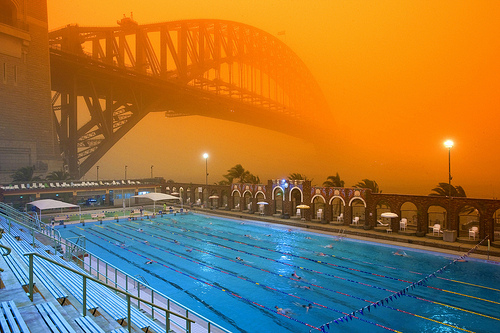
Sydney Dust Storm by Ianz, used under Creative Commons licence.
Lastly, I think it’s pertinent that you all see this Monocle Culture video about Alfred Sirleaf, a newspaper editor in Monrovia. Each day he writes up the Daily Talk using local vernacular on a large blackboard outside his office, in order that the people can have access to the news where otherwise they could not afford to.
You can contact me at August(at)newcurator(dot)com
I’ve been involved in discussions about what punk is before and they’ve never ended nicely. You’ll always get arguments about authenticity, terms like “true punk” or “real punk” get thrown about and soon afterwards someone makes the statement that everyone else is wrong.
I will hammer anyone who tries to push this discussion into those terms. Go take it to some record shop or music forum. I realise the term is weird and wide-reaching, but I refuse to get bogged down in semantics.
To avoid this happening, I threw the question out on Twitter and Facebook. What I’m more interested in is “punk” as a suffix. Cyberpunk, Steampunk, that kind of thing. I wanted to make sure I was going to speak about something that there was a general consensus on. Thanks to everyone who responded. The same kind of words were appearing, if not slightly different takes on them. Things like “Rebellion” or “Alternative” came up, but a general sense of an underground or fringe/”not mainstream” approach. Sarah Anton (Phillyspice on twitter) said that “It could be a desire to explore the new, desire to push boundaries just to do it, etc.”
I dunno about any solid definition, but this will do as a basis for what I’m talking about. There’s a reason people write books about this sort of thing. There’s also a reason why people hate the use of “punk” as a suffix as it is, that every use bleeds anyway any real meaning.
What a time to then introduce the concept of Edupunk.
I also plan to annoy these people even further by stealing including what Dan Cull called PrezPunk (I suggested AcetonePunk).
In the true spirit of using a punk-suffix that has no link to the original meaning except an overused statement of rebellion and promotion of the alternative, I offer Museopunk.
What does that mean? This is the exciting part: I’m not sure yet. I’m not going to put forward anything like a manifesto. Lord knows we have enough of those flying around and they barely make any difference. We live in a time that’s beyond manifestos. I guess this is why I like the -punk suffix. It’s not laying down the rules in stone.
I’ll tell you something, I think we’re creating a generation of Museopunks. There’s too much talk of museums and money. Endless securing of funding and applying for grants. Corporate sponsorship or government criteria. And when it all goes wrong and money is diverted away or philanthropy ain’t what it used to be, don’t you wonder when museum’s lost their soul? Dan Cull said (on Facebook) that “punk” is about the community over profit margins. Well, for a non-profit sector, we sure are concomitant to profit-making world.
I imagine the satirical situation, where a museum staff spend all their time applying for funding so they can get paid to apply for more funding.
I don’t want to get to that.
Yet, it seems to me that some of the most interesting people I have spoken to because of Newcurator are freelancers, graduands/post-grads, those barely starting out or clinging onto the bottom rung. This is where the Museopunks are. They have some of the best ideas and the most energy yet they aren’t very high in the hierarchy.
Notice how I don’t say, “they don’t make much money”? We do it for love, not the money. As Paul Orselli points out, the upper echelons are all about fundraising anyway.
Something I’m not going to go into (because it needs more research/questions) is the innovative uses of technology and a strong belief in keeping things Free. This, as you can imagine, is almost another article, especially with the Tories in the UK making noises about how they plan to stuff culture but also the soon-to-be-widely-available museum APIs. This makes me instantly think about John Robb’s Standing Order 11: Co-opt, don’t own, basic service, which at the time I couldn’t make much sense of in the museum world. This requires further thinking.
Edupunk is about the anti-commercialisation and DIY attitude for teaching and learning. Dan Cull’s Prezpunk focused on conservation, citing many community projects, which I liked the idea of deinstitutionalised . I’d say Museopunk overlaps Edupunk a bit and encapsulates Prezpunk, so there’s a lot more -Punk to fill, and I’ll admit that Nina Simon probably has a few things covered.
But when you think about all the functions of a museum or a curator, nobody in those two Wordles said anything about making money.


Latest Comments