I’ve been keeping an eye on this business of Southampton City Council selling off artwork from the collection in order to pay for a Titanic Museum/heritage centre. Mainly because I hate the idea of politician meddling in collection management policies. Also because Southampton City Council hasn’t exactly been stellar in its stewardship of the museums it already has.
Not that local paper has helped. I swear, if you a sample of the most philistine opinions possible, check out the comments section of the reports from The Daily Echo. I had to laugh at the suggestion that the Southampton City Art Gallery, which is free to enter, was “elitist”.
When it comes to deaccessioning debates, I may have got too caught up in the US version. I like the idea of museums being able to further their autonomy. I like the idea that collections could be made more precise and that objects be made available to other museums. I like the idea of a process that means museums don’t have to hold onto something for the sake of holding on to it.
This is where I neglect the UK aspect: I hate the idea of elected officials sabotaging museums to meet their own ends, especially with such short-term prospects. Make no mistake, this is not art to be sold for a Titanic Museum. This is art being sold to get politicians re-elected after they can show off their new tourist attraction building.
Thankfully, it seems the councillor who set up the Southampton City Art Gallery had the same thoughts. Robert Chipperfield made sure the Tate was consulted in anything concerning his bequest. Now that this museum heavyweight have made its feelings known, the Museum Association (who have been surprisingly quiet) have also said this risks breaching ethical guidelines.
I’m part of the Save Our Collection facebook group, who have done an excellent job on keeping everyone informed. They organised protests, petitions and even had someone on Antony Gormley’s plinth holding up a cut-out of Rodin’s statue. I’m really pleased at all they’ve done and proud to support them.
But this will only happen again soon. Some other council without any foresight will start targeting collections as some sort of plunder-able resource. It will continue until the Museum Association does something and states that elected officials cannot make deaccessioning decisions and that all such decisions must be made by museum institutions alone.
‘What’s the real story, then?’ asked a man of his eight or nine year old grandson, who had said that the museum’s text about the portrait of a 16th century gentleman farmer ‘wasn’t right.’ The boy told him an epic tale of bullfighting instead. It was fascinating to listen to and underlined for me the power of images on the imagination.
Photographer Taryn Simon’s recent TED presentation was about her work taking images of ‘secret sites and worlds we wouldn’t normally get to see’. She discussed two projects: photographs of other-wordly, behind-the-scenes locations, and wrongfully convicted people at crime scenes. Simon is interested in the multiple truths attached to images and opined here that the viewer’s perception hinges on the intent of the creator. She brings forth some compelling ideas about the use of photographs in criminal convictions for instance. In explaining the intent behind her own photographs, she outlines her own intent in presenting them, but what if she didn’t? What would we think? As she suggested, I would bet that it might not be exactly what she had just explained to us. There are always other stories surrounding the work: the idea of the other, the alternative.
The reading of art changes over time and with new evidence or thinking comes reinterpretation. Traditionally we learn from art historians about the meanings behind works. ArtBabble’s newest partners, SmartHistory made use of new technology to present a different kind of discussion about classical art. Describing themselves as a ‘dynamic substitute’ for traditional art history learning, they used Second Life ‘correspondents’ (real-life art historians) to interpret using a recreation of Michelangelo’s ceiling to the Sistine Chapel. In conversation they explained its significance, making, which techniques were used and focus on particular scenes, all of which you might expect from a traditional lecture. What made the difference is that it being Second Life, it can be viewed in the round and they can also fly about to see things close up. I would love to see this used to greater effect giving alternative explanations and with opposing historians and interpreters having debates in-situ in Second Life.
Or what about some children giving their opinions? In the Our City podcasts, schoolchildren made recordings about their hometowns in a worldwide learning experiment. I do wonder how much input the children have into what they think is important in their city and how much the adults guide them. The episodes I have listened to describe their cities in rather pedestrian terms. Whilst I realise that there has to be guidance, they could use the children’s own language and creativity to a greater extent.
This leads me to an idea. Make a podcast wherein children could to tell others about both the real and imagined stories of the paintings. What would it be like to step inside a Gainsborough or a Mondrian. Would it be hot or cold, would there be other people or creatures in there? What might have happened just before that captured moment? This could lead to a large-scale outreach project set up between museums and galleries worldwide to supplement traditional art history and promote wider engagement between children and paintings.
There was a storyteller in residence recently at my local gallery, as part of an archaeological exhibition about the Stone Age. Performing at the height of the school holidays, he held swathes of children rapt with tales of hunting, fishing and trading. More than the life-sized wall painting of a mammoth or the guess-the-smell-of-the-stone-age boxes, he really brought the period to life for the visitors. They could ask him questions and recieve an accurate answer (I believe that he was an archaeologist who was also an amateur actor); they could see how a Stone Age person would dress and how he would use weapons. But none of this would have really come together had it not been for his verbal delivery. That made it come alive.
I have already addressed what makes a ‘good’ podcast (for me). I came up with a number of suggestions for ease of use and interest. One thing that I didn’t mention was the perhaps the most important: the style of presentation. When listening to podcasts and watching videos, I’m sure you notice as I do that no matter how interested you are in the subject, sometimes the presenter just bores the pants off you. That’s when I find my mind wandering from the latest developments in exhibition design to what I’m going to have for dinner, or what might be on at the cinema. This is clearly not what the makers of these media intended.
One of the most charismatic podcasts for storytelling that I have found (well, apart from The Moth, of course) is The Memory Palace. The latest episode reported on German prisoners of war escaping an Arizona prison camp in the 1940s. While this might not sound all that enthralling to you on the face of it, the presenter Nate DiMeo has that same great delivery as the Stone Age man. This coupled with an evocative backing track that lent itself to the spirit of the story really kept my attention.
I think it is well worth museums utilising people who can deliver the stories into museums and galleries to bring their exhibitions alive: even if only for special events. Get your podcast-makers to lay more emphasis on the delivery of the content too. The podcast and its presentation is one more layer of the interpretation, and one which needs equal standing with the gallery exhibits. In fact, it could even be just one part of the whole of the exhibit or collection, where you have to listen to the podcast to gain specific information in a museum version of transmedia storytelling.
I like to think of it like this. The most important person in the museum for the visitor is the assistant at the front desk who can tell them about that day’s tours and events, why the museum has loads of Simian ware but little flint and where is good nearby for lunch. The most important person to the podcast listener or video viewer is the presenter. They are the public face; the first impression for the whole outfit. It’s all in the delivery, people.
You can contact me at August(at)newcurator(dot)com.
* Catherine Manning – To act as ’story keepers’ and to encourage people to interpret the world we live in from different perspectives.
* J@simpleposie – To risk being with the art, immediately and contemporaneously and to offer it in that spirit; to love showing art to people.
* Max Rhino – To ensure the proper balance between preservation and accessibility for a given collection; to act as a subject matter expert available for consultation by anyone requiring information.
* Perian Sully – To mediate between raw experience and information. To give material culture life and uncover new paths for uninformed and informed minds alike to travel.
* Karawaane – To help the development staff fund raise via smart & engaging shows/programs/etc.
* Steve Smith – Provide Context. (To, for,and with an Audience. Driven by Mission. Within the limits of space, budget, time, and technologies.)
* Kirsty Hall – Placing artists and works in a new context that encourages a deeper understanding of the art.
* JenniferNg – To challenge audience to new knowledge, or to think about existing knowledge in new light using the most effective means possible.
* Mia Ridge – To collect stories, whether sublime or ridiculous, to let us know which is which; be able to tell us significance of objects
* Museum of Folly – Contextualization is the most important curatorial function.
* Paolo Viscardi – Enabling intellectual and physical access to and effective future development of museum collections.
* Joanie San Chirico – To create a work of art in itself by hanging a cohesive, well thought-out exhibit.
Thanks to everyone who took the time to respond. I appreciate it.
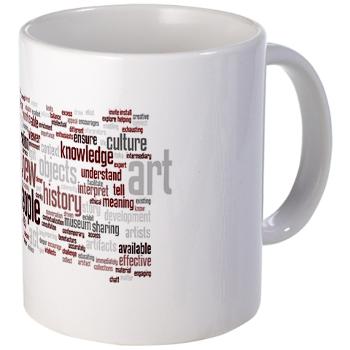
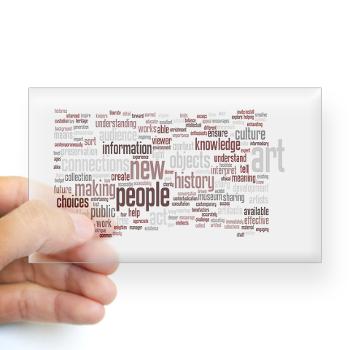
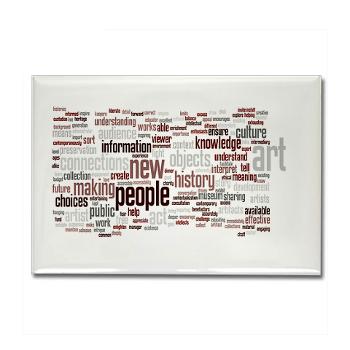
Big and right in the middle; people. I’m not sure if there is a more poignant symbol for the function of a curator. Yet, there are still many curators who hide in offices all day. Right next to “people” is the word “connections”, which many of the responses had as a theme. It appears that the expectations of curators is to provide the legwork to provide meaningful “connections” in a society overrun with “links”.
Also of note, “new”. Strange, when you think that curators and museums are mostly dealing with historical information, yet there must be a “newness” to the outcome. A “new” viewpoint, a “new” fact, a “new” object or a “new” experience (if nothing else, then “new” to me). What fascinates me as a reader of Lipovetsky (who says that the Supermodern era is not an era of new culture and fashions, but a recycling of previous trends) is how this appears to mean that the curator, who has collections/objects of a “historical” era, is having to do just that.
As per usual, I’ve put this on a mug, but also a magnet and a sticker this time. All can be bought from the newcurator shop.
* Stephanie Stambaugh – The curator must liberate. First free all art from its unseen existence, then free patrons from their fear of seeing art.
* remaerdyaD – To serve as an antidote to the common misperceived charity of benefactors by publicly reflecting the state of artifact
* Oh No Jo- Imparting universal appeal, so any level of art & culture background realizes importance of works and can learn more.
* KirstenTeasdale – To help people sort through an excess of information/choices and to shed light on objects that might be missed; to sort wheat from chaff.
* Jay Jordan – To be able to speak coherently after an exhausting install, opening reception, and wine with dinner
* Thomas Tunsch – To connect the histories in order to preserve cultural heritage by enrichment
* An Xiao – To deeply understand both artist and audience and be an excellent steward of both.
* Gilliane Richardson – To spark the thoughts of others, intrigue their intellects, and inspire people of all ages to appreciate history
* Francesco Spagnolo – Explore and create connections that artists, academics and the public do not (yet) see.
* Anon – To elicit new connections and possibilities, to act as an intermediary in service to both the artist and the public
* Laura (opheliacat) – Impart understanding, sharing knowledge of objects & their history in a way that is accessible and even entertaining! (AND) The curator is custodian of a collection that s/he must understand & interpret.
* Allison Brown – Educating & inspiring a new generation of (art) history enthusiasts.
* Mar Dixon – TO ensure the artifacts are maintain & kept in safe environment & available when/if needed. Preservation.
* Suzanne Fischer – Making choices, making predictions, making connections. Helping people make meaning from the past.
* Emily Hummel – To draw connections, bring meaning out of the seemingly meaningless. To enlighten.
* Elena Gonzales – Work for good. Get folks to question and share. Move things forward. And, yes, facilitate.
* Maria Silvestri – To tell a story that a viewer makes themselves.
That’s 25 answers. I would like another ten. Drop them into the comments (Make it short), twitter me @newcurator or use the #MIFC hashtag.
And, if it isn’t plainly clean, all these people are worth following.
Last time was an interesting exercise. Want to ask another question and compare the results.
Usual process. Respond to @newcurator on twitter, use the #MIFC hashtag (so I can keep track) or answer in the comments with a single sentence. Don’t worry if it doesn’t appear immediately. It has to go through a validation process.
I would really appreciate as many answers, retweets and passings-on as possible. With these things, it always works better this more people’s involvement.
I’ll probably do the Wordle and possibly a mug again, but this question really interests me because of my last post. Curators are changing into new roles yet others are considering the curator as an ideal. So its high time we need to ask:
I don’t strictly know what to make of this. I’ve long been saying that museums are a media and can learn a lot from the problems of other media industries. Especially when it comes to adapting to the future methods of consuming media. One warning is when the media is entirely consumed by the methods. The music industry will long be used as the example of non-adaption. Newspapers and journalism seem to be the next ones seriously thinking about this. My Death of the Curator articles were about a similar trend where the role of the curator would change beyond what it is recognisable now by crowdsourcing or social media being used to make curatorial decisions.
Four articles that came to me over the past couple of days has caused a major rethink. I took the “Death of the Curator” scenario to be part of the similar early movements like copyright-infringing MP3 downloads and Myspace Music or “citizen journalism” and free online news content. But there appears to be a line of thinking towards a bizarre convergence. The Curator may die but in it’s place will be New Mutant Curator.
I was originally going to talk about two more instances of Death of the Curator that offer glimpses of the new role I was originally talking about.
Via Nerdgam’s excellent tumblr (because, curiously, none of the links work) is London’s Next Top Curator by Salon Contemporary (No, me neither). Six contestants each run a pop-up gallery to compete for a final put to public vote on the website. This must be the first time I’ve seen curators put to vote in this way. Heh, maybe I should enter.
Another project is ArtPrize, but again seems to be mainly an artist competition with an interesting use of several social media outlets. I like how Art:21 called it “decentralised curation“. From what I can tell, it’s the role of curators and galleries in this competition that needs to be noted. Whilst their final decision-making privileges are put on hold, they get the chance to influence:
…playing a large role the formation of the event, each presenting a collection of entries that reflect their own sensibilities and expertise.
Fascinating. We’ll come back to this.
Continuing on the theme of learning from other media industries, Jeff Jarvis of Buzzmachine continues to try and save newspapers. His latest delightful neologism is “Hyperdistribution”. But hold on, let’s pick through this strategy a bit.
* Reverse-syndication – Okay, maybe this one is newspaper-orientated, but it generally means acting as a base for a network of people to distribute. “In the link economy, value is created by he who creates content and she who delivers audience.” Hell, I get a lot of messages from museums telling me about their stuff. Social networks do this sort of thing, especially on twitter. But maybe there’s an organisational model here to make affiliate bloggers.
* The embeddable paper – Getting content out there? Getting other people highly involved in your content and to pass it around? Can you say “The Commons“? How about Powerhouse putting their collection documentation under a Creative Commons license? I would list Brooklyn Museum’s stuff but there’s too many of them, but they have certainly branded each and every one very well.
* Specialization – I could argue that museums are too generalised, I could argue that they’re not. There aren’t too many general museums that aren’t ancient and successful anyway. But I have noticed more newer museums pointing towards a particular theme.
* Social engagement – Museums are all over this.
Well, so much for learning from other media. It seems museums are ahead on the innovation scale. Newspapers need to become more like museums. Hold on, aren’t museums already going through a period of intense cutbacks? Saving newspapers by using social networks, technology and media to deliver hyperdistributed content… just like Brooklyn Museum, who still took a financial kicking recently.
And now it’s being said that “Curation is the new role of media professionals“. Relying upon a person’s expertise and style to act as a information filter for you tastes. They use Arianna Huffington as an example, but I could throw in the Boing Boing crew, Warren Ellis and Tyler Brûlé and any number of people, experts in their interests, organising research, delivering in a unique and interesting way. Hell, I could argue that Bill O’Reilly and Keith Olbermann fit this model. Personalities bigger than the news they’re supposed to represent, acting as filter and commentator to a specialised audience.
All my talk of museums learning from other media innovations and mistakes and now they’re all talking about becoming museums! Just try to draw a diagram of this! And museums curators are slowly being replaced by audience-participation-heavy social media experiments, instead taking on the role of… an expert… a filter… a commentator… relying upon the force of their personality and position to influence and direct a particular audience.
The Curator is Dead. God only knows what this new Über-Media Mutant Curator of the Information Superabundance Age coming to replace it will be like. But there will be many of them. In a less dramatic way, the convergence of many media roles into a “Curator-class” seems inevitable.
“My proposal has three parts. First, the unnecessary restriction on deaccession proceeds should be eliminated. Second, when an important work of art is deaccessioned, other museums should be given an opportunity to purchase a work – to keep it in the public trust or its region – in much the same way the United Kingdom and other nations regulate the export of works of art. Finally, when any museum is considering a deaccession, it must provide reasons for the sale and publicize the decision to allow for public comment.”
Sounds good.
A final point concerning Southampton’s decision to sell artwork to fund a Titanic museum, I don’t think the AAMD rules would allow that. To be honest, I’m very surprised the UK guidelines have allowed it. Pretty sure Southampton City museum workers were going on strike over pay not that long ago and now the council want another museum?
This is a case where I’m against this deaccessioning. Southampton City Art Gallery has a very particular reputation. They decided a very innovative collection policy of securing art that would greatly appreciate in value. This often meant they had a knack of picking future prize winners. They acted like a commercial art collector, but with the reputation of a public institution.
This is why I would like a Forth Part to this proposal: The decision for deaccessioning must never be made by an elected official.
I like to think this would keep deaccesioning along the lines of collection management.
Marketing through social media and social networking is nothing new. Integrating your blog, your museum’s Facebook page, and twitter stream into your marketing plan is the smartest way to do it. But I want to talk to you today about real-time marketing and the opportunities it presents.
What’s real-time marketing?
I swiped the term from Paul Dunay, who writes about the idea on the Marketing Profs Daily Fix. He talks about a customer-service issue that was resolved in 15 minutes using twitter. Dunay offers the analogy: “if you had a leak in your basement would you wait 45 days for a consultant to put on a webinar on How to fix your leaky basement?”
People want your attention now.
As I was reading Dunay’s post, I was in the middle of listening to the audio book version of Groundswell (2008) by Charlene Li and Josh Bernoff.
There’s a great chapter on listening in Groundswell. The authors talk about companies that carry out market research by creating online social networks for their customers. One example is the M.D. Anderson Cancer Center in Houston, one of several cancer centers in the U.S. that have introduced patient social networks. M.D. Anderson didn’t need foster community – there was already a vocal community of cancer patients connecting online. Inviting these patients into this new environment helped them learn where they were failing their patients, and try out new ideas — in real time. M.D. Anderson got feedback in real time, instead of putting together focus groups, planning complicated surveys, and probably asking the wrong questions anyway.
At the same time, I was reviewing a new report by Universal McCann, called Wave 4. The Wave reports annually highlight research into online social media and social network usage world wide, and break it down country by country. More than 22,000 people who reported that they used the Internet every day or every other day in 38 countries were surveyed.
Wave 4 sees active Internet users consolidating their content creation and sharing in their online social networks of choice – Facebook, MySpace, Orkut, etc. — rather than through stand-alone sites like Flickr, YouTube, or Blogger. And social network users are sharing stuff more than ever: 76% upload photos, up from 45% in the previous survey; 33% upload videos, up from 16.9%.
Skeptics say that people join social networks and then never use their accounts. UM’s study says that nearly two-thirds of Internet users have managed their own social network page, and 71.1% of users have visited a friend’s page.
Online social networks nowadays emphasize real-time communication, and people are using them.
People want information in real time. They want entertainment in real time, they want sharing in real time, and they want an answer in real time.
According to twitter lead engineer Evan Weaver, 80% of twitter usage happens through third party programs on computers or mobile devices. That means if someone is visiting your museum, not only do they have the means to comment on the excellent or awful experience, they are likely to do so.
There is an opportunity here for marketing the arts, and by marketing I mean just about everything everyone in your institution does.
Lots of museums are using twitter now. Lots of them are using Facebook. And most of these are using real-time communication to send advertising messages.
This is the part of the post where I’m supposed to talk about conversations and engagement.
But I’m thinking more about listening and responding.
Are you using tools like BackTweets to find out who is linking to your site and what they’re saying about it?
Are you using Twitter Search to listen to the chatter (or lack thereof) about your museum, or your upcoming exhibition, or the lecture that happened last week?
And if you are, how do you plan to respond?
It’s a customer service opportunity – someone driving around with their family looking in vain for parking around your building could be directed to the parking deck with the discount for museum visitors.
It’s a market research opportunity – are people talking about the Surrealist posters they got at your gift shop when you thought they’d be raving about the more art-historical aspects of your Dali blockbuster? Is your approaching exhibition on Galileo on anyone’s radar screen?
It’s a museum marketing opportunity – let’s say registration is slow for your family workshop next Saturday. Can you create a promotion on the fly to share on your Facebook page, something that encourages parents to spread the word?
I’m not saying we should abandon marketing planning. But in 2009, planning should be flexible. You have the opportunity to use online tools to listen more closely and react faster, and take advantage of real time communication that counts. If you show up in their Facebook updates, people pay attention to you.
Today, the more nimble you are, the better able you are to respond to crises big and small. If you work for a large museum, this may seem like trying to turn around the Titanic. But the opportunity is there. Champion the idea of real-time marketing inside your institution or risk being sunk in the long run.
Thinking out loud on twitter, I said how I was thinking aloud that newcurator should have a weekly comic strip. Some kind of simple sitcom interlude.
Well, too many people liked the idea.
So I had to take it more seriously. After a weekend of thinking, I’ve come to some conclusions.
1) The idea of a possible four-panel strip about museum volunteers has something about it to work as a plot.
2) I cannot draw.
3) I’ve not been able to design some kind of stick-figure style that I can use to get over this.
4) I do not feel right asking people to help with this.
I know what I want it to be like. Think about Diesel Sweeties by the excellent R Stevens. That style means he doesn’t have to make a brand new strip every other day, he can copy and paste the characters and make minor adjustments (Well, he could. Truthfully, I have no idea how he works). Something like this means I could concentrate on writing rather than spending lots of time drawing features on character faces.
Look at Zero Punctuation by Ben “Yahtzee” Croshaw. I love how this looks. It’s essentially stick figures, but there’s a style to it (that I’m in danger of ripping off if the early drafts are anything to go by). Again, simple, circle hands, circle heads and a variety of eye expressions. Some cutting and pasting and it looks good.
Oh, and don’t suggest stick figures. XKCD.com has all that sewn right up.
So, I’m screwed. I can write the damn thing, just no way to make it. I experimented with characters with QR codes for heads. It didn’t work.
To everyone who came back with suggestions or offered to help. Thank you every much, but I’m just not sure. Several people recommended programs or websites with comic book templates. This is instantly sticky. The main reason I haven’t completely ripped off Yahtzee is because I don’t want to get sued and maybe want to make a t-shirt. I’ve looked at them and didn’t feel the copyright issue was solved.
Massive thanks to the artists to offered to do something, but again I’m not sure. This is for a few reasons. Nobody will get paid, except maybe me and Google ads and possibly a T-shirt (which again throws up problems). I remember early ArtFridays. People were busy, which is fair enough, but some weeks I couldn’t get 20+ artists to get me an image of what they’ve done.
No, I would need to do this myself. I don’t feel right asking someone to commit to it every week with very little going back to them. Especially when they’ve got better things to do.
I did toy with the idea of an “open source” comic. I write the character descriptions, biographies and the scripts, a small online community do one-four panels each. Again, have no idea how this would work. It could probably be an interesting experiment, but what happens when nobody does anything for a particular episode?
So… I can only ignore this for now. I’m going to concentrate on the writing part and see what happens. Don’t expect anything soon.
Crowdsourcing or curating, or a bit of each? It’s the talk of New Curator and the talk of the airwaves. Since Pete’s posts Death of the Curator I and II, I have noticed aspects of this debate turning up more and more in podcasts. None in the realm of museums themselves admittedly, but in areas like business and architecture: you’ve got to think laterally here. During the past week, I’ve picked up on these three.
Harvard Business Ideacast discussed the pros and cons of giving the consumer what they have asked for. Does it really work? In talking about business strategies in the recession they championed ‘Innovation that transforms the meaning of things.’ (Isn’t that kind of what curators do in interpretation?) Business professor Roberto Verganti argued that the Wii would never have been invented if Nintendo had listened to the gamers. Players wanted more powerful passive consoles with more functions. Seems they didn’t know they wanted something to get them up and actively moving and interacting until it was presented to them. His argument was basically, if you ask people you get more of the same and nothing new. While I realise that not all curators will go for radical reinterpretations of their collections either, this does appear a good case in point against relying too heavily on market research or crowdsourcing. It will just be the same old, same old.
On the other hand…
Carol Coletta’s Smart City radio show took the theme of city planning in response to emotions this week. Talking to Vancouver planner Larry Beasley, Coletta asked why experiential planning was better than the more traditional efficiency-of-services based way. Beasley argued that designing at the level of the human being, appealing to our emotions, would make us want to live in cities again and ‘feel true affection for them’. It is not made explicit but it seems that they have done extensive market research to come up with these conclusions, which are then actioned by ‘the city’. Obviously there is an element of selection going on, or Vancouver could have have ended up with giant candy floss trees and bright yellow municipal buildings. Essentially though, the idea is that the city can then choreograph an innovative vision for their community in accordance with all the things that its people need for feelings of wellbeing.
In the middle of talking about magazines branching out onto the web, NPR Pop Culture put forward that the magazine is the only medium with a distinct point of view, that of the editor, and this distinguishes it from all others. This comment made me stop and think. Of course, I have to disagree. Museums do this too. Exhibitions, galleries and whole museums are put together from the point of view of their editor: the curator(s). So, if we took crowdsourcing to its logical conclusion, museums would not have the distinct point of view of their editor anymore, the curator. Does that matter?
Remember this? Crowdsourcing, the darling of business 2.0, being able to replace the work of a curator trying to create a coherent set of displays. Even more worrying if the crowdsourcing if based upon the low-brow model of reality TV.
Thinking of algorithms for recommendation systems, I instantly think about last.fm. Music recommended to me based upon the listening habits of thousands of other people who have similar tastes as I do, offering to “fill in the gaps” to my listening collection.
Brooklyn Museum pull another rabbit out of the hat with BrklynMuse, a mobile-friendly recommendation system. A “Gallery Guide powered by people”. It takes the data of other people’s likes (and their moods) and offers you things you may like. I asked Shelley Burnstein (in a rather vague way, I admit. I wasn’t sure how to frame the question) if they were tracking stats that could be used to passively crowdsource curatorial decisions, like a Brooklyn Museum Top Ten. I’m kinda glad Shelley said they weren’t. But you see how such a system could be used as a market research/performace rating system for objects. I believe Brooklyn Museum are focusing this as a guide than anything else.
I mean, you’d want to use this to get people to walk all over your museum, not narrowing their attention.
Five months after I said it, and a year after Brooklyn Museum’s Click! exhibition, TEC-CH Blog talks about a design exhibition called Democracy. Tagline: The Curator is Dead. Long Live Democracy, which irks me because it suggest that curators are not part of a democratic process. If anything, curators within museums are providing (often free) access to education, historical information, art and culture. I would say they are fundamental to a democratic society as a free press.
Powerhouse Museum are doing (organising? Particopating in?) a community curated event, Common Ground. A projection of each institution’s top 25 images in the Commons as voted by the community.
I antagonised a lot of people when I said the curator was dead. Perhaps intentionally. I didn’t want to say “The Change of the Curator” because that happening all the time. This change is sudden and quick and could be a real shift in methodology. Not that I think curators would vanish. To me, I would consider Shelley and her team to be the curators behind Click!, creating systems rather than completed products. Or tell that to people like the BoingBoing crew. Xeni Jardin calls herself a “Curator of Internet Esoterica, Anomalies, and Curiosities” on her twitter account. I think she’s doing alright for herself.
That may be the little death that brings total oblivion for curators: Fear of having to become famous.
Last weekend I had my first real-life demonstration of Layar. It was pretty impressive and it occured to me that you just can’t appreciate how it works as you move the phone, when viewing a demo of it on a computer monitor. Listening to KCRW’s Design and Archtecture podcast, I hit on the begininnings of an idea. They reviewed the film (500) Days of Summer which has an architecture driven plot. The film’s co-writer, Scott Neustadter talked about filming in Los Angeles, using only pre-1940 buildings as a backdrop. The premise for this was that the main character ‘…sees beauty and meaning only in the past.’
41c Angelus Temple by Kansas_Sebastian. Used under Creative Commons.
So, say he has a phone with Layar on it. It might work best for him by showing him information not about what is there currently, but was was there in the past. A museum of information through time and space. If you think about it, this is what Google Street View will become. Their 2008/2009 images of the world are a snapshot; an archive of a moment.How often will they update them? What will they do with the old ones? I hope they keep the images available and build onto them.
Could museums and archives use old photographs, plans and title deeds of places to construct this kind of historical augmented reality treasure trove? It would be a massive undertaking admittedly, but I would love to see it.
Incidentally, on the same podcast there is an interesting interview with architect Richard Best. In a gamble to be proactive in the recession he went on a reality TV show with a real estate theme. And won. It paid off for him, but the thought of reality tv makes me shudder.
Sony’s Reader Daily Edition was critiqued by APM’s Future Tense. They postulated that it might overtake the market leader, Amazon’s Kindle. It will be able to facilitate wireless downloading of books, has a touch screen and will be able to read pdf files and google books. The most interesting thing for me is that Sony are linking with a scheme for borrowing library books in e-form. The loan will then expire in three weeks, like a normal library return. This seems like a great idea. Especially as buying e-books has not always meant that you got to keep them. This type of loaning service seems indicative of a point made in JISC’s recent documentary Libraries of the Future. That ‘…technology is adapting to meet the needs of users’.
Lastly, a great video from New Scientist showing how new laboratory techniques can be used to make you feel as if you are your virtual avatar by inducing an ‘out of body experience’. I don’t know how this might be used in museums and galleries, but I do like it. Enter, stranger.
Following on from my love letter to Augmented Reality, there’s something I touched on at the end that looks like something worth following up. Almost at the same time I was thinking about it, I watched another keynote speech by Bruce Sterling to the guys at the Layar Augmented reality browser launch event. (For those who don’t know, Layar is a great little app for Android smartphones). About halfway through the speech, Sterling gave a very interesting suggestion for the AR industry to combat the inevitable lowbrow/downmarket uses by being involved in museum culture.
How exactly is that going to work?
I’ve alluded to this many times; AR would allow for more information to be “connected” to an object, and I left it at that. You could take a painting or an archaeological treasure and surround it with extra bits of media, floating text boxes, video or maybe a ghostly hyperlink to a collection database entry (if you’re unimaginative).
Stuff that you could do on paper and screens, ultimately. Oh, you could design a better UI to hold the information. Historically, museums aren’t interested in that. Something like AR that smells a bit like an “optical Internet” (a phrase Bruce Sterling rightfully sneers at), it’s most likely going to be a bought product or outsourced to a freelancer. Few museums will want to get involved with designing that architecture. They’ll want to buy something they can fill. So what can AR do for collections management?
I pull this image from Marieke Guy’s Rambling of a Remote Worker. It’s the Gartner Hype Cycle, a graphic to show where a lot of new technologies are and where they’re going and predictions about how long it will take. What’s right next to Augmented Reality in the Technology Trigger phase, heading towards the Peak of Inflated Expectations?
So, we have two emerging technologies, one that can make all kinds of information or 3D images dance before our eyes, and another that can print out 3D objects. Remind me again why museums are still Draconian over photographs? Whether it’s holding onto increasingly meaningless intangible assets or holding onto an ultra-materialistic purpose of controlling access, we are rapidly heading towards a cultural state where it won’t matter. Your photographs and image protection will almost seem quaint. Best thing to do would be to open it up and get it all out there like some museums are doing, getting some interest in them and some use out of them because otherwise it will look like you’re desperately protecting your own handful of sand.
3D printers and 3D overlays. You’d think that some serious 3D scanning equipment is going to be needed soon, right? I can’t imagine we will entirely rely upon 3D modellers and 3D animators to deliver this. I doubt people are going to pay someone to sit down and create thousands of models with Sketchup.
This will be the next step in digitising collections.
It’s going to be a pain. I doubt everyone has got around to photographing their entire collections yet, and now we have to give each one something akin to an MRI? Where are we going to get a scanner big enough to go around our twelve foot high statue? And do we really have to scan in every single archaeological fragment and splinter?
But think how cool it would be. Download a 3D model to your phone and spin it around, look underneath it, look really closely if the resolution is good enough. Look at it as an X-Ray, infrared or something similar (then spin it around again). Hell, if 3D printers get into homes, why can’t I print out one inch-high paper models of my favourite museum objects? Or download 3D models onto your own AR museum layout, moving around bits of QR coded paper as your webcam tells you how you’re repositioning Roman pottery. Maybe even a little AR curator could follow you around and belittle your efforts of exhibition design or grasp of Art History.
AR people need a good cultural foundation. Museums have a big resource to make it happen.
D’aaaaw, isn’t that cute? A six year old applied to be “Diwector” of the National Railway Museum in York. He was only offered the new position of “Director of Fun” and obviously happy to accept the lesser appointment due to the economic situation.
Sam Pointon, I hope this whole exercise is a lot of fun for you and get to enjoy yourself.
But I’m going to talk about how this makes me sick to my stomach. First, watch the video in the BBC article. Now watch this.
You see, not only are they exploiting the cutesy factor of a six year old boy to act as the brand-padding to their “child-friendly” image, it’s not even an original marketing ploy.
And this gets down to the crux of the issue for me. Any of you who thought, “That’s so nice of the museum to do that” or “That museum is so child friendly”. Stop. This is what they want you to think. Is it nice for a museum to use a child to get column inches? We normally think these actions appalling when a celebrity does it, pushing their children around in the vain hope that it will get their picture in the glossy magazines.
Is the museum “child friendly”? Personally, I’m beginning to despise the term. But this story tells you nothing - nothing - about the policy, design or ethic that make this a child-friendly place. If it is being geared towards access for children, it’s more likely because there are 4 or 5 curators or education officers working damned hard to make it so.
You know what alerted me? How many six year olds do you know that post letters? This report may give the whole idea that it was the kid’s “application”, but come on, there are adults behind this. An adult would help him write it, and adult would have given him the stamp and told him how to address is (if this even happened at all), and adult read this and passed it onto someone who saw the marketing potential and an adult arranged the press releases.
From Culture 24: (Do you think Sam honestly had anything to do with this?)
Sam is taking his new appointment particularly seriously and is already canvassing the public for suggestions on how the NRM could be made more fun. If you have a suggestion for Sam and his team then you can fill in the online comments card.
Not so cute now, huh?
And one kid, just one, gets to act as poster child for a museum’s excellence with children and you all go “Awwww”. Suckers. You’ve allowed yourself to be completely taken in by a highly orchestrated event masked as a spur-of-the-moment altruistic occurrence. They didn’t show you the education officer dealing with 100 kids a day and getting industry based awards. They could have the best child-access-policy-whatever in the country that’s been made completely inauthentic because they showed you a kid in a tie being told to act like an advert.
There’s no such thing as “harmless PR”. I accept that every one of us at some point will tow the line or promote our bosses or say the marketing spiel to sell a little bit of our souls for the sake of hopefully benefiting the whole rather than the individual, but can we wait until they’re reaching voting age before you single one out to be your branding puppet? The misdirection was good in this but I can still see the strings. This boy is being used to increase visitor numbers.
I find that sad. Museumchausen by proxy.
I wonder who was behind this. I wonder if it was more a “marketing” person than a “museum” person. I would think the former because a marketing person is more likely to have the contacts/abilities to get BBC News to cover the story and I like to think a museum person wouldn’t be insensitive to the thousands of under-threat or laid-off museum workers by showing that a cute/marketable six year old can get job when you can’t.
Hopefully, Sam will get the authority of governance to remove someone when they’re not being fun enough.
I was asked a while back why I’m so interested in Augmented Reality. To me, it’s the polar opposite of a computer “kiosk”, something I’ve hated on several times regardless of touch/multi-touch capabilities. Is comes down to a question of design intent or, more specifically, platform. Brooklyn Museum’s Shelley Berstein has written a blog post about kiosks, so I want to share some thoughts.
First, a story.
I’ll keep the name of this particular museum hidden. I use them as an example for my criticism, not to negatively criticise that particular institution. At the time, they had just gone through a massive renovation. Everything was now behind steel-framed reinforced glass and proper lighting. So the space looked good.
There was quite a large amount of objects on display. More than I would have thought necessary. Rows upon shelves of them with only very small one sentence descriptions on labels. I was no expert on the subjects and felt a little overwhelmed by what I was supposed to be looking at.
I asked a question of the people on the desk. Admittedly, I don’t think they were curators but I only asked if they had a particular object. They took me to a computer. It was broken. They took me to a another computer. That was broken as well. They told me to go home and look at the database online. I did, and found the object I was looking for as well as plenty of other information.
This is what Shelley calls a “Lose” situation; the website in a kiosk. I go a bit further and say its the “Not Better Than the Internet” situation. I went home and got something better than what the museum was offering. Even if the kiosks were working, what was I gaining from turning my head and looking at the objects?
What museums do well is material Reality. They have that sussed. Objects as authenticity is almost intrinsic to the definition of what a museum is. Even when “Intangible Heritage” was the vogue, it was still in terms of the actions surrounding objects. (This seemed to mean the conservation of dance, theatre and skills in Third World or Far East countries to stave off the impending “Western” Monoculture, if UNESCO is anything to go by).
The treatment of technology in museums is still in this materialistic Real way: The Kiosk, just another object on display. A monitor with touchscreen or a keyboard, bolted to a wall or given its own plinth, technology on display just like any other object.
Before I get hundreds of suggestion of good kiosks, I will admit that Shelley’s comment book computer is a sensible idea, so there would be good and bad kiosks just as there is good and bad AR. The point I’m trying to make is about design and, as always, the future. A kiosk approach to technology in the museum concentrates that platform into a limited space, which was fine many years ago when that was cutting edge. Without meaning to sound like a post-cyberpunk novel, but technology is now a homogenised aspect of our everyday lives.
To put it simply, my phone is better than your kiosk is ever going to be.
A kiosk also breeds a bad habit I’ve noticed in museum. They get installed somewhere then forgotten about. They are never updated and ignored until they break. This may be why I think they always look so dated. They’re as static as the objects next to them. I imagine there are kiosk-types that do update with use, like the comment book computer, if the comments are viewable by all. I admit that’s acceptable. At least it’s doing something. I think about the use of kiosks at the Mattress Factory, but I like to think they have the right idea of it being a node of technology within their overall technology overlay.
Overlay. I can stand anywhere in a museum and use my phone and get information. I could get artist’s biographies, historical articles, even news about what’s in front of me. But that’s still contained within a device. Okay, a far more mobile one that I have total control over and with less limitations. It’s still a concentrated device connected to the Other Place known as the Intarwubs. What excites me about Augmented Reality is how it can fill the gap between the superabundance of information out there and our actual lives. Updating Apps could associate huge amounts of updating information right in front of the objects the museum wants us to give a damn about. And we would be able to control it… or at least keep asking for more and ask for it in a language that won’t completely offend your intelligence.
Look at this and look at the possible future an Augmented Reality platform in museums has. What’s the latest advancement in kiosk? Now, you can use more than one finger.
Maybe Augmented Reality won’t stay on phones and we’ll have goggles or visors or contact lenses and control our infomation hallucinations with Pranav Mistry’s Sixth Sense technology (four fingers!). Maybe, crazy idea, the Augmented Reality platform could perform actions to the objects…
I spoke about Cross Reality before. The use of sensors to bridge Augmented Reality and Virtual Reality. Again, more possibilities being tested because technology is permeating every fabric of our lives and culture and dragging that funny universe on our computers into this Reality. I wonder if, through this and the increasing complexity of fabricators, the next phase of museum digitisation will be scanning of objects into 3D models.
God knows what that will do to our authentic Museum Reality.






Latest Comments