
Our(Future>Past) by Anyhoo. Used under Creative Commons
We could look at the past and future in two ways. Either the past is a primary source of social traditions or a lot of failed dogmas holding back progress. The future will either be working towards a positive utopia or an apocalyptic wasteland.
Presentism takes the view that the future is unpredictable beyond what we build towards right now and the past is so alien that it holds no more meaning than a source of recyclable fashions. Presentism means an emphasis on short term goals, quicker gratification, speedier technology, here-and-now and constantly moving from place to place.
Since museums deal mostly in historical information, what does it mean for them when the past is alienated so much? The problem lies in Presentism culture of consuming-at-speed and a visitor’s attitude that struggles to relate to seeing more than one roman coin or three hundred examples of medieval pottery. It’s an attitude of wanting more, experiences new things and taking enjoyment from the act of rediscovering things in a new light. If this is the case, how many return visits from this kind of person can a museum expect if they do not change the displays? Presentism in museums is about consumerism and consumers vote with their feet.

Past, Present, Future all muddled up by freshelectrons. Used under Creative Commons.
With so much of history highly documented and rarely different between museums in the same field, what this does to museums is a creeping syndrome I’ve called the “Museum of Last Tuesday”. There seems to be a movement in museums to obtain relevancy though exhibitions about increasingly recent events. Such examples would include exhibitions about current ongoing news topics, cultural movements only just considered the mainstream and still-living celebrities. So when the Exhibition of Emo appears, just remember that I called it first.
Whether Presentism is a positive or negative depends entirely on the purpose. Museums tackling current affairs, acting as reporters as much as conservers and taking the risk at holding an opinion appears to be an exciting route they could take. On the other hand, they could be accused of being monuments to fads or opportunism.
This category will track outbreaks of Presentism in museums and offer analysis on what the greater outcomes will be.
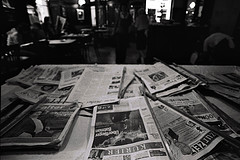
Newspapers by Alex Barth. Used under Creative Commons
An individualised frame of reference means that information is built upon or delivered via a single person or entity. There are some media that do this naturally by putting an equal emphasis on the title as to the names involved. Movies have actors and directors names at the top of their posters and at the start of the film. Books and novels have the writers name right on the front, sometimes fighting for space for the actual name of the book. This creates expectations of style as well as appealing directly to a fanbase.
Other media do this more subtly and possibly accidentally. Take the news media for example. Whilst journalism aspires to objective reporting, we know there is an editorial process in line with a particular political standpoint. Who we choose to listen to is how we individualise the references. In America, choosing to listen to Bill O’Reilly or Keith Olbermann is a personal preference in how you want your news delivered. In the UK, reading the Guardian or the Daily Mail is an individual’s decision to accept the newspaper’s worldview as similar to their own.
There are two sides to individualising frames of reference. Information comes from a single person/entity but the receiver can exercise all preferences or prejudices in how that information arrives, individualising what references to frame.

State Library of Victoria by Asiatic League. Used under Creative Commons.
There is a growing aspect in museums and this individualisation, but not in the same ways. It is unlikely for individual curators or museum directors to get top billing to an exhibition or have their names put on every piece of written text. Museums act as institutions rather than entities and a neutral political correctness is preferred to possibly offending with one-sided arguments. So museums are leaning towards exhibitions about individuals, be it Tutankhamen or Matisse. These take the format of a “star exhibition” and a chance to see an internationally recognised figure. Sometimes, these figures are modern day celebrities, like Kylie.
The other side of individualised frames of referencing, museums should be geared towards but slow to take up. Allowing visitors to entirely customise the information could enhance their experience no end, but possibly change the role of curator entirely. There would also be issues about coherence of theme and if the visitor wants a customisable source of information, then how is a museum better than the Internet? A mid-point between these points would be allowing visitors the customisation of various augmentations to an exhibition, most likely through new technologies. Curators then have new methods of communicating to an audience through different forms of curatorial techniques.
This category will look at this kind individualism in museums, the changes it brings around and how it affects the future of museums.
Everything looks set for a 2009 launch. During this time of year, very little is going on, people are otherwise distracted and museums tend to close.
NEW CURATOR will look at topics, issues and news surrounding museums and politics, technology, internationalism, individualism, expansionism, presentism and architecture. All together acting as a lens to see how the future of museums is being planned out.
Expect news, commentary, reviews and a whole bunch of museological internet fodder.
Follow us on twitter.
Contact us using the contact form. Especially if you have your own museum blog or website or are an indie curator/artist organising your own exhibition in the upcoming months.
We love getting messages.
Also, buy a book from the specialised Reading List.
NEW CURATOR. Tracking the Future of Museums.


Latest Comments