
Here comes Bruce Lee... by diankarl. Used under Creative Commons
The home of the Late Bruce Lee will be turned into a museum. The Hong Kong town house was donated to the city by real estate tycoon Yu Pang-lin.
Personally, I would have every tour guide dressed as a different opponent from Game of Death.
The discussion about “deaccessioning” or “disposals” seems never-ending. The more bizarre thing is how little this much discussion does in changing the rules. Something could be said that an industry full of conservators is not going to make massive radical changes. So it’s up to a lawyer to experiment with the issues. Donn Zaretzky at the fascinating The Art Law Blog approaches this topic a lot (possibly because legalities in museums are either deaccessions or illicit trade). The latest argument states the benefits of adding this statement to collection policies.
Ensure that the institution or individual to whom you sell commits in some binding form to equal or higher conservational standards and equal or higher public access.
Apparently, American guidelines are that any funds from selling art must be for used on buying more art and not plugging funding gaps or meeting overheads. In the UK, it’s almost impossible for museums to sell, let alone for more art.
When Richard Lacayo analyses the National Academy Museums plight in the same way, that survival of a museum should be paramount, Tyler Green of Modern Art Notes says that this is accepting institutional failure and the whole collection should be distributed to other public organisations.
I like how the argument can swing from one side to the other. Zaretzky idea, I like to think, could pave way for the founding of more museums. Lacayo recognises that museum survival is paramount and the rules limit a museum’s options. Green’s dispersal idea sounds like the need for a museum version of “calling in administrators”. Since the role of most museum associations is to act as an enforcer, how difficult would it be to turn that role into a regulator?
Isn’t there is a way that all these could work in the same system? The problem seems that they is a lack of a system, with only protectionist standards.

The Metropolitan Museum of Art by no_typographic_man. Used under Creative Commons
The Metropolitan Museum of Art in New York has made an addition to its acquisitions policy.
The Museum normally shall not acquire a work unless provenance research substantiates that the work was outside its country of probable modern discovery before 1970 or was legally exported from its probable country of modern discovery after 1970.
This change comes from pressure from Lord Renfrew, a long standing advocate for stricter museum guidelines, who seems to achieve that by playing the Met and the Getty off each other.
“I shall be pointing out in my lecture that [Met leaders] still have a way to go before they have the clear and transparent guidance which the Getty now follows. The Getty has taken the lead and retains the lead!”
Expect “The 1970 Rule” to be a museum buzzword of 2009.
- RichWhite: @smannion - Cobalt framework would be wonderful for building distributed “Museum Worlds” ! Google 3D warehouse support
- kloh: Taking family to the Bowers Museum.
- xeno: @kloh I thought that said “The Bowser Museum”. I almost had a happy attack.
- rentonhistory: Useful advice for nonprofits in an economic crisis: “Declare an emergency.”http://www.blueavocado.org/…
- sorgsorg: OHH I forgot to metion.. I saw the Dan Quail Museum today, yes, the Dan Quail Musuem.

MUSEUM OF OXFORD by joshuawillis. Used under Creative Commons
There is nothing that defines economic Presentism better than massive budget cuts. The short-term planning of cutting back in the hope that better time will allow for rebuilding is not much of a plan but acts of desperation. Culture should be thriving during these times, providing free events as well as a greater sense of meaning during depressing times. Instead, cultural activities are often unnecessarily threatened.
The Museum of Oxford in the UK is threatened with closure for the sake of saving £200,000 a year. The museum makes up for less than 1% of the £32.15 million spending budget.
As Mr Joyce of the Oxford Civic Society rightly points out, “Once it’s closed it would be difficult to reopen it.” Culture isn’t something that lends itself to being closed and restarted. To shut the museum for £200k would only mean having to spend more than that to reopen it in the future. But at that point, is the damage already done?

Protest telegrams by kamoda. Used under Creative Commons
If there is one thing to change a museum’s overnight, it’s politics, both internal and external. Government involvement can change priorities and funding. Membership organisations can create new ethics guidelines and requirements. Museums themselves can get into all kinds of trouble should their actions become a political football.
This category acts as a catch-all section covering anything from copyright to policy changes.
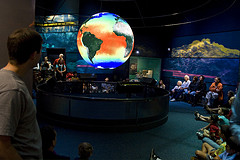
Science on a Sphere by woodleywonderworks. Used under Creative Commons.
When tracking examples of new curation, technology is going to be a major part. There is very little in a museum that can’t be improved with some kind of new tech, especially that of a visitors experience.
It can also go disastrously wrong, breaking at every moment, spiralling costs or ending up completely redundent.
What is also interesting are how some museums with very limited budgets are trying cheap innovations, DIY approaches to creating something and using already available technology in new ways.
This category looks at new technologies being used in museums.

San Francisco Airport by riacale. Used under Creative Commons.
This term is used to describe a new form of museum outreach that goes beyond standard museum practices. This term may also prove to be difficult to understand as I’ve completely made it up.
A lot of museums look to go beyond their walls in many different ways. Loan boxes are a good example; a school has the opportunity to obtain a box of museum objects for a short time. Conservators and collection managers are often offering services outside of their own institutions. Since museums often deal with archaeology and archaeology is typically an outdoor activity, it could be argued there is associated museum practices included. There is another form of museum expansionism that doesn’t seem to be as centralised. It’s when a museum starts invading open spaces or when you find something like a bit of a museum where you didn’t expect.

Memorial by wenedeux.com. Used by Creative Commons.
There are many general examples of this growing area. Airports seem to be the most typical: works of art or museum cabinets of artefacts have started appearing next to departure lounges. What makes this more interesting than a cabinet in school is that airports are nothing more than obligatory pauses in a person’s transit. The equivalent would be a museum exhibition on the street. In saying that, there are instances of street museums to be added to street art and street performances.
If you had a museum with no walls, what would the changes to the curatorial process be? What if you had the resources to spread a museum across an entire city? These are question pointing to an extreme, but the answers could become very interesting when made a little more practical. Looking at some of the possible issues faced seems to almost reflect issues of the entire society. Security of the objects is one to go alongside the security of the people or the nation. Would a cabinet with items from a museum be any different than a billboard, and would people react the same way? What happens when someone doesn’t like what they see or takes offence? Does the museum have a right to be so forward?
This category will hope to find more examples of finding museum practices expanding into new space.
Posted in Design on 04. Jan, 2009
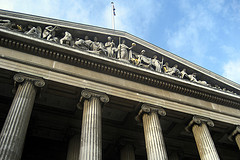
British Museum by wallyg. Used under Creative Commons
To talk about what museums are doing to be innovative and where the future of museums is going, a lot can be said about the current trend of museums rebuilding, renovating and expanding or moving entirely into new buildings. As old building wear out or no longer offer the necessary functionality, mostly because they had a previous life as something entirely different, there is a need for purpose-built museums. The architecture that comes with this new trend is a fascinating area of discussion. What a lot of new museum architecture is about is the fashion for spectacle above all else. The identity that the museums are trusted to keep safe within themselves seems unrelated to the identity of their exterior. It’s like finding your grandmother’s long-lost engagement ring inside a Kinder Egg. Sure, you were caught by the want of chocolate and a toy on your way out of a shop but your surprise was a real sense of your heritage.
What a museum becomes is a monument or a landmark as well as a cultural centre. This is ideal for using a new museum building as a catalyst for regeneration, which seems to be a primary focus for cultural activity especially in the UK. This form of museum presentation creates an expectation of brands and image rather than a sense of expertise. Furthermore, the brand-spanking new building offers new resources, new uses of technology and possibly most importantly, more space. Being a spectacle adds to the attraction for visitors but at what cost?

Royal Ontario Museum by Vlastula. Used under Creative Commons
There is meaning in buildings. The symbolism, identity and function resonate with the people; take any iconic skyline and it means something to the local population. Museums have that inside and out, where the discovery of meaning permeates every pore. The meaning of spectacle is only that of itself. These new museums are often placed where they neither reference their surroundings nor acknowledge the existence of something greater than themselves. So they dominate the meaning of an area.
Would you put a giant globular construction of steel and glass alongside angular stone buildings from the 18th century? Possibly, if the intention of regeneration was to completely replace and demolish the area’s identity and set a new standard.
This category explores the architecture of museums and what it is becoming.

Internationalism by BertPass. Used under Creative Commons
A museum has to deal with issues about representation. Be it a single person, a town, a nation, a culture or a movement, a museum interprets collections to represent a definition. A museum of modern art represents what modern art is, a local authority museum represents the identity of an area and its population.
With almost every city in the world being within at most few days travel, all the world’s economies and politics becoming interconnected and information from anywhere accessible in minutes or seconds, what are the issues about international representation in museums?
The most straightforward one is language. Many museums choose the technological option, using foreign language audio guides or handhelds. There are still many museums, either through lack of resources or commitment, which do not offer any other language support. This may be because the users of the museums are not from other countries.
To which the response is: why not?
To ignore the international stage is to ignore a part of representation. To act as an agent of definition means creating meaning for everyone. Excluding people from that definition, especially on grounds of language or nationality, is an act of misrepresentation. It is a duty of museums to represent their collections in every field. One of those fields is right across the entire globe.

Abstract Globalization by duke.roul. Used under Creative Commons
The next issue is one of purpose. The British Museum repositioned itself to act on internationalism, holding exhibition exchanges around the world, forming partnerships and choosing to be a representation of the world in Britain. This is a reflection not only of a world beyond the borders but that nations are becoming increasingly diverse in creed, colour, race, ethnicity and language. This may be easy for a large national museum to achieve this, but what about the small town museum? What purpose does a local museum have trying to be international?
The answer remains: why not?
This category is about instances of internationalism in museums and how the changing world is changing museum but also how museums can improve in this area.

Our(Future>Past) by Anyhoo. Used under Creative Commons
We could look at the past and future in two ways. Either the past is a primary source of social traditions or a lot of failed dogmas holding back progress. The future will either be working towards a positive utopia or an apocalyptic wasteland.
Presentism takes the view that the future is unpredictable beyond what we build towards right now and the past is so alien that it holds no more meaning than a source of recyclable fashions. Presentism means an emphasis on short term goals, quicker gratification, speedier technology, here-and-now and constantly moving from place to place.
Since museums deal mostly in historical information, what does it mean for them when the past is alienated so much? The problem lies in Presentism culture of consuming-at-speed and a visitor’s attitude that struggles to relate to seeing more than one roman coin or three hundred examples of medieval pottery. It’s an attitude of wanting more, experiences new things and taking enjoyment from the act of rediscovering things in a new light. If this is the case, how many return visits from this kind of person can a museum expect if they do not change the displays? Presentism in museums is about consumerism and consumers vote with their feet.

Past, Present, Future all muddled up by freshelectrons. Used under Creative Commons.
With so much of history highly documented and rarely different between museums in the same field, what this does to museums is a creeping syndrome I’ve called the “Museum of Last Tuesday”. There seems to be a movement in museums to obtain relevancy though exhibitions about increasingly recent events. Such examples would include exhibitions about current ongoing news topics, cultural movements only just considered the mainstream and still-living celebrities. So when the Exhibition of Emo appears, just remember that I called it first.
Whether Presentism is a positive or negative depends entirely on the purpose. Museums tackling current affairs, acting as reporters as much as conservers and taking the risk at holding an opinion appears to be an exciting route they could take. On the other hand, they could be accused of being monuments to fads or opportunism.
This category will track outbreaks of Presentism in museums and offer analysis on what the greater outcomes will be.
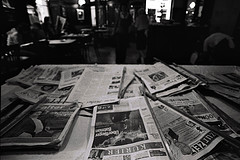
Newspapers by Alex Barth. Used under Creative Commons
An individualised frame of reference means that information is built upon or delivered via a single person or entity. There are some media that do this naturally by putting an equal emphasis on the title as to the names involved. Movies have actors and directors names at the top of their posters and at the start of the film. Books and novels have the writers name right on the front, sometimes fighting for space for the actual name of the book. This creates expectations of style as well as appealing directly to a fanbase.
Other media do this more subtly and possibly accidentally. Take the news media for example. Whilst journalism aspires to objective reporting, we know there is an editorial process in line with a particular political standpoint. Who we choose to listen to is how we individualise the references. In America, choosing to listen to Bill O’Reilly or Keith Olbermann is a personal preference in how you want your news delivered. In the UK, reading the Guardian or the Daily Mail is an individual’s decision to accept the newspaper’s worldview as similar to their own.
There are two sides to individualising frames of reference. Information comes from a single person/entity but the receiver can exercise all preferences or prejudices in how that information arrives, individualising what references to frame.

State Library of Victoria by Asiatic League. Used under Creative Commons.
There is a growing aspect in museums and this individualisation, but not in the same ways. It is unlikely for individual curators or museum directors to get top billing to an exhibition or have their names put on every piece of written text. Museums act as institutions rather than entities and a neutral political correctness is preferred to possibly offending with one-sided arguments. So museums are leaning towards exhibitions about individuals, be it Tutankhamen or Matisse. These take the format of a “star exhibition” and a chance to see an internationally recognised figure. Sometimes, these figures are modern day celebrities, like Kylie.
The other side of individualised frames of referencing, museums should be geared towards but slow to take up. Allowing visitors to entirely customise the information could enhance their experience no end, but possibly change the role of curator entirely. There would also be issues about coherence of theme and if the visitor wants a customisable source of information, then how is a museum better than the Internet? A mid-point between these points would be allowing visitors the customisation of various augmentations to an exhibition, most likely through new technologies. Curators then have new methods of communicating to an audience through different forms of curatorial techniques.
This category will look at this kind individualism in museums, the changes it brings around and how it affects the future of museums.
Everything looks set for a 2009 launch. During this time of year, very little is going on, people are otherwise distracted and museums tend to close.
NEW CURATOR will look at topics, issues and news surrounding museums and politics, technology, internationalism, individualism, expansionism, presentism and architecture. All together acting as a lens to see how the future of museums is being planned out.
Expect news, commentary, reviews and a whole bunch of museological internet fodder.
Follow us on twitter.
Contact us using the contact form. Especially if you have your own museum blog or website or are an indie curator/artist organising your own exhibition in the upcoming months.
We love getting messages.
Also, buy a book from the specialised Reading List.
NEW CURATOR. Tracking the Future of Museums.


Latest Comments