Sam does seem nervous with a camera in his face, and does focus on the “space for art” explanation that seems to get lukewarm responses from the passersby, but I think this is a champion project.
Now, in it current state (and reasoning), the project fits into the genre of “street art”/”public art”. There are just two small details that would turn this into Grade A Museum Expansionism
1) Obviously, the theme. Change the focus from a mini site-specific installation art gallery to a museum micro-exhibition. It seems that the current plan is for artists to create new works of art to fit in the hole. The only difference is that any object (that fits) could be placed in there. I suppose a creative/artist curator would have the licence to find all kinds of interesting ways to display objects. Also, QR Codes, Bluetooth, short-range radio transmitters? Would all go a treat in something like this.
2) It’s when Sam says he’s looking at other spaces all over the city that is so interesting. Let’s imagine the project is successful and all kinds of small otherwise useless places like this are found and turned into displays (artist’s work or otherwise). This is when it stop being street/public art, yes? I realise the next point is debatable, but I’m going to run with it anyway. Street/Public art is the prerogative of the artist. Artist sees space, artist fills space. What Sam and Paula become at this point are curators. They find the display space on the streets across the city and control the ouput. Yes, yes, they’re not doing proper museumy things like collection management or environmental conservation, but those aspect can be added later. Sam and Paula become Metrocurators.
(I almost made this concept a homage to Warren Ellis by calling it Transmetrocurators)
Now, here’s the exciting bit. Just as Sam says, he’s just a recent graduate, looking for spaces. He isn’t made of money, he’s not doing this attached to a institution like a gallery or a museum. This is the guerrilla tactics of the Metrocurator. Small, streamlined, low-cost and high impact. This guy got on the BBC News (and here!) and he didn’t need a big organisation behind him to do it.
This kind of on-the-city-street mini exhibition space need a term of its own. It has to describe being a museum, being small, being inside nooks and crannies and being on a city street… Alcoveum? What do you suggest?
This is a call out to anyone who reads this site who’s a dab hand at creating a little webapp.
Basically, I’ve had an idea but lack any coding ability to pull it off. I could try to use some of the tools out there already, but it would look messy. Would prefer someone to do it for me and do it properly.
You know that part were I said I have no coding ability? Well, I’m also not sure what abilities someone would need. I imagine php, mysql, css and maybe something else weird and alien to me.
I don’t see this as a large project. I’ve seen more complicated facebook apps than my idea. What I can’t do is pay you. What I can do, and what expect, is something on it saying “developed by…”. I wouldn’t mind somehow releasing it under Creative Commons to solve any ownership issues.
Yes, it have something to do with museums. If it works, it’ll be a nice piece of activism.
Interested? Drop me an email at pete(at)newcurator.com and I’ll send you the details of my idea. If lots of people reply, then I’ll choose the one I like the most.
IMA Director Maxwell L. Anderson’s address at the Museums and the Web 2009 conference, Moving from Virtual to Visceral. The video is a little over an hour long and well worth watching just because of the mass of inspirational ideas one can take from it.
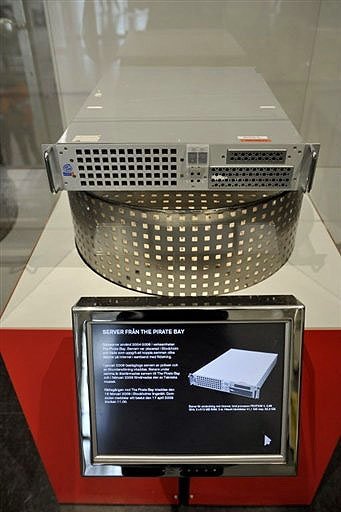
“This is an object of contemporary society and a museum collects such items,” curator Nils Olander told AFP.
“And it is a part of our mission as a museum not to avoid complicated questions,” he said.
Nil Olander may also be entirely in line in saying, “Look. This is the server that delivered the most popular web site to come out of Sweden by spitting in the eye of international copyright laws. Don’t you think this is important?”
The Guardian and the Saatchi Gallery (who else?) are putting on Your Gallery @ The Guardian exhibition. In short, a panel of judges have shortlisted 30 artists (from the 10,000 who submitted on saatchi-gallery.co.uk/yourgallery/) and now the general public will reduce that 30 to 10 who will be put on display (by voting at arts.guardian.co.uk/yourgallery/ or texting it in).
Crowdsourcing the curatorial decisions of an exhibition. The process of museums has been brought to the lowest common denominator, pitched somewhere between reality TV and youtube’s most-viewed list. My point is about individualism in museums is entirely proved.
Let’s make the comparison between museums and the “old” news media of print and television. Let’s face it, they are both firmly “media” in the industry of information. You can argue the differences somewhere else. For the sake of my argument, museums are an “old” media. Possibly one of the oldest. What makes it the exception is that new/social media hasn’t completely ruined it or caused a massive rush to adopt it. You’ll find the Guardian on almost every social network or new technological advance. I think there’s about 10 UK museum institutions on twitter.
They are two methods for media to take, both opposite ends of the individualised spectrum. At one end, individuals-to-individuals. Old media does this with celebrity and personality as intermediates that we consume. We choose Bill O’Reilly or Keith Olbermann to shout back at us our own political bias. We listen intently to to those objects of our fandom as they tell us stuff. New mediathe Internet Blogs are starting to cotton onto this, as I read more and more of “blogger-as-curator” or “celebrity blogger” (terms I don’t think would exist without the Cory Doctorows of the world) and “original content” becoming the an Internet Brahma bull and that Stephen Fry is King of Twitter or something.
This is only half-occurring in museums (probably in the same way I can only half-argued museums as old media). Celebrity is certainly becoming a more central feature but that’s certainly been the case with art since the year dot. It’s when David Beckham curates an exhibition of his favourite British archaeological treasures you know the paradigm has truly shifted. Museums may have its occasional superstar director, but ultimately the curator is hidden behind the institutional banner.
Individuals-to-individuals firmly puts the power into the hands of the consumer, with everyone else trying hard to make enough noise to become famous enough for you to listen.
The other end is individuals-as-social. The Internet is all over this and old media often have to rely on the new to provide access to this construct to which they had no answer. They best is the glut of phone-ins associated with reality TV, as the social-individual-media-consumer votes to keep or kick some dancer/singer/c-list celebrity. The new gave the people a voice in media of conversation. Granted, the majority of the social media voice may not adding much and with so much noise we often return to the Doctorows and Stephen Frys to show us stuff. What individual-as-social creates naturally though is the ability to create lists. Youtube has a Most Watched. Delicious and Digg have top items. Twitter loves to tell us who has the most followers.
One of the casualties of media is journalism, and this is where the comparison offers a warning. Proper journalism, as in a job with actual skills to do right, is bumped behind individualism. You can be any kind of celebrity and be a popular blogger or columnist and reach that individualistic market. That hill is very steep to be a “celebrity journalist”. We only need one O’Reilly/Olbermann. We don’t need either to see what the most popular music video is or what’s the world most favourite picture of a cat. The Crowd and tell us that for us automatically.
Museum curators and print journalists have a lot in common, in that it is their skills that turn an amount of information into something worth giving a damn about. There are plenty of other places to find out about the DefCon of journalism, especially the ever increasing problem of how to get paid. At this current moment in time, the museum curator is “safe”, got nothing to worry about. “It will all blow over”. The fact that there is a gallery in London who are going to offer thousands of people, many without art history degrees, the ability to choose what goes on the wall. The first step new media did to try to kill old media was to make the skills unimportant under the banner of “democratising”. “Everybody can get involved!” also means “It doesn’t matter what you know!”. Suddenly, your art history or archaeology degree isn’t looking so important, your museum post-grad may not be enough and your years of experience don’t mean much in the world of facemuseumtube when your job can be done by a thousand unpaid contributors. Curators may be safe now, but they would do well to look over their shoulders to their destitute journalist buddies.
“In the world of new media nothing can be achieved alone; by working with exceptional companies such as Apple we can use the internet to help fulfil Tate’s mission to make art available to all.”
Apart from, you know, those without iTunes. Which I don’t so I can’t offer any more comments. Would be good if I could find those videos somewhere else without having to download a program I don’t want.
It’s interesting to see that the Tates are the first museums on iTunes U. The rest are universities.
Coming out of radio silence for an important news bulletin.
ArtBabble, which shut its doors for some tinkering before the proper launch, is open and has something special to show us.
I first mentioned ArtBabble back in February and was impressed by the design, the video delivery system and general elegance of the site as a whole. What it did do and didn’t do made, for me, a successful project. What it didn’t do was try to be a web 2.0 thing by trying to be a new facebook or twitter for museums. What it was doing providing content. Real original content properly madewith somedirection. You may miss how this is important in the world of linkblogs and retweets, but it didn’t pass me by that I was being told something and should listen.
The social aspect are in there, everyone gets a profile and discussion threads attached to every video. But whilst youtube is like trying to be social in a (very loud, very full, obnoxious) bar, ArtBabble is like attending a lecture with progressive seminars.
ArtBabble has now lost its betanity and we find out who its been mixing with. Namely Art21, LACMA, MoMA, SFMOMA, the Smithsonian American Art Museum and the New York Public Library. They all have a few videos up and I expect they’ll have more soon.
That’s six museums and one non-profit collaborating to give to annotated mini-documentaries.
Lindsay O’Leary and Jeffrey Inscho talk about how they use QR code technology in their gallery. In this video, QR codes are used to replace the number of paper guidebooks as part of their greening initiative. They also set up a way for people to download a QR reader to their (hopefully compatible) 3G phone. I like how they also used QR codes to distribute more than just text content.
Google’s mission is to organise the world’s information and make it universally accessible and useful.
I doubt there is any better at organising information. So what could Google do to organise the world’s information in museums?
Google Collections - I’m not sure I’ve met anyone 100% happy with their collection management software, just like people weren’t happy with email until Gmail came along. Google Collections would need to be completely online with a set of mobile apps, import/export functionality with as many existing programmes, conform to the various standards, allow to be customisable to fit into a museum’s own website theme, have APIs available to all museums and just do something to make the whole process quicker and easier for all museums, even the small ones with nothing but volunteers. And make it free.
Google Museum Maps – Take detailed architectural plans of all museums to make accurate outlines of exhibition spaces. Create online tour maps with details about room names, exits and the like. Google MuseView – Google get one of those massive multi camera tripod things and walk around a museum with in on a trolley. With a click and a drag, you could view 360 degree panoramas of the inside of museum space. I guess the artwork of copyrighted stuff gets blurred. The maps contain GPS data from Google Collections, so whilst walking around a panorama you could click on an object and get its database record.
Google Object Search – Simple really. Get Google’s powerful search engine onto museum collections. This is just because too many museum collection search engines are just not good enough. How useful would it be to find museum objects on a “loc:” or “type:” or accession numbers?
Picaseum - Just as a competitor to the amount of museum DIY on Flickr. Competition is good and Flickr isn’t helping them much. Something a bit more tasked to help and with more features to open up museums’ photographic collections.
The only improvement I could suggest would be introducing GPS and location-aware software so the device starts the sign language video dependent on where you are rather than punching in a corresponding number. Hell, you could make it an iPhone app. Apart form the fact that I can’t imagine many people with hearing difficulties owning an iPhone.
Maybe QR codes could trigger the video? Put a small camera on the back and take a picture of the codes? Or RFIDs and just be near a video trigger.
You could go even more over the top and use augmented reality, so you hold the handheld in front of you and the person signing walks around the museum with you, signing as she goes. Maybe giving actual tours, signing “take a left here” or “look over there” and signing when you hold her in front of something.
Trust me to take a very cool simple idea and turn into a massively expensive one.
For some reason, I tend to give science museums a lot more leway in criticisms, due to the fact that they tend to walk a parallel path to other history based museums (Well, certainly in the UK).
There is something that makes sense and doesn’t make sense to me about this: the Science Museum in London has a new £2 million exhibition called Cracking Ideas, and the theme is Wallace and Gromit. For those who don’t know, Wallace and Gromit is a series of stop-motion animations by Nick Park. One of the main plot points is Wallace’s love of crazy Goldberg-esque contraptions or bizarre devices (and his use of the adjective “Cracking”).
So, science museum, aimed more at those still in school, Wallace & Gromit, animation, strange machines, must be some science. Yeah, I can see the whole thematic sense even though Wallace’s machines are far more on the side of fantasy and humour than science. But I like I said, I’m more easy going on science museums.
The exhibition is the idea of the Intellectual Property Office, who decided to plug into the wackiness of Wallace and Gromit in order to increase the flow of people taking out patents on inventions.
It cost £30 to £100 for the IPO’s services. And then it all becomes clear. £2 million to make an exhibition child-friendly by making it look like the world of Wallace & Gromit to shill for the IPO. This isn’t science, this is looking at people’s bad ideas of sellotaping pillows to their head for sleeping on a train.
Wallace and Gromit? Another celebrity endorsement.
I like to think that newcurator.com always has the future in mind. Every post and article or weird thing I uncover is either presented as “Imagine what this will be like in a museum” or “This is the beginning of a greater trend”. So wondrous things like augmented reality to more fundamentals like deaccessioning policy are going to be part of whatever path museums will take. The purpose is to allow for a bit more creative/imaginary discussions without dealing with the absolute finer points
I don’t tend to offer too many opinions, rather offering food for thought and commentary. I do have opinions on everything but I like to save them for discussions rather than use newcurator.com as a personal soapbox.
But I am fascinated with the future and the movements happening right now. I consume tons of media about this even thought I’m no futurologist. I recognise my influences on my interests and what made me think the way I do. I can’t think of anyone else that has influenced me more than British writer Warren Ellis (I imagine that link will be NSFW at times).
Mr. Ellis writes comics. I first read his work TRANSMETROPOLITAN… years ago. Spider Jerusalem, outlaw gonzo journalist (based slightly on Hunter S. Thompson) writes about his world of a grimy ultra-consumerist future. This isn’t your Glossy Star Trek future or Terminator 2 future. This is a future of future-shock and cultural weirdness instead of apocalypse or utopia. But parts of this comic are becoming true.
It was first published in 97 and look at what it talked about before it happened: Strange tech like News “feedsites”, sunglasses that take pictures and cats with two faces. Then look at the events, like a hurricane destroying a city acting as a distraction during for a corrupt President who then removes civil liberties or a man being gunned down by police because of his “suspicious behaviour” of holding onto his wallet because plain-clothes police rushed at him. You may recognise the history Mr. Ellis is repeating with his own spin, but it’s scary when his own spin is suddenly accurate. We then look at the other things that populate this world and wonder if they’re next. Splicing genetic code for fashion statements? Tattoos that act as television screens? Air Jesus trainers that allow you to walk on water? Downloading your consciousness into a cloud of nanobots?
Everyone once in a while, something of TRANSMET breaks through into our reality.
Who influences your Vision of the Future?
So, I recommend you pick up TRANSMET, and also look at DOKTOR SLEEPLESS and if you’re feeling particularly Strong/Brave, CROOKED LITTLE VEIN.
Apparently, the scenario is that you are curator Susan Anderson and you’re in the museum during a large earthquake. Everything is thrown onto the floor and there are puzzles to solve in order to save objects and get around the museum’s security systems.
Now, the large graphic on the front of the box says “Hidden Object Game”. Is that like the hidden objects games I used to play in Flash? Where you had to find almost a single pixel amongst a huge complicated image like the world’s most frustrating Where’s Wally? Wouldn’t know having not played the actual game.
It’s nice to see museums as settings in computer games. I can’t think of many times that has happened. I can only think of a GTA IV mission and the level from Condemned 2. Warning: The video in these links are ultra violent, contain naughty language and people getting killed in a variety of graphic ways. Strange how museum’s are typecast. The Condemned 2 video is interesting through, because it’s basically a guy walking around a museum with an advanced mobile phone. The game obviously works upon a set of location triggers. How hard could it be to make Condemned 2 in real life using augmented reality hardware? (Without, you know, the brutal murder and stuff).
Can anyone else think of museums in computer games?
This is kind of interesting to me because I’ve had a great idea for a computer game involving museums. But, I have no idea how one goes about getting ideas on paper. I can’t code or draw or make models, but I already have a framework of what the game in my mind. Can anyone help point me to a format of how to write/author a game?
I know of web teams that have one person per 30,000 pages. I know of web teams that don’t even know how many pages they have. I know of web teams that don’t even know how many websites they have. Is that quality? Is that management?




Latest Comments