There was a time in the late 80s that every boy wanted a giant floor piano, only for parents to ruin those dreams with piano lessons. That piano is now going to the Please Touch Museum in Philadelphia, where children will play chopsticks with their feet, or adults in their mid-twenties to thirties can pretend to be Tom Hanks.
The concept sounds simple. One upon a time, touch screens and electronics in museums were once impressive. Now, we have these things in our homes. Museums therefore have to make technology invisible in order to improve the sense of wonder/illusion/”magic”.
But “teknomagi” (I’m keeping the Danish word as it sounds cooler) doesn’t have to be so complicated. The “Mejlbystenen” at the Cultural History Museum in Randers, Denmark, used only sound, light and a lot of motion sensors.
The ending of this video is particularly impressive. To think, all this information on display could have just been on a panel, and the visitor would be staring at a rock in a box. This “teknomagi” brings to life an object through a innovative use of narrative and the visitor leaves with the narration, not a distraction of the inner technological workings.
You can also see the photos in Google Maps, but they’re releasing one photo a day on there and the scrolling is something to be desired.
Why is this on Google Earth and not any other image viewer? I suppose it marks the location of the museum so acts as advertising and brand expansion. The news that there are no other plans to do this with other museums does not make sense as the thought of being to fly around several museums and see paintings extremely close up would have some appeal. It would be even better to fly around inside a model of the museum and see the actual location of the art as it stands, but I can imagine security people would have a field day at such a suggestion.
I hope other museums get to do this. It would make me pick up Google Earth again.
Shelley by Brooklyn Museum. Used under Creative Commons
Shelley Bernstein over at the Brooklyn Museum announces the Wikipedia Loves Art project. The rules are posted here on the project’s flickr page. The aim is to take photographs of museum pieces and use them on wikipedia articles. In a genius move to get around the sticky copyright issues, the photos are to be Creative Commons and the museum objects have to be from before 1923.
And Shelley dares to tell us that they’re “lo-tech” over there. I’ll enjoy following this how this project turns out.
mediamuseum: If anyone saw Batman on top of the Telegraph & Argus building a couple of hours ago it wasn’t Christian Bale, it was a photo op for us
lunder: Removing aged varnish from a 1934 oil painting by Pino Yanni titled: Waterfront Scene – 4th floor paintings conservation lab
brooklynmusuem: sneak peek – 5000+ images from our Libraries and Archives just went into our collection online. deb blogging tomorrow. http://bit.ly/geie
They asked Reach Advisors to be “edgy and provocative”.
The paper looks 15 years into the future and studies the population’s age, gender, economic status and communication technologies. So, people get older, live longer, have financial worries and everyone uses facebook and youtube.
(The whole section on women in this paper baffles me.)
15 years into the future of museums will look like… right now? Not a single mention of future legal issues, like copyright or deaccesioning/repatriation ethics. I do agree on the point that globalisation will change things, bigger museums going “global”. Still, this sounds like now, not 2034.
Apparently, 2034 museums will act as a “respite/retreat” from technological future shock. (Someone better tell the Brooklyn Museum).
All together, the paper feels thin. There are more interesting discussions about the future happening out there on the blogs. This paper doesn’t so much start the discussions, but state some very basic points. I would hope the future isn’t so mundane.
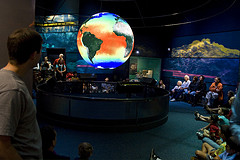
Science on a Sphere by woodleywonderworks. Used under Creative Commons.
When tracking examples of new curation, technology is going to be a major part. There is very little in a museum that can’t be improved with some kind of new tech, especially that of a visitors experience.
It can also go disastrously wrong, breaking at every moment, spiralling costs or ending up completely redundent.
What is also interesting are how some museums with very limited budgets are trying cheap innovations, DIY approaches to creating something and using already available technology in new ways.
This category looks at new technologies being used in museums.




Latest Comments