Whenever I get a new follower on twitter that says they are in “Marketing”, more often then not, that’s just cause for an instablock. This is the only way to deal with any snake-oil salesmen.
So when I say that Arts Marketing guru Maryann Devine is the real deal, you can trust me on that.
Today, Maryann is launching a ten-week e-course called “Arts blogging — without the angst!“. Ten lessons and worksheets delivered to your inbox. Check the link for more details and how to sign-up.
Normal prices are $61 for the course and $68 for the premium course that comes with a whole bunch of additional extras.
But there’s an extra special 30% off for all newcurator readers, making the price $42.70 or $47.60. Just use the coupon code NEWCURATORRULES. Code valid until 15th August.
There has been an interesting juxtaposition in the podcasts that have caught my notice this week. They have been either about the very latest developments in technology for the future or the preservation of things that are being lost.
APM’s Future Tense talked to NASA about their communications projects. They have already tweeted from space, but aim much higher (and further) than that. By building an interplanetary internet they want to be able to make the most of spontaneous interactions with space vehicles and telescopes. I’d love to think it could be this:
‘Take more macro photographs of that crater, send them to the Hubble telescope and copy the email to the Smithsonian so they can archive them at the same time.’
Normally in space exploration, you would have to plan to take those photographs on your next mission, so this would get things working much faster. How could this technology have an application for museums? Could we send data out there instead of just retrieving it? A virtual space museum? I would love to hear what you think.
The BBC World Service special report Save Our Soundsdiscussed the changing soundscape. In a thought provoking podcast, they covered urban sound design, lost soundscapes and are preserving sounds by charting aural turnover on an interactive map.
Sound is often used in museums: as part of audiovisual display, as oral history or in interactives. What I find more interesting though is the sound of the museum itself.
If you closed your eyes for a couple of minutes what would you hear? It really depends on where you are. There could be the hubbub of school groups or the quiet contemplation of people considering art on the walls. The hushed but frenzied excitement of somebody discovering an object they love and telling their friend. A film quietly playing to itself on a slow day. The scratch of a pen on paper as someone takes notes. Footfall, chatter, excitement, boredom. And behind the scenes? Typing and papershuffling in the offices. A telephone conversation. The whirr of machinery in conservation services. The clatter of someone making a cup of tea in the staff room.
I bet that your museum sounds different in all kinds of ways to the one where I work.
I think that it would be an interesting experiment to have a museum sound art exhibition. Chart a day in the life of a museum, edit the snippets and pipe it into a gallery. I would love to people-watch while the visitors figured it out. Very subtly done, it might seem like a haunting.
Too self indulgent? Or just seeing things from a different perspective? I think it is worth a shot.
I started off talking about new technology. All technology gets old eventually and will probably end up in a museum. Here is a great videocast by The Stuff of Genius about that once brand new technology, long range radio.
I’ll try my best to describe this new definition of hyper reality, but understand I’m still trying to get my head around it.
First, reality. Plain old reality. Go outside, go to the park. You understand this concept, yes?
Then there’s virtual reality. Computer-simulated environments. I remember when this meant putting on a heavy plastic welder’s helmet that burnt your retinas showing you out-of-focus polygons. Now, it can mean Second Life, a virtual world where you can put on cat ears and burn your retinas trying to work out why you suddenly crashed into a virtual billboard.
Augmented reality, in theory, is adding a layer of virtual over common reality. Normally in the form of a mobile phone (I still think AR should be in goggles) and using GPS, “viewing” reality then gets some extra information. It’s still in the very early stages of icons and hyperlinks. You could use an AR device to look at a building and see it has a giant floating marker above it or a yellow outline that then links to the building’s wiki page. We haven’t gone into William Gibson territory where your AR device shows that building being eaten by a 60-foot space squid. Yet.
So, what’s Cross Reality? ReadWriteWeb has these twoarticles, but I’ll summarise: Real world sensors affecting virtual reality world (and I guess vice-versa). In short, turn something on in the real world and the virtual thing comes on as well. If it isn’t happening yet, I imagine it will soon, but you can turn the virtual thing off and the real one will turn off as well.
As soon as AR get to the Gibsonesque animated giant squid stage, I guess it would also bridge the gap further. Imagine, I’m standing in an art gallery in Paris with my AR goggles, in front of a large kinetic sculpture with two buttons. I look to my left and I see a SecondLife avatar piloted by a man in front of his PC in Brazil. We can talk to each other. I press a button and the sculpture spins clockwise. Donaldo’s avatar presses the other button and the sculpture spins anti-clockwise. We are both seeing a spinning sculpture.
Then I walk away from Donaldo, clearly annoyed at his virtual button pressing. He sees me walk away and his cat ears display the “sad” expression.
This example, whilst elaborate, is pretty simple as I’m only talking about CAD models and synchronised switches. Cross Reality can involve a serious sensor net pouring data into a virtual world. Augmented Reality in the invasion of the real by the virtual. Cross Reality is some of the Real World dripping into the virtual. And who are the purveyors of the materialistic reality with a repository of cold, hard reality-based information? Some sensors, some program architecture and your museum’s datashadow runs in tune with your museum without much further work.
Quick Example: You have a gallery with a SecondLife shadow. You hang pictures on the wall that have small RFID tags on corners of the frame (for positioning). Your virtual shadow also shows these pictures. When you change the exhibition, the virtual gallery changes automatically.
What could be potentially exciting is a plug-and-play system. Like when you plug in your USB drive to your PC it automatically recognises it and (hopefully) can run it straight away. Well, imagine your gallery having similar USB ports and when you plug in your… laser light show or something, your virtual world picks up the 3D model out of the device and has it act the same in the virtual world.
How could a museum get better the more people use it?
The question comes from the analogy of the web/museum 2.0 label. Wed 2.0′s “architecture of participation” has more than enough examples, what are the museum equivalents?
Two things first: The question says “How could”, so I’m allowed to be as liberally creative with my answer; the other is “better”
Better?
What does a better museum look like? One with high visitor numbers? Increasing visitor number surely means the museum is getting better as an unused museum is surely a poor thing. Maybe I should be thinking in marketing/business terms and getting better with more users is dependent upon the goals and objectives of the museum? We want 2000 local schoolchildren to do our education program. We would be better if we had 6000.
These example don’t make any reference to participation apart from passive attendance. I should include the 2.0 set of relationships between Museum and Mob. Something more than just increasing the statistics of object and observer. To be “better”, there must be problems/issues and therefore solutions. Museums have plenty of problems. Museum 2.0 is involving users in the solutions. More users, more solutions. Or at least a solution based upon an average.
So what are museum’s problems? What could be done better?
There are two starting points, I guess. One is complete transparency. Opening up, declaring all your problems, shouting “We’re doomed!” and then try to motivate your users to offer solutions. The other would be to construct the problem as a puzzle or game (a la Superstruct) and act as carefully influencing guides to your users to see where they end up.
Out of all museum problems, is one of them a lack of knowledge? I get a bit cynical when it comes to crowd-sourcing knowledge. Not because of any elite sense that I would only listen to academics, but I struggle to see what obtaining 1000 people’s thoughts on a particular object achieves. I know I say this after quite liking The Odditorium‘s encouragement of creative responses, but Museum 2.0 is what happens after. Are all those labels kept? What happens when they are all put in a folder? Are they Beautiful, Emotional or Useful or are they just adding to the clutter?
Are they thrown away? If they all are, then the users are making anything better than your numbers and the exercise is redundant. If a few are kept, say the ten most interesting labels are curated, then you didn’t need 2.0 participants – you just need more interesting people in your museum.
Keep them all, keep half or none. Is this participation making the museum better or solving its problems? I guess it was published in Seb Chan’s blog, and received more blog attention from me and Nina so I guess that’s a benefit. Maybe it could spark new ideas because of it. Baby steps.
So what are the problems? Money? (Maybe a bit tacky). Collection Management? Using an increasing amount of users to find what is Beautiful, Emotional or Useful based upon participation with objects. If something is in your collection and it’s never been seen, nobody cares about it and/or its broken, maybe you could consult several thousand people as to whether or not its truly is a Museum Piece. You would have a better, more efficient, less wasteful museum.
(Okay, okay, you deaccesioning police. Take all these objects not wanted by one museum and put them on a museum-only eBay that only museums can purchase from. Store all the objects in ghost boxes.)
Would a user’s experience be enhanced by this? It could mean they wouldn’t experience the bad. It would mean that what is in the museum has been decided to be worth something by the wisdom of crowds…
Doesn’t look like a lot of fun, does it?
Problems made better with more people… Painting the building? General maintenance? Many hands make light work-type jobs? An incredible army of microvolunteers working to make the museum a better place? Well, instead of flooding the foundation, how about the flooding the top? Microtrustees, each paying a small amount of money (helping the museum no end) to get one vote in the running of the museum (making it better). More users, more income, more rounded direction etc.
I may have not given a satisfactory conclusion, then again, my hazy definition of a “better museum” would probably need more than my solitary opinion.
Quite a few video-heavy post recently. Here is part one and part two of Director of the National Academies Press, Michael Jensen giving a speech to the AAUP. In it, he talks about the environment, digital open access and the radical changes required for scholarly publishing to adapt to the future. All in about 16 minutes. (Via if:book)
Replace publisher with museum and the speech still makes relevant points.
They talk UK politics (I agree with Serota about nobody wanting to be Culture Secretary). They talk about geopolitics with MacGregor clearly pushing his internationalism. Interesting he associates it with London as the City of Diasporas. They talk about the Marbles. I like to think my insight was right. The question of ownership is redundant, the question of taking it around the world is more important. They talk about sculpture, the Olympics etc.
Then Bamber Gascoigne makes them take about the future, museums and the Internet. It was Serota’s answer that stood out for me:
The big challenge for big institutions over the next 20 years is going to be to what extent we wish to simply remain authors and to what extent are we going to become publishers?
Boom. Serota shows why he’s one of the most important museum directors in the world. MacGregor spoke about the Internet providing access, which is fair enough. Serota sees the Internet as a medium of information and museums as sources of information. Curators will be far more like Editors (Ahem! Okay, I said magazines, but I think the statements are still relevant). Okay, it may not be what comes out of a MW200x conference, but
Summer holiday season is upon us. What do you see and do when visiting a new place? Guidebooks point us to the highlights of the city or region, but what of other local things?
Smart City podcast discussed spottedbylocals.com. This tourist information blog, described as an ‘atlas of emotion’ is made up of suggestions of what to see and do by local people. For them, the best things in the neighbourhood are different to the guidebook ideas. It seems that seasoned travellers even say ‘sometimes the tourist attractions are the least interesting part of the trip’. Well, this doesn’t bode well for museums and galleries does it? They’re often the highlights in the guidebooks. What to do?
I suggest that museums play on this idea themselves, making use of their local visitors. An exhibition project combining local topographical art,personalised Google maps and visitors’ connections to these places and objects has potential. It could breathe life into tired collections and provide a way to get local people in the doors, as well as visitors from further away. It’s a similar idea to those exhibitions where the whole point is that visitors write their own interpretive labels. This information mapping could be extended even further. Adding catalogue data to the map would be valuable for staff and researchers. It would allow them to see the locations of finds or views. Map your collections using local knowledge. Like a visual version of oral history?
Listening to The Future and You, I kept the mapping idea in mind. American guest Robert Hooker discussed trends in IT, globalisation and immigration in the UK. It is always interesting to listen to an outsider describe your own environs. Some of what he said didn’t sit comfortably with me, but it did make me question how narrow my own experience is. Sometimes I find this reflected in the narratives that museums tell. Migrants will inevitably have different views and experiences of the local area. Being an outsider allows you to see things in a different light. Running a museum project to harness these narratives could create a new layer to the map. Or a new map altogether. A way of charting local history as it happens from multiple viewpoints.
Kansas Historical Society’s Cool Things in the Collectionfocuses on and discusses the biography of one object per podcast. A story cloth made by Hmong refugees narrates the story of the escape from Vietnam at the height of the war. This narrative textile seemed to me a predecessor to the mapping idea. The traditional use of fabric to tell a story that can be packed up and transported with you for easy accessibility has correlations with today’s Internet use. Save your map online and you can open it up for perusal through any Internet connection, wherever you are. Evolving the mapping idea in another direction, a virtual map could even chart the ethnic minorities’ diasporas and journeys to the local area.
Technology has moved on but the importance of storytelling has remained a constant. Local museums need local narratives. Bring them up to date.
Through The Extraordinaries, you might be able to use your smart phone — while waiting in the dentist’s office or standing in the Dept. of Motor Vehicles line — to:
• add identifying tags to photos and videos for a museum
I don’t know why Futurismic mentions Twitter as no-one else does. Although it would make sense for them to try to use it as iPhones are not the be-all-and-end all of smartphones.
Museum collection folksonomy isn’t a new concept. I’m always reminded of this whenever it’s brought up.
There are things already out there that do this, like Steve.museum. Wikipedia Loves Art and the Indicommons certainly touches on this area too. I like the idea of doing it with twitter. I remember Shelley at the Brooklyn Museum doing a “guess the animal” with a bunch of x-rays on twitter that I enjoyed playing. I wonder if you could automate the same sort of thing. People follow a twitter account that spits out links to an object every 15 minutes and you reply with a bunch of hashtags. There would probably need to be some kind of banned word list and method to moderate the more weird answers. Maybe the program could keep score/give prizes/promo codes. As far as I know, this isn’t already happening.
But I think the idea of microvolunteering in museums has a lot more to offer. I’m not sure when online-based volunteering became crowdsourcing tags only. I’m pretty sure that most volunteers sitting in museums aren’t trying to come up with one-word descriptions of objects.
Here’s a though about voluntwittering: I could spend all day volunteering trying to hand out leaflets about an exhibition or I could reach about 2000 people with a retweet in a few minutes. I don’t get rewarded for a RT (maybe a thank you) yet I could say on a CV that I volunteered with a museum if I stand in the road trying to catch random stranger’s attention (which is prettydamn important in getting a museum job nowadays).
I just want to pull these three links from my delicious account. There’s definitely something here that needs more thought. Chime in with any additional add-ons.
1. dropstuff.org – I think I understand this. There’s a giant mobile hut covered in LEDs on one side that acts as basecamp for all the editing/curating. There are also a bunch of what they call DS_HOTSPOTS, which I think are vending machine-sized physical links to the network. The Dropstuff network integrates five other 2.0 social networks as sources of creativity. You see, they have three layers to what they display: professional, “open stage” and workshops. It all meshes together wonderfully.
2. Armadillo: The FEMA Trailer Project – The MIT Visual Arts students turn one of the FEMA trailers used as temporary housing into a project incorporating design, politics, ecology, art, research and science. If you imagine this as a mobile museum exhibition, it goes far beyond that as simple temporary space. I’m not suggesting it would have to be exactly the same, but seeing this would feel like participating in an ongoing workshop. I don’t know if I’m being clear here, but you can see the difference between this and a cargo container with things hanging on the inside, right?
3. Pop-up Shop – KiosKiosK is a temporary/short-term shop front to sell creative products as part of a regeneration plan.
You see how I think there’s something that can meld these three things together. I was thinking along the lines of pop-up shops acting as stations and front-of-house to mobile museum exhibition workshop trailers that are all linked with a hydra-connected network of social networks and vending machines. Thrown in QR Codes and GPS for fun. If there was a way I could incorporate mini-satellites, I would.
There’s something missing to all this. I can’t quite put my finger on it, but I think its lacking one more stolen integrated idea. These three allow for extremely high-end mobility and flexibility as well as a solid foundation where needed. It may seem art-heavy but it really doesn’t need to.
Listen to the Gears is a new podcast-related column written by new staff writer August.
I recently attended a symposium where all speakers had been tasked with ‘mixing up the conference experience’ in any way they chose in order to offer an atypical angle. One paper was successfully presented via Skype. Another delegate revealed behind-the-scenes of her digital textile practice instead of the finished artwork. These different ways of working were well received and I kept them in mind whilst listening to this week’s podcasts. What ideas came up that could offer fresh perspectives for museums?
There seemed few podcasts that did not mention the iPhone upgrade CNET UK and wired.com’s Gadget Lab both weighed up its pros and cons in very different styles. I suggest that the lauded voice recording system on this and other smart phones could record instant reactions to objects and exhibitions. In a wifi hotspot files can be emailed straight to a curator. These clips can be processed and fed back into the galleries via headphones adding an extra dimension to the exhibition. The application might also be used for oral history collection. Don’t you all want to know what the visitors are thinking? Of course public participation is open to abuse and would need managing. It may make an interesting project for a group of interns.
Anthropology podcast ‘absolutely intercultural’ discussed the idea of virtual mobility in relation to university exchange programmes. Instead of actually travelling to another country, classes from the host university are delivered to students in their home university. The presenter was very keen, but admitted that not all believe in the idea. While I am not sold on cultural exchange without the actual exchange, it may have an application in museums. In literal terms, it might appear forward-thinking for children from Britain and Israel to take museum education classes together by video link (as happens with some schools in remote regions). However this could stray into dangerous territory by using museums as tools in global politics. More practically, an extended family of global staff working remotely on projects where being onsite is not needed expands opportunities for recruitment.
The Museum of Science, Boston’s Current Science and Technology podcast explained in simple terms the 5D data storage system that is currently under development in Australia. The implications of disks which can store 7.2 terabytes of data each are enormous for museums. How many disks would it take for the catalogue of the British Museum. Or the Smithsonian? I like the idea of a whole museum being on one disk. Museum store in a drawer.
The best listen this week was BBC Radio 3′s Arts and Ideas. They discussed how cultural figures ‘become adjectives’ (Orwellian, Dickensian etc). Back in January Pete suggested ‘McGregorism‘ to describe the global policies of the BM’s director. Who else from the museum world might earn their own adjectives? Will we talk of Serota-esque and Lowrian display or Andersonian collecting policy in the future?
I suppose what these videos demonstrate is this being the newest of the new media. You can affect, interact and manipulate the information or you experience information in a 3D overlay. There are also two type of AR on show. The first one (I assume) uses barcodes and markers to set dimensions and the hardware adds the detail with loaded programming. The second one is uses GPS and an internal compass as positional tags to data request. It’s interesting to see which ways they both could go. I’ve looked at the barcode AR before, so let’s think about GPS AR
I haven’t found one, I’m guessing it exists or soon will, but what would interesting/useful is a mobile AR CAD program. Take your Android or iPhone and build a 3D object and assign a GPS to it. If it can shoot zombies, it can play with Lego. Or even build the object in the space you want it. When that happens, what will happen to the moderation? Does every one’s creation get put onto server’s for all browsers to access, creating a weird new search engine where we stand in a place and search for a word? Or will institutions provide there own apps with all the information preloaded and carefully constructed? I imagine both.
What concerns me in the first instances is what happens when a place finds out that someone has AR’d swear words all over a museum’s artwork or flooded the exhibition space with adult adverts? I think it will be the next mutation of cyber-squatting: your coordinates in GoogleAR are already dominated with a SecondLife style nightmare and what can you do about it?
Could Intellectual Property laws include coordinate-defined areas? “This model has been removed as it violates the GPSrights and Safesearch Filter of The Guggenheim Museum”.
15 things went on the delicious bookmarks, mainly a lot of stuff that I may make some proper comments on at some point. I’ve put a couple of sentences or quotes on each one.
Conductive body paint allows for electrical current to pass through without frying bit of skin in the process. What you’re seeing in this video is the dancer creating connection between copper contacts.
This has great Teknomagi potential. A little ink and you can turn body movements into a switch. I’ll put it into context. Imagine you have a door. The absolute basic way to open it is a door handle and push. A slightly more advanced way (if you like) is a button you push and opens the door. Above that, doors that open automatically, either with movement sensors or RFIDs.
Now imagine a door where you had to place the correct hand sign on to it? Or a door that opens when you have to draw the correct symbol? Hell, you could make it even more interesting buy only opening if the correct pattern is on your hands. Any talk of participation in museums, you have an ink here that turns your visitors into wizards.
I spent a long while trying to find the right video to demonstrate a point, a lot of them were getting silly with the potential applications. This one only makes one, “You’re phone could change into a laptop then back into a phone”. No it couldn’t, unless you phone was already the size of laptop, or you wanted a laptop that can only do what a phone does. Programmable matter looks like it can change shape and colour, not mass and certainly not into a different component.
“Create a new media type“. The video imagines furniture, business meeting rapid-prototyping and art. I imagine a bank of these Claytronic pools being the ultimate in access to museum collections. I imagine the conference papers of the future being about 3D digitisation, the issues of conservation about scanning objects to an atomic level and whether people can claim copyright on a temporary near-identical object even if it dissolves back into a grey goo.
What would the ethics be? This could change every idea about material culture we know, especially the tenet that says being in the presence of an object is better than any digital image. Well, how about a being in the presence of a digital 3D solid replica that you could smash open and have a look inside and then hit the reset button?
To which I would say, “what’s the point?” How much more would we rely upon narrative for the experience?
I have about 260 feeds going into my Google Reader. Many of them are Google Alerts or delicious subscription-type feeds. I sit in a torrent of information from a plethora of sources. All day, I’ve seen a billion people talking about Ben Stiller printing money. Not that long ago, I stopped trying to report on every story about how museum’s were cauterising massive financial bleeds. We live in a world where a fake museum is making more money than actual ones.
Yes, a fake museum. I don’t care if it said it was the Smithsonian. Any museum using straw as packing material is clearly one rooted in fantasy.
I wondered if I had lost the ability to write about the future. All my news feeds and I can’t find inspiration or motivation to write about the outbreaks in museums. It’s not helped by the New Yorker and David Hockney getting thrills out of making art that looks like bad mid-90s point-click-adventure games with 2009 technology.
The late J. G. Ballard once said:
I would sum up my fear about the future in one word: boring. And that’s my one fear: that everything has happened; nothing exciting or new or interesting is ever going to happen again… the future is just going to be a vast, conforming suburb of the soul.
The Ballardian nightmare is that we would run out of innovation. If news patterns are anything to go by, the recession has done something worse: It has put our future on pause.
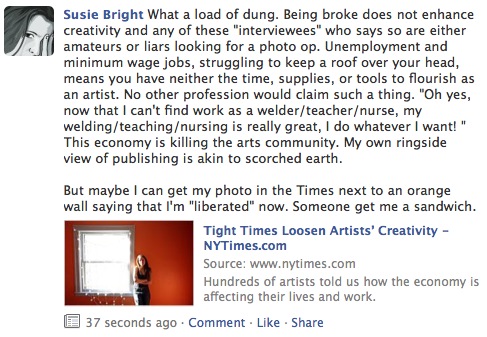
I’m viewing this through newcurator editorial lens. Everything I blogged was chosen (sort of) carefully. They were not all heralds of a sweeping changes in the museum mainstream, nor end points of discussion. They were little steps or small shifts along a path that I would sometimes get demonstrative over to make a point. I notice there has been a a distinct lack of these steps compared to a couple of months ago; an innovation downturn. Don’t believe what the New York Times says about “Tight Times Loosen Creativity”. What Mike Daisey (and Susie Bright) posted in response says it better than I could.
From mikedaisey.com
I’m talking about things making the news here. I say nothing against most of the bloggers I read who all make such fascinating reading. Sometimes I think I may as well hand Nina Simon the newcurator keys or risk becoming one of those annoying as hell pingback blogs that just copy my content. That’s why I’ve got delicious and tumblr.
This is also not a criticism of people working in museums (before someone undoubtedly accuses me of this). It’s more a comment on the current State of Things. You can see it in the wider microcosm of the art world. Repatriation and restitution is on the increase with museums all over the world handing back objects or going to court over it. Even JP Morgan recognise a good thing. Economic Plight = Culture / Ownership. There’s an Asset Grab going on and the only people actually buying are part of a French/Arab coalition.
What happened to the museum news? Or should I say, what happened to things in museums that were news-worthy? A dinosaur with bad posture and I think Manchester Museum plan to lock up a man in a tower. Looking at his quotes, it’s probably for the best. Same goes for so many art critics who appear to be having collective attacks of existentialism as they try to work out what they do and what they are now good for.
So I try to think about and research the Metrocurator and Death of the Curator ideas. First thing I find? There was a discussion about so many related issues that not only Godwin’d but stamped over well-worn ground in circles rather than any kind of exchange/development of ideas. It made the whole thing sound horribly and frustratingly boring.
No, this isn’t another blog war. This is me remixing two blog posts a la Jason Nevins Vs. Run DMC.
I found these two blog posts at roughly the same time and was intrigued at the sense they made when put into other/wider contexts. This is partly an experiment, and party because whenever I see two lists (especially two lists of criticism!) I want to see if I can make a… critical matrix!
Paul Orselli’s ExhibiTricks said Five Things that make grocery store exhibits bad. I’m going to summarise and turn them into fundamental statements about the wider aspects of museum design, therefore museum intent. You have to read the original blog post for a greater explanation. But this is five bad design
1. “Anti-Green Design”
2. “Inefficient”
3. “Creatively lazy”
4. Unintended Messages
5. Fundraising ploys
Martin Weller of The Ed Techie made a list of Four Assumptions of the Publishing Apocalypse. These Four Things came from the criticisms of journal publishing’s outdated referencing guidelines concerning digital content. Again, go and read to see where I’m going with this. I feel there is a lot in common with journal publishing and museums, especially the academia, the resistance to digital and the fact that both are media and follow media methodologies.
A. The assumption of power
B. The assumption of quality
C. The assumption of immutability
D. The assumption of proprietary
Now, lets see if these 5 and 4 statements can make 20 pearls of wisdom. I apologise for the epic length of this article.
A1. The resistance over eco-digitisation - I’m going to take this as a statement about materials and museum’s failing ability to be eco-giants. Just think about the amount of paper a museum uses and wastes. Now, I want to believe that every single leaflet a museum produces is worth keeping, but its not the case. How much can be digital? Why isn’t every museum leading the eco-way? Solution: You only have to look at what the Mattress Factory is doing.
A2. Ignoring digital efficiency – I’m going to interpretPauls’ statement as "wasting staff time" and I think about all the other ways staff are locked into old fashioned practices. Solution: Too many to count but one example is a registrar using RFID tags to provide a better collection management. I think there needs to be new training to get over this issue.
A3.Stifling Creativity – I think this is a matter of trusting staff. Look at what Google do with encouraging side projects in order to tap into their staff’s abilities. The issue here could be the result of losing too many creative people to other industries. Solution: I would say the venture culturalist model in some form could help.
A5. Money Priorities – An ugly realisation that may be above my pay grade to solve. We’re all suffering in one way or another recently and museums have taken a kicking financially despite numbers increasing. Solution: If you come up with one, I’m sure we’d all like to know. The Museum Bailout idea on a grand scale (like national organisation level) could have done something, I’m sure. Everyone working together to improve membership numbers. Also, Maryann Devine spoke about a For-profit model for the arts which could be considered but would take a massive change in industry thinking.
B1. Green Quality-What is best for the museum should be what is best for the planet. I don’t mean this to be a puritan statement against extravagance, but as Paul said, is there a need for an overabundance of plastics? Yes, it is nice to have a giant molded cartoon character in an exhibition The other side of this is touring exhibitions. What is the carbon footprint of flying art from China? It would be a shame if it couldn’t happen. Solution: Greater ethical guidelines produced. Does there need to be a change in how we view materialism? Would people accept a rapid-prototype of the same object on the other side of the world?
B2.Inappropriate ideologies – Martin talks about quality as elitism and Paul talks about entropy. I’m going to take this as the stagnation of new people into the field. Solution: Go waaaaaay back to my article on museum HR to find all kinds of talking points.
B3.Lack of new ideas – There definitely needs to be a modernising process that say that something done 100 times doesn’t make it good. This is were the authority needs to be relaxed and inspiration needs to come from other sources, especially with online/technology. Solution: (and a great example of what I mean) The Brooklyn Museum released an API and someone made an iPhone app. Its time to tap that massive developer community out there and trust that they are not random amateurs.
B4.Narrow Meanings – Bit of a paradox to hold authority over quality yet make mixed connotations and contexts. But it happens. I think the problem here is overcoming bias. Solution: I fully believe that people can handle an incredible amount of information, why stop at labels and information boards? Send them down paths, let them explore the data themselves, give them everything you have on a subject in a manageable format. This must work otherwise wikipedia would never have become so big.
B5. Marketable Standards – Tricky, because if something work and makes money, why change it? But are you trying to “sell chunks of museum real estate”? This is where the US and UK differ. In the UK, it’s not so much a preoccupation with sponsorship but a concentration on under-16 education to receive funding. It either case, it can skew a museum plan into unsustainability in a long term ie. Young single males aren’t going to go to a place overrun by children. Solution: Don’t let it dominate your path. More variety of… products. (Ug.)
C1. Eco-Denial – THE PLANET IS DYING. Solution: SAVE THE PLANET.
C2. Comfortably Slum – There’s no excuse for inefficiency, especially with a financial crisis. Solution: Time for an audit. Hell, get some strategists in. I can recommend one.
C3.Repetition, Repetition, Repetition – You know what happens when you don’t change a stuck record? People get annoyed. To me, this is again an area of stagnation that would take a huge effort to overcome. Solution: More graduate programs, more internships, anything to hike new thinkers into the museum society. Government’s should really pay for this.
C4. Stay the course – I am of the opinion that individuals can consume information much faster than ever. Look at how viral marketing works and how it’s the only game in town. Cultural flashes before being replaced by the next meme. I think museums need to speed up their turnaround of content before people tire of them. Solution: I touched on this a bit in my Make Museums Like Magazines article.
C5. Knife-Edge Finance – What happens when there’s a financial crisis and there an over-reliance upon so few reliable income streams? Google “museum” and “crisis”. So much is broken, I don’t know where to start. Saving museum workers jobs would be good. Without them, there’s no museum. Just a room of stuff. Solution: Hate to say it, but can we rewrite deaccessioning ethics yet? You know, without dragging reputations through the mud. There must be some way to protect the public’s trust AND museums without flat refusals. I would prefer thinner museums than no museums.
D1. Ignore the problem – Yeah, without wholesale change the problem is going to get fixed. Solution: Need more Museum Eco-activists.
D2. No Other Models – I think you’ll find this changing quite fast. See any post of mine about museum expansionism. Solution: Adapt. Invent new systems. The Commons.
D3. Cultural Black Hole – Again, there’s a risk of losing good interested people to other industries. Again, I think of newspapers like I did in Death of the Curator. What happens when there are thousands of people who can work in a newspaper? They start blogs. Solution: Diversify, jump on bandwagons, find any new outlet and dominate it before it turns on you (eg. the music industry and mp3).
D4. Signal & Noise – Maybe more of the same, but museums shouldn’t talk about “authority” or “authenticity”; like they’re a given. They are things to be earned and they can vanish pretty quickly so its pretty dangerous ground to describe yourself in such ways. Today’s media is a lot of noise over signal and boasting isn’t going to help. Solution: Add to the production. Take Artbabble for instance. Those videos feel like documentaries made by experts… mostly. There’s something more that just showing or curating but producing something else. (This point isn’t 100% clear and may need further thinking).
D5. We own museums – Sponsorship can go somewhere else or dry up, people vote with their feet and imagine if all the big companies started their own museums rather than normal philanthropy. There is very little freedom for museums to combat this when you think about it. Solution: ?
There. 20 thoughts over 1500 words for you to ponder over the weekend. I apologise for any grammatical errors but it is quite late. If anyone has anything to add, like a different interpretation or a different solution, add them to the comments with the (letter)(number) reference at the beginning.
For no other reason that vanity, but also proving that The NEWCURATOR Twitter Acquisition/Disposal Policy works. I have been blocking every follow-hoarder, every spam zombie, every single person trying to sell me something and every single “marketing strategist”. I followed every museum worker or artist (allowing to be liberal with the definition).
I didn’t-follow-back only those who I could work out what they did. (If you feel I should be following you, let me know).
@newcurator's followers grouped by Bio description
I’m not sure how the algorithm works so I have no idea why Arizona is there.
Top 10 @newcurator's followers grouped by Occupation
I call the policy a victory. You know what this means? It means the newcurator twitter followers list is a comprehensive and moderated… heh, curated directory of the arts and culture industry. Imagine if all everyone followed each other? That would be a major creative/museum twitter network of contacts. Who needs twibes?
The Museum Boijmans van Beuningen in Rotterdam had an exhibition enhanced by the AR+RFID Lab using… Augmented Reality and RFID tags. Just look at the possibilities this kind of system has, especially for handling collections or archaeology-heavy museums.
We just need to work out a decent way for this to be in a pair of goggles and we can all pretend to be in a Will Gibson novel.
I’ve wanted to show this video for a while, not just because it’s pretty amazing but also because it is a very creative way to make a point/display information. Everything about the BMW museum is to display the elements of design that goes into every car, established by the different car outlines appearing. You also get a strong sense of the BMW branding that extend to the rest of the museum. These shapes aren’t being scribbled out on paper or clunked together on a CAD program, they’re gently and aerodynamically built out of thin air. If there’s a better example of preparing the audience to the sense of awe running through this museum, I can’t find it.
Let’s be honest, a bunch of Bimmers in a building is called a car showroom.



Latest Comments