Last weekend I had my first real-life demonstration of Layar. It was pretty impressive and it occured to me that you just can’t appreciate how it works as you move the phone, when viewing a demo of it on a computer monitor. Listening to KCRW’s Design and Archtecture podcast, I hit on the begininnings of an idea. They reviewed the film (500) Days of Summer which has an architecture driven plot. The film’s co-writer, Scott Neustadter talked about filming in Los Angeles, using only pre-1940 buildings as a backdrop. The premise for this was that the main character ‘…sees beauty and meaning only in the past.’
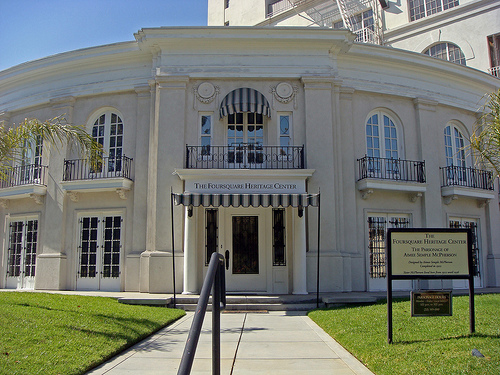
41c Angelus Temple by Kansas_Sebastian. Used under Creative Commons.
So, say he has a phone with Layar on it. It might work best for him by showing him information not about what is there currently, but was was there in the past. A museum of information through time and space. If you think about it, this is what Google Street View will become. Their 2008/2009 images of the world are a snapshot; an archive of a moment.How often will they update them? What will they do with the old ones? I hope they keep the images available and build onto them.
Could museums and archives use old photographs, plans and title deeds of places to construct this kind of historical augmented reality treasure trove? It would be a massive undertaking admittedly, but I would love to see it.
Incidentally, on the same podcast there is an interesting interview with architect Richard Best. In a gamble to be proactive in the recession he went on a reality TV show with a real estate theme. And won. It paid off for him, but the thought of reality tv makes me shudder.
Sony’s Reader Daily Edition was critiqued by APM’s Future Tense. They postulated that it might overtake the market leader, Amazon’s Kindle. It will be able to facilitate wireless downloading of books, has a touch screen and will be able to read pdf files and google books. The most interesting thing for me is that Sony are linking with a scheme for borrowing library books in e-form. The loan will then expire in three weeks, like a normal library return. This seems like a great idea. Especially as buying e-books has not always meant that you got to keep them. This type of loaning service seems indicative of a point made in JISC’s recent documentary Libraries of the Future. That ‘…technology is adapting to meet the needs of users’.
Lastly, a great video from New Scientist showing how new laboratory techniques can be used to make you feel as if you are your virtual avatar by inducing an ‘out of body experience’. I don’t know how this might be used in museums and galleries, but I do like it. Enter, stranger.


My father was born in Johannesburg, South Africa, in 1920. Until recently I just thought of the place where he grew up (we live in England) as a lost forgotten world. Then, during a visit recently, I asked him about where a photograph of his mother and grandparents was taken. He told me the address, so I looked it up on Google Maps and switched to satellite view. Hey presto, we were suddenly in the town where he grew up. We quickly found his house, school and dozens of places around there that he remembered. It brought his early life into mine with huge force. I made a Google map of his youth – wonderful. Now I can envisage his early life much better.
From that experience I realised that Google Maps (and by extension, as you say, Google Streetview, and Earth etc) have the ability to be time based services. So long as Google Maps keep previous versions and make them available via the API it will be possible to go back in time, to look at the planet at different stages in the past. After a hundred years or so, this will become a vastly powerful tool for all sorts of research.
Exactly! That’s a great example of just what I meant.